


85 Seconds To Midnight: What Is The Doomsday Clock?
By
8 months ago
Experts have warned we're closer to apocalypse than ever before
In the headlines this morning is the ominous news that scientists have shifted the Doomsday Clock four crucial seconds closer to midnight. It’s the closest we’ve ever been to the end of the day – but what does it mean?
What Is The Doomsday Clock?
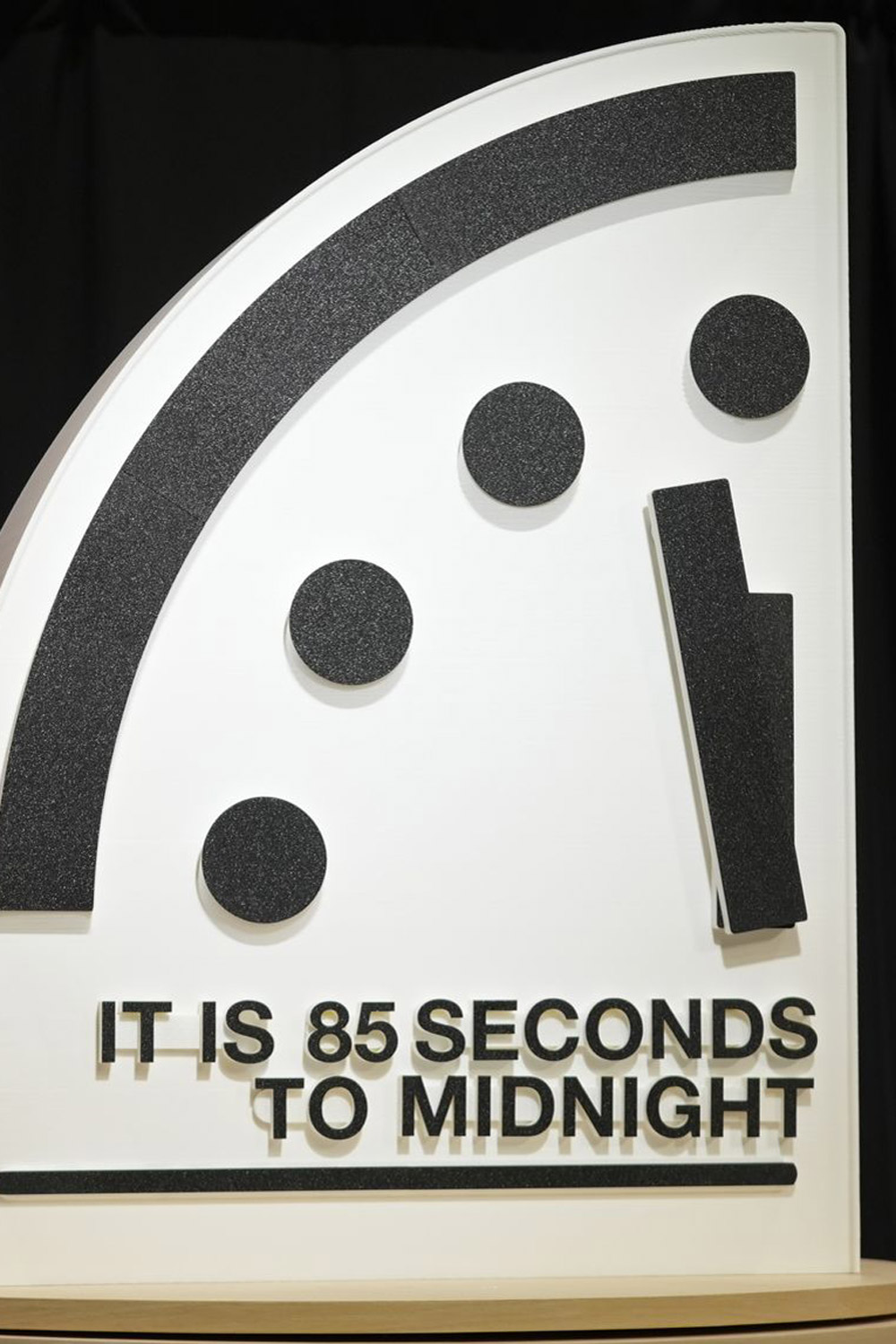
Managed by the Bulletin of the Atomic Scientists, the Doomsday Clock is a scientific metaphor used to estimate the likelihood of a human-made catastrophe – and when. The hypothetical catastrophe is represented by midnight on the clock, with all of the time before it representing the history of the universe. Today, scientists set the clock at 85 seconds to midnight, the closest we’ve ever been to the apocalypse.
‘The purpose of the Doomsday Clock is to start a global conversation about the very real existential threats that keep the world’s top scientists awake at night,’ says Daniel Holz, PhD, SASB Chair, Bulletin of the Atomic Scientists, and professor at the University of Chicago. ‘National leaders must commence discussions about these global risks before it’s too late. Reflecting on these life-and-death issues and starting a dialogue are the first steps to turning back the Clock and moving away from midnight.’
How Is The Doomsday Clock Determined?
The main factors influencing the clock are nuclear warfare, climate change and artificial intelligence, and the time is set every January by the Bulletin of the Atomic Scientists’ Science and Security Board along with its Board of Sponsors which includes nine Nobel laureates. In 2026, the clock was set on 28 January, with the bulletin citing the threat of escalating conflicts as the pivotal reason for bringing it forward: the Russia-Ukraine war, border clashes between India and Pakistan, and the US and Israeli bombing of Iran, alongside continued tensions in Asia and across the Western Hemisphere following President Trump’s return to office.
‘In terms of nuclear risks, nothing in 2025 trended in the right direction,’ said the bulletin’s CEO, Alexandra Bell. ‘Longstanding diplomatic frameworks are under duress or collapsing, the threat of explosive nuclear testing has returned, proliferation concerns are growing, and there were three military operations taking place under the shadow of nuclear weapons and the associated escalatory threat.’ She added: ‘Every second counts and we are running out of time. It’s a hard truth, but this is our reality.’
The 2026 statement reads: ‘A year ago, we warned that the world was perilously close to global disaster and that any delay in reversing course increased the probability of catastrophe. Rather than heed this warning, Russia, China, the United States, and other major countries have instead become increasingly aggressive, adversarial and nationalistic. Hard-won global understandings are collapsing, accelerating a winner-takes-all great power competition and undermining the international cooperation critical to reducing the risks of nuclear war, climate change, the misuse of biotechnology, the potential threat of artificial intelligence and other apocalyptic dangers.’
On the climate change front, the statement notes that atmospheric carbon dioxide levels reached a new high over the past year, rising to 150 percent of pre-industrial levels. Natural disasters and erratic weather conditions are becoming increasingly common across the world, with ‘deluges and droughts hopscotching around the globe’, and Europe experiencing over 60,000 heat-related deaths.
Another factor for the clock change is the acceleration of AI, which the bulletin says poses ‘a different sort of biological threat: the potential for the AI-aided design of new pathogens to which humans have no effective defenses’.
It’s pretty terrifying stuff, but the statement ends with a call to action for world leaders to ‘pull humanity back from the brink’ – particularly those in the US, Russia and China. You can read the full statement here.
Who Made It?
The Doomsday Clock was created by physicists J. Robert Oppenheimer, Albert Einstein and Eugene Rabinowitch in 1947, and has been maintained by the Bulletin of the Atomic Scientists ever since. The first time setting was seven minutes to midnight, and the clock has been set backwards eight times and forwards 19 times in its 78-year history. The most optimistic outlook came in 1991: 17 minutes to midnight. The least optimistic outlook came in January 2026.
What Happens If We Reach Midnight?
Well, the hope is that we will never reach midnight; if we do, that means disaster has struck and humanity is wiped out. Amidst a disaster on that scale, it’s unlikely the Bulletin would prioritise shifting the hands on their clock.
‘When the clock is at midnight, that means there’s been some sort of nuclear exchange or catastrophic climate change that’s wiped out humanity,’ the Bulletin’s president and CEO Rachel Bronson explains. ‘We never really want to get there, and we won’t know it when we do.’