


C&TH Book Club: The Typing Lady & Other Fictions By Ruth Ozeki
By
5 months ago
Ruth Ozeki talks to Belinda Bamber about her new book of short stories, the power of fiction and why it’s okay to be unhappy
The Typing Lady & Other Fictions is a dazzling collection of short stories by Ruth Ozeki, who won the 2022 Women’s Prize for Fiction with The Book of Form and Emptiness, and was shortlisted for the Booker Prize in 2013 with A Tale for the Time Being. Ozeki is a filmmaker and Zen Buddhist priest who lives in Massachusetts, USA. Here she talks to Belinda Bamber about Zen meditation, fictional enlightenment and her new collection.
Interview: Ruth Ozeki
Belinda Bamber: The title story, ‘The Typing Lady’, plays with our curiosity about whether the typist in the library is in fact you. As so often in your stories, you insert a recognisable aspect of yourself and play with our desire to know how much of your writing is autobiographical. You’ve also said that your stories don’t exist without us, the readers. How old were you when you first began to write and at what point did you start to explore the porosity of these definitions of author/narrator/reader?
Ruth Ozeki: I started writing stories when I was quite little, and I wanted to be a novelist when I grew up. I’m mixed race, and I came of age in the 1960s and ’70s – before the publishing industry realised that people of colour liked to buy books too – so the novels I read and loved were written by novelists who were unlike me, predominantly white and male and often British, and from this I extrapolated that mixed-race American girls would not grow up to be novelists.
I grew up, and the literary landscape changed, expanding my sense of possibility. My experience of straddling racial and cultural identities was central to my experience of the world, so when I finally did try to write a novel, it felt natural to write a protagonist who was a mixed-race, half-Japanese and half-Caucasian American, like me. I quickly realised I had a problem that white male authors did not have. A white male writer can write a novel with a white male character, and readers will not automatically assume his novel is autobiographical. This is the benefit of a more generic identity that is an archetypical ‘norm’. But the racial specificity of my protagonist meant that readers would assume she was me.
So instead of working against this, I started playing with it, leaning into it and turning what might have been a problem into a feature not a bug. In that first novel, My Year of Meats, I made my mixed-race character six feet tall and gave her green hair so readers could tell us apart. In my second novel, All Over Creation, I made the protagonist so dysfunctional that readers wouldn’t dare ask if she was me. Neither of these strategies worked, and in both cases, the characters were seen as autobiographical. In A Tale for the Time Being, I gave up and just named the protagonist Ruth.
As I was writing these novels, though, I began to realise that a writer can’t completely control the way a reader reads her book, nor should we necessarily try. A novel is a collaboration between writer and reader; each of us brings our own lived experience to the page, and together we co-create the characters and their fictional worlds. By giving my characters recognisable aspects of myself, I’m asking readers to make assumptions – working with them rather than fighting them. I’m inviting readers into a metafictional world that upends and destabilises the traditional “distinctions” between reality and fiction and creating (I hope) a kind of playful intimacy between writer-reader-character within the imaginative world of the book. As a mixed race person, I’m most comfortable in grey areas with blurry boundaries.
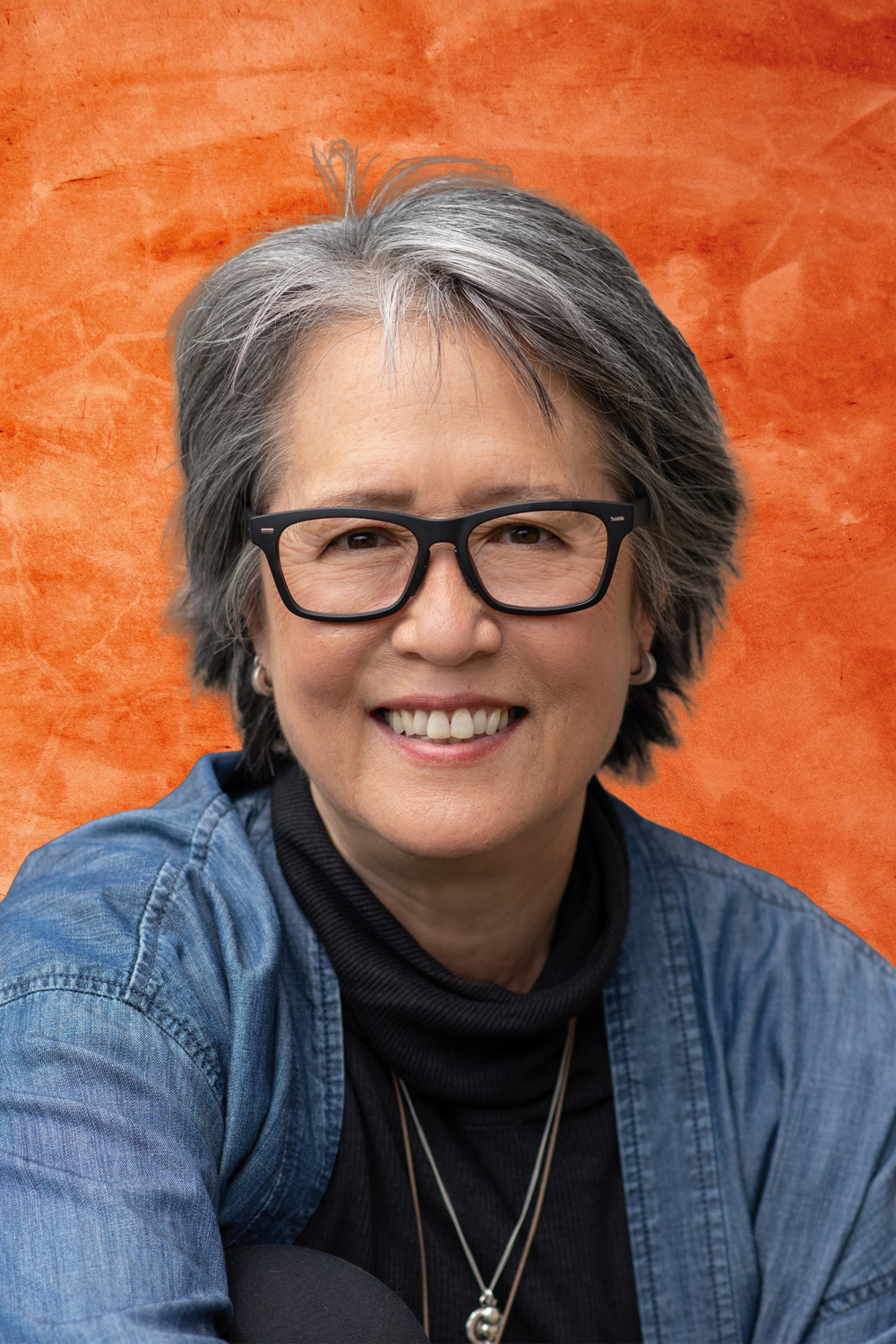
Circling briefly back to ‘The Typing Lady’, she is a character from my last novel, The Book of Form and Emptiness. She’s an older Asian-looking woman with black glasses like me, who sits in a public library, watching the other characters in the novel and typing up detailed field notes of her observations. Like me, she tries not to interfere with the action unfolding around her, but sometimes she can’t help herself. This semi-fictional typing lady is the protagonist in the first story of The Typing Lady and Other Fictions.
BB: In the story ‘Where Ambition Goes To Die’, there’s a writer whose driving sense of ambition is personified as a ghost figure that walks alongside her. The writer tries to lose that ghost, because she wants to give up on the immense challenge of writing another long novel. Is there a ghost of truth about you in that story? Or are you still (hopefully) writing long-form novels?
RO: Ha! I wish it were that easy to put one’s ambition to rest, but mine has plenty of life in her yet. We are currently working on a new novel, and my intention is to rein her in and keep it short. Of course, I have said that about all of my novels, and I blame her for their length and complexity. Still, maybe we’ve learned something about brevity from writing the short stories. One can always hope.
BB: You once wrote that ‘when we read a story, we bring our own lives to bear on it and make it ours no matter what the writer might have intended’. If we read books to find ourselves, do you write them to find yourself?
RO: I don’t write books to find myself, because I’m not convinced there is a self to be found. But I do write books to find out about myself – or rather my selves. In Buddhism, the self is a fluid construct, an ever-evolving, ever-changing story that is inextricably entangled with – and contingent upon – the causes and conditions that arise in the world. So, as a writer shaped by Buddhism, every novel or story is an exploration of these fictional selves and the interplay between them and the world. To paraphrase Walt Whitman, we contain multitudes, and I write in order to study these multitudes. Thankfully, none of my novels has brought enlightenment. That would be terrible. I’d have no reason to write!
BB: To what extent is your writing about the art of listening? Your characters often seem to hear things other people are deaf to, such as Benny listening to objects speaking in The Book Of Form and Emptiness.
RO: Listening, for sure, but I think of writing as a full-bodied sensory practice, not unlike meditation. You sit down, open the gates to your senses, and pay attention to what is going on, both inside and out. In the West, we think of ourselves as having five senses, but in Buddhist physiology, the mind is a sense organ like the nose, or the eyes, or the ears. And just like the ears perceive sounds, and the nose perceives smells, the mind perceives thoughts and feelings. So ideas and feelings are objects of perception and not really all that different from sounds or smells.
In meditation, you let the thoughts and sensations go. When I’m writing, I write them down. When I sit down in front of the computer, I take a moment to close my eyes, and relax my body and mind, and open my sense gates. This helps me tune in, and I start to notice all the sounds and smells and tastes and physical and mental sensations that are roiling around, inside and out, some pleasant, some unpleasant, big, some subtle. So when I start to write, if my own senses are alert, I can tune into the body/minds my characters more easily, which in turn helps them to perceive their worlds in more subtle ways.
BB: Your stories have changed the way I look at the world, a gift for which I thank you. Which writer has changed your perspective?
RO: Thank you for saying this. I’m hoping the change is for the better, and if so, I’m glad, but I can’t really take much credit. Books are more like mirrors, reflecting back what you already know and maybe just haven’t found words for.
I’ve read many books that have changed the way I experience the world. One that pops to mind is Sei Shonagon’s The Pillow Book – not the whole book as much as her lists. There are over fifty, and include things like clouds, and trees, and birds, but also more unusual categories like ‘Rare Things’, ‘Poetic Subjects’, ‘People Who Have Changed As Much As If They Had Been Reborn’, and ‘Things That Make The Heart Beat Faster’.
Our taxonomies both reflect and shape the way we experience the world. If you only make lists of things you have to do, then that’s all you’ll ever do. If you make lists of ‘Things that Make the Heart Beat Faster’, your heart will beat faster.
And in the category of ‘Books That Have Changed How I See The World’, I would include One Hundred Years of Solitude by Gabriel Garcia Marquez, which introduced me to magical realism, Lydia Davis’s short fiction which showed me how short a story can be, as well as Ficciones by Jorge Luis Borges, Susanna Clarke’s Piranesi, and Rohinton Mistry’s A Fine Balance.
BB: Your characters feel so real, relatable and revelatory, even as you keep reminding us that all of life is ephemeral, that in the Japanese sense of wabi-sabi, everything could be an illusion. How do you manage this sleight of hand?
RO: It’s not really a sleight of hand as much as a conjuring of reality. To assert that things are ephemeral doesn’t mean they aren’t real. Quite the opposite: the reality is that everything changes and nothing stays the same. We know this and experience it sometimes as loss and other times as liberation, but we cannot deny that it is true. This truth lies at the heart of wabi-sabi and Japanese aesthetics: things are beautiful because they are ephemeral. That’s where beauty gets its power to move us so deeply.
BB: In the Acknowledgements to The Typing Lady you say that some of these stories were the result of ‘visions’ told you by friends. How does it feel when a character materialises in your head?
RO: The visions in the acknowledgements are more prosaic and refer to ideas the commissioning editors had for the publications in which my stories appeared. The visions that arise and materialise as characters in my head are different and come less from ideation and more from fragments of experience: a tone of voice, an unresolved emotion, a snippet of conversation overheard on the street, a dream or a memory. These fragments get stuck in my consciousness and start to develop a shape and sheen. Maybe it’s similar to the way a pearl responds to an irritant, turning a bit of sand into something else, something beautiful.
BB: Why do typewriters keep recurring in these stories?
RO: I love typewriters, and a few years ago, I happened to pass a used typewriter store in Cambridge, MA, and before I knew it, I’d parked the car and was inside, testing the machines. A few hours later I left with a beautiful old Royal from 1956, the year I was born. A few weeks later, in NY, I bought a second: a 1940 Smith Corona. The third was a two-toned German Olympia I found on eBay. You can see where this is going. I had to put the typewriters in the stories in order to claim the growing collection as a business expense.
Typewriters are mechanical objects. Each machine has a unique history of the people who made it and the people who typed on it – what the philosopher Walter Benjamin might call an ‘aura’. I love the tactility of typing, the physical effort that your fingers have to make for each letter, the impressions they leave in a page. I love that you can’t erase completely, and so the record of your thinking and effort and the time you spent is right out there in the open. I love the sound they make with their movements: the clacks and dings and ratcheting of the rollers and gears. I grew up with typewriters. I remember the sounds of my parents’ typewriters from early childhood and the excitement I felt when I was allowed to type on them. I felt like a real writer.
BB: Your early experience as a film and documentary-maker means gives you a strong visual quality as a writer. Have any of your stories been optioned for movies? Which of these short stories would you choose to direct as a film if you had the backing?
RO: My novels have been optioned, but the short stories haven’t, at least not yet. If I were going to direct one of them, I think it would be ‘One Art’ because it is the sexiest, and it complicates a story we think we already know.
BB: I love this line from ‘Dead Beat Poet’: ‘You got a poetry portal up there in your cerebellum, babe. A little hole where truth slips through. A profound ability to suffer […] Most cats in this country get their mind-holes sealed by the time they enter grade school. Only their assholes are left. It’s a national catastrophe.’ Do all your friends have ‘poetry portals’?
RO: Everyone has a poetry portal! Life is demanding and not very poetic, so most of us walk around all day with our portals closed, but the portal is available to us when we remember to open it up and enter.
BB: How can storytelling slip the closing net of AI and swim free towards a new, inimitable voice?
RO: I’m not sure anything can escape the closing net of AI, but I also think AI can be an interesting partner for a writer. It’s helpful when researching certain fields, like medicine or contemporary culture. The trick is to ask the right questions, always double check its answers, and never let it actually write anything for you, no matter how eager it might be to help.
BB: The cross-cultural Japanese-American influences of your upbringing permeate your stories (including ‘The Anthropologist’s Kid’ in this volume), as do your environmental concerns, your intimate knowledge of American campus life, and the Buddhist outlook of your spiritual vocation. These are recurring themes, yet you don’t seem afraid to write outside of what you know: in the voice of a man or a schoolboy, for example. Is there anything you suppress or are afraid of writing about?
RO: I’m sure there are things I’ve suppressed or been afraid of writing about, but I can’t think of anything. Generally, if I find something interesting and want to write about it, I do. I try not to be lazy or careless, and to push past harmful stereotyping. It’s always harder and more time-consuming to write about worlds I don’t know because of the research needed. In A Tale for the Time Being, for example, when I wrote from the point of view of a kamikaze pilot during WWII, I had to learn about the history of the time and the conditions of the war, and read many diaries and letters of actual pilots, before I felt comfortable speaking in that character’s voice.
BB: I enjoy the tender relationships you portray between, for example, Mel and Fae in ‘Leafblower’ and between Moon and her granddaughter Maddie in ‘The Problem of the Body’. Where does your evident delight in older people – and intergenerational relationships – come from? And how does it feel, as you grow older yourself, to enjoy delight from younger people in turn, whether in your role as writer or as Buddhist priest?
RO: The delight comes from my mother. She had Alzheimer’s and my husband and I took care of her during the final years of her life. She appears as a character in A Tale for the Time Being, but she also was an inspiration for the 103-year-old anarchist, feminist, novelist and Zen Buddhist nun, old Jiko. My mother was none of these things, but she comes from Japanese samurai stock, and she was tough. She grew more gentle and patient as she aged. She was also very funny, right up to the very end.
I love growing older. The older I get, the more I see my mother in me – all of her stubborn, weird tics and turns of mind, but also her patience and humour – and so it’s like she’s with me, or rather in me, part of me, and I find this comforting.
I’m lucky. I have lots of young friends, and they delight me. My husband and I live apart during the school year – he teaches in New York, and I taught in Massachusetts – and we rent out part of our house to a former student. It’s great having a young housemate. Young people’s lives are so much more interesting, and it’s great to have a live-in informant.
BB: You’ve written about ‘my two beloved practices of writing and Zen’. Do you relate to the ‘the anarchist feminist Zen Buddhist novelist nun’ in A Tale for the Time Being? How is your inner anarchist doing?
RO: My relationship to old Jiko, the anarchist feminist Zen Buddhist novelist nun, is aspirational. I wouldn’t call myself an anarchist, at least in the political sense, but I do share antihegemonic values and a belief in cooperation and mutual aid. My anarchic tendencies manifest more in my work and way of life. I grew up with the slogan ‘Question Authority’, and that’s still the maxim I live by, more so now than ever.
BB: You famously advise your students to meditate before writing and wrote in your blog that ‘Writing and meditation are practices that allow me to feel my feelings’. Why would your feelings not be ‘allowed’?
RO: I think what I meant is that both activities create the space and time and stillness I need to turn my awareness inward and notice what I’m feeling. Much of what we feel, we ignore or disallow because we’re busy and distracted. Maybe that’s the reason we stay busy in the first place, to avoid the discomfort of feelings that are too big or unpleasant or complicated or overwhelming. We barely realise we’re doing this. But when we meditate or write, we give the feelings enough space and time to make themselves known, and that’s a good thing, because we need them to better understand ourselves, and we need them to write.
Writing and meditation have many things in common, but they are also different. Meditation is a practice of noticing and letting go. Writing is a practice of noticing and capturing. I think meditation makes me a better writer. I’m not sure if writing makes me a better meditator – I suspect not!
I’ve been meditating off and on since I was a teenager. My Japanese grandparents were both Zen practitioners, and I got serious about Buddhism and meditation when I started taking care of my parents at the end of their lives. It was a very difficult and emotionally turbulent time, and meditation helped me hold the grief and not simply behave reactively.
There was a wonderful Japanese novelist-turned-Buddhist-nun named Setouchi Jakucho, who, when asked why she decided to be ordained, replied that in order to be a writer, she needed a backbone. I agree with her. Writing is a slippery business. It’s good to have some grounding.
BB: Your stories often express concern for the environment and the impact of human actions on the planet – have any of your novels had a political impact?
RO: I do have some direct evidence this happening with first novel, My Year of Meats. After it was published in Israel, I was contacted by an Israeli lawyer representing women in a class-action suit against the manufacturer of diethylstilbestrol (DES), a hormone given to pregnant women from 1940 to the 1970s, with terrible consequences. He told me the book brought media attention to the issue, and after its publication many more women joined the suit, which led to a successful outcome for the plaintiffs. He wanted to thank me.
Kurt Vonnegut had what he called ‘the canary-in-the-coal-mine theory of the arts’, which goes something like this: Artists and writers are like canaries in a coal mine. They are useful to society because they are so sensitive, super-sensitive, and when they start to squawk and flap and keel over, you know something is terribly wrong. I think this sounds about right. Vonnegut later said that all our ruckus made no difference – nobody important cared – but here I disagree. I think people do care, and all our squawking and flapping and keeling over does have some homeopathic impact on the way we humans live on the planet.
BB: Is it really ‘OK to be unhappy’?
RO: ‘It’s OK to be unhappy’ is the advice the dead beat poet gives to the young editorial assistant, whose mind he has hijacked. It’s his rephrasing of Buddhism’s First Noble Truth, which posits the inevitable reality of suffering. Suffering exists. And although we pathologise it and medicate it and push it away, there is nothing unnatural about feeling unhappy, and we’re built to take it. When I first heard this, I felt a tremendous sense of relief. It’s not my fault!
The First Noble Truth of Buddhism is also the First Noble Truth of Literature. I can’t think of a single work of literature that does not have suffering at its core, and this is good news for writers. Without suffering, we would have nothing to write about.
BB: You’ve written that you heard your father speaking to you after he died and there are ghosts of many kinds in this collection. Is there life after death?
RO: I haven’t died yet, so I have no idea. I know that the dead hang around in our memories, our minds, and our literature. The ancient Romans believed when you recite the verses of a dead poet, it’s the dead poet who is borrowing and speaking with your tongue.
BB: I disturbed fellow passengers by laughing aloud when I was reading The Typing Lady and Other Fictions. You’re a droll observer of human frailty, but what’s beyond humour right now?
RO: I don’t think what’s happening politically in the United States is at all funny – quite the opposite – but there certainly have been many utterly absurd, buffoonish, and downright comedic moments, which deserve to be laughed at, and at the same time taken very seriously. Cultivating a non-dualistic attitude toward humour and grief can help keep us sane. I don’t see these as opposites; as we know from Shakespeare, tragedy needs a few clowns. The problem here is that we have too many.
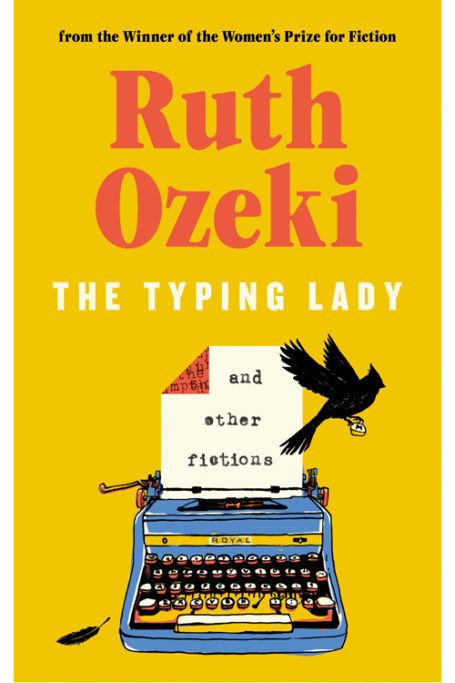
The Typing Lady by Ruth Ozeki will be published by Canongate on 28 May.
Hardback, £18.99