


Wuthering Heights Interiors: How To Bring Gothic Whimsy To The Dining Room
By
2 months ago
The weird and wonderful interiors of Thrushcross Grange take on new life in Emerald Fennell’s latest cinematic release
Happy Wuthering Heights day to all who celebrate. The hotly anticipated adaptation of Emily Brontë’s one and only novel has finally landed in cinemas, bringing with it a slew of mixed reviews – but plenty of praise for its stellar cast, fantastical costumes and surrealist interiors. It’s the latter that immediately grabbed our attention from the first watch, with the fantastical rooms of Thrushcross Grange resonating with our love of weirdness and whimsy. And these come in spades in one particular room; the dining room, where much of the drama in Wuthering Heights seems to take place.
Where Is Cathy’s Home Set In Wuthering Heights?
As Kate Bush so proclaimed: out on the wily, windy moors. Wuthering Heights, both the novel and Fennell’s silver screen remake, are backdropped by Yorkshire’s dramatic moors – with the film shooting several scenes out in the Yorkshire Dales to capture those beautifully broody moments that underpin Brontë’s magnum opus.
But when it came to the eccentricities of the manors and interiors that feature in Wuthering Heights, Fennell and her team opted to film predominantly on sets. You can read more about how Cathy’s martial home of Thrushcross Grange was created here.
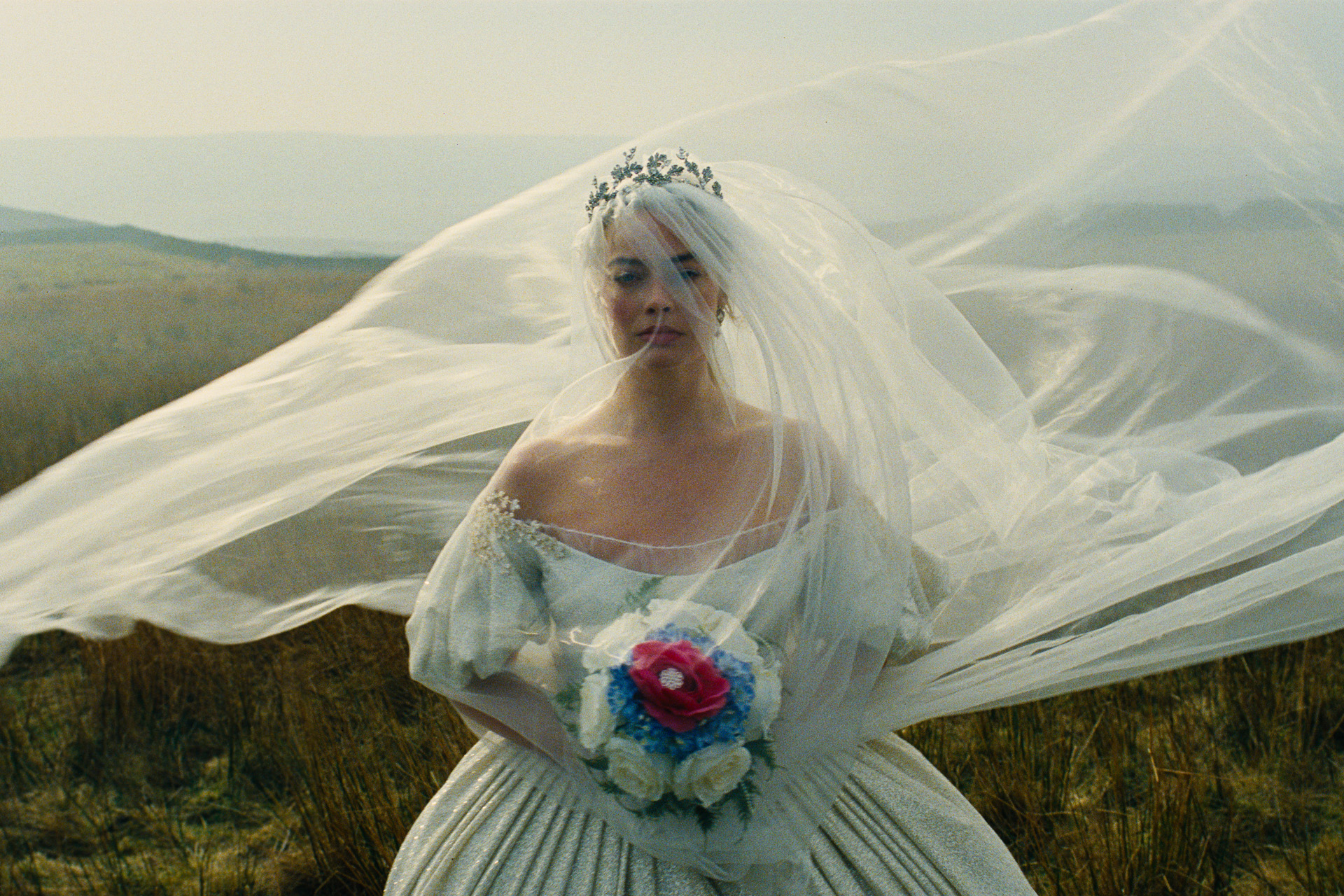
Margot Robbie stars in Emerald Fennell’s Wuthering Heights, in cinemas now. (Warner Bros.)
Who Designed The Set?
The sets we see in Wuthering Heights were the work of British production designer Suzie Davies. Davies, who became an Academy Award nominee for her work in 2014’s Mr. Turner and 2024’s Conclave, is no stranger to the creative world of Emerald Fennell. In fact, she and Fennell have worked together on sprawling country estates before, when Davies was put to work creating the interiors for her 2023 hit Saltburn.
But Wuthering Heights is perhaps one of the more creative projects Davies has undertaken in recent years; not just a period piece, Fennell’s Brontë blockbuster wraps gothic romance in layers of Magritte-esque surrealism. Not so much period accuracy as it is period fantasy, the film’s costumes, soundtrack and set design are both recognisably historical yet jarringly modern.
‘We knew there was going to be this sliver of liminality between reality and surrealism, and we were aiming for this little sliver,’ said Davies in an interview with House & Garden. Citing Baz Luhrmann’s Romeo + Juliet and Sofia Coppola’s Marie Antoinette as starting points, the set designer then plucked out a series of artists and artistic movements from her moodboard: German Expressionism, Brutalism, Breughel, Ingmar Bergman and Stanley Kubrick.
The result, as we see onscreen, is bizarrely brilliant – an unsettling play on colour, silhouette and texture that successfully unmoors an audience from its sense of setting. (A fitting feeling, considering the spiral of events that take place in Brontë’s novel.)
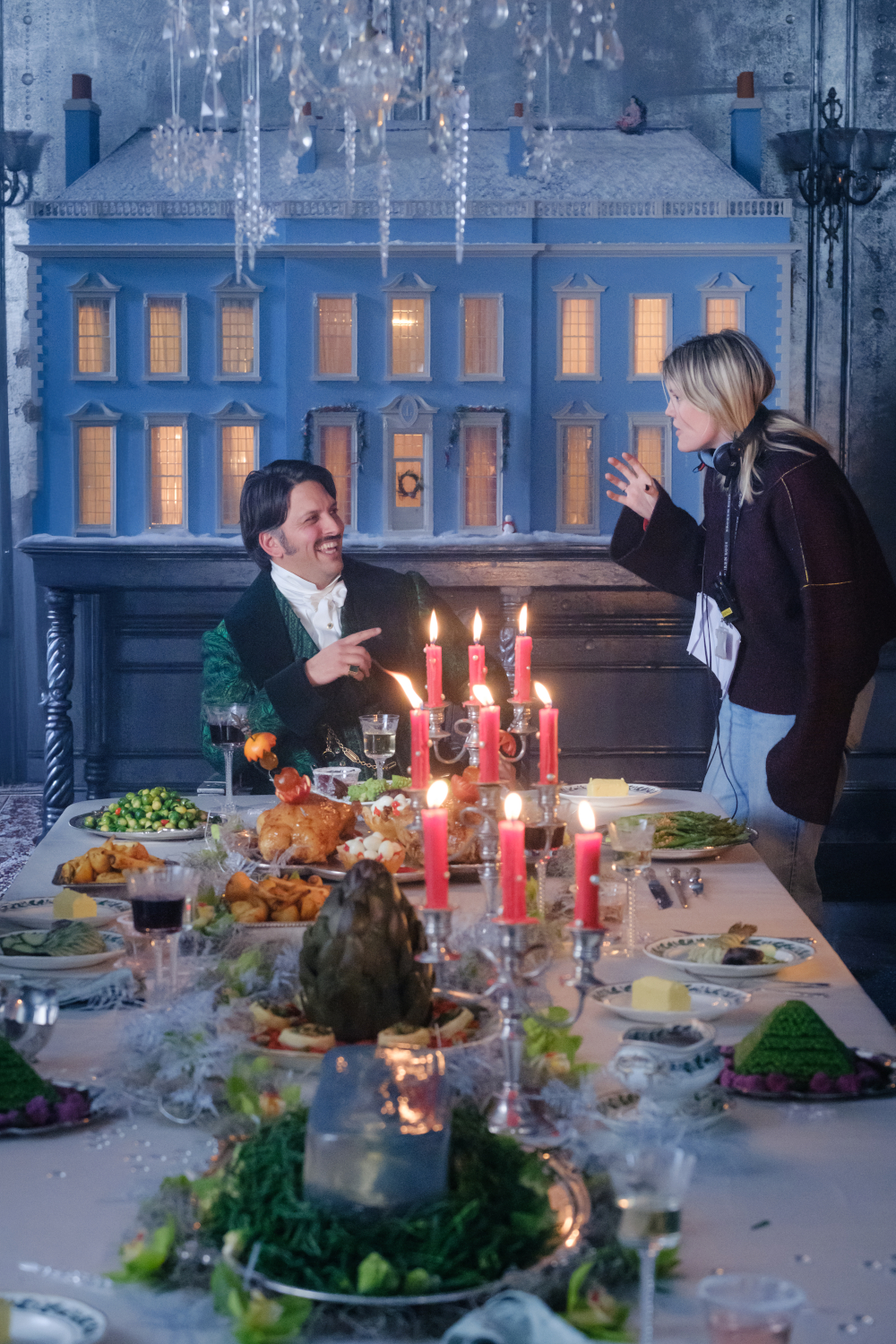
Shazad Latif and Emerald Fennell on the set of Wuthering Heights (Warner Bros)
In Focus: The Thrushcross Grange Dining Room
As we see in Architectural Digest’s tour of Thrushcross Grange, Cathy’s home is a jewellery box of sensorially sumptuous interiors. There’s a red fur-lined staircase, a drawing room covered in tiny blue crystals, a plastic-wrapped dressing room and even a bedroom reinforced with plush, padded wallpaper modelled after Margot Robbie’s skin. (Yes, her real skin.)
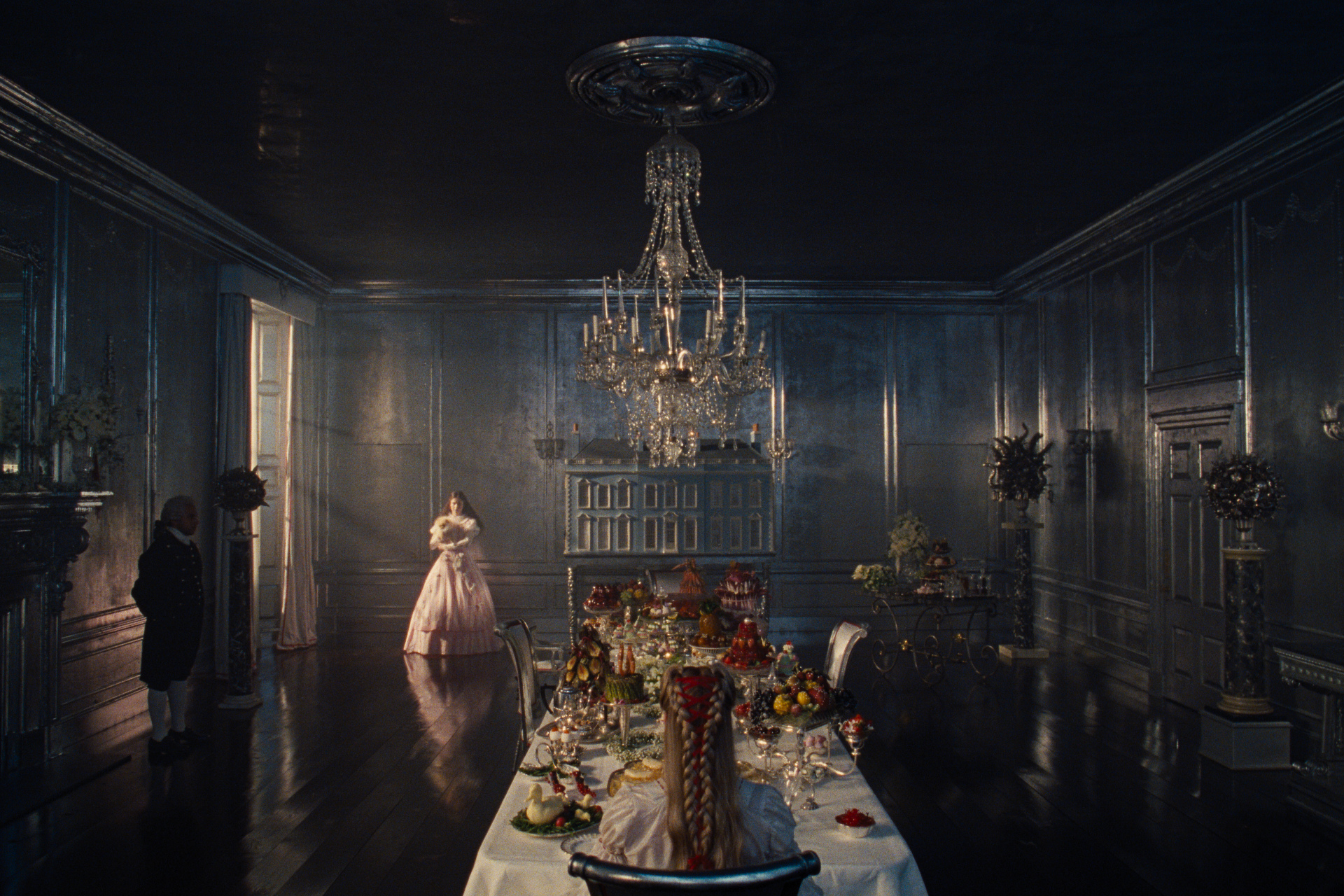
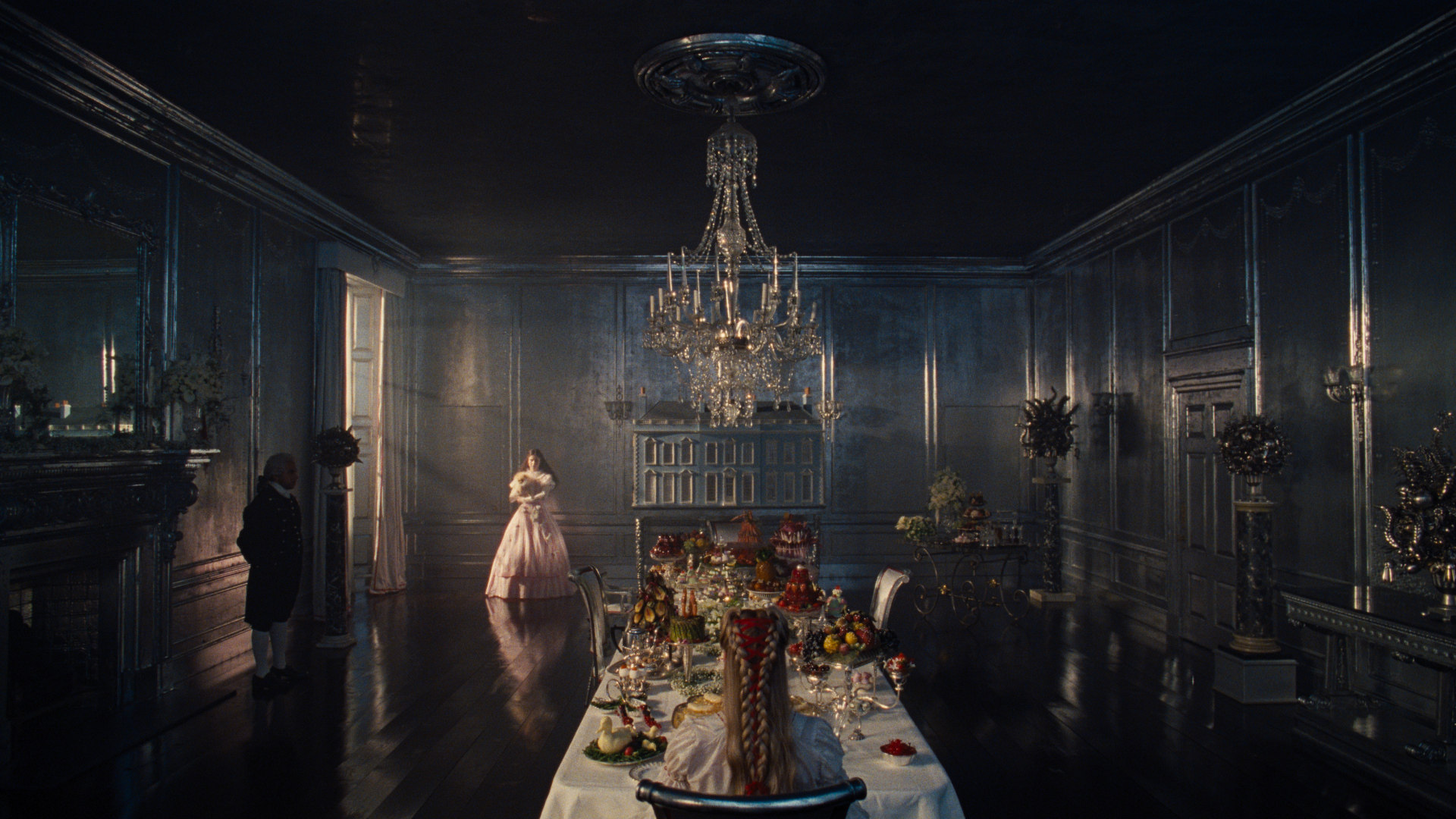
But one room that stands out as a central hub for the home is the dining room. Furniture is sparse – a long, linen-draped dining table, a dolls house and an ornate chandelier – but the tactility of the silver-lined room makes it a literal feast for the eye.
‘The set designers have taken a few Regency details for the dining room and reframed them with a contemporary slant to create a surreal space,’ notes Ali Childs, founder of Studio Alexandra. ‘There are the traditional details we would expect, that anchor us in the time period: the proportions of the room with its generous ceiling height, the fireplace and the dark wooden floor, but they have been distorted in a way that leaves the viewer feeling slightly unmoored.’
The emptiness of the room itself lends the space its sense of oddness, adds homeware designer Rebecca Udall. ‘The dining room subverts expectations; where the default might be a traditional, grand period styling, they have created a space that is almost stark in its vastness. They have used the grand proportions we would expect from a manor house of the time period, but instead of lots of dark wood and regency detailing have opted for empty space. It allows the long dining table, with the doll’s house at its head, to be the main focal within the space and a real centrepiece for the drama to play out around it.’
‘There are none of the high-backed chairs, huge rugs or walls adorned with art that would reassure us about where we are,’ adds Ali. (In fact, Davies has mentioned in multiple interviews that she and the team would hunt down furniture from varying time periods, pull them apart and put them back together in patchwork combinations.) ‘The walls, while panelled, are covered in metallic silver, which paired with the shimmering light from the chandelier and fireplace is atmospheric in a way that feels tense rather than cosy and cocooning.’
While it doesn’t sound like the most homely space on paper, Thrushcross Grange is undeniably stunning – dining room included. The more contemporary detailing that fills the space also makes it all the easier – and tempting – to bring a slice of Wuthering Heights home. But where to start?
Margot Robbie as Cathy Earnshaw and Alison Oliver as Isabella Linton in Wuthering Heights (Warner Bros)
How To Build Your Own Wuthering Heights Dining Room
The Walls
A key feature of the dining room that makes it a standout space is its walls. ‘Burnished metallic walls, dripping in crystals, create a room that exudes opulence and refracts the soft candlelight all around,’ highlights the team at Cole & Son.
Davies had designed the walls with the intention of making the space feel wet, settling on a cool-toned metallic (even with light shining off it, this isn’t a space that feels warm) decorated with liquid-like drops that cascade down the walls and onto the furniture in Regency-inspired dots and swirls.
But while modern in appearance, the use of metallic finishes in great stately homes was a real thing. ‘Gold scrollwork and elaborate decorations can appear gaudy to the modern eye, but this was done for a reason: the primary source of illumination was candlelight,’ explains Peter Gomez, Lead Designer at Zoffany. ‘Designed for evening entertaining, such rooms come to life when candlelight plays across their interiors and reflective surfaces.
‘Two defining aesthetics in the dining room in Emerald Fennell’s Wuthering Heights stand out: a reflective quality and a largely monochrome palette,’ he adds. The walls ‘evoke the look of antique mirrors, as well as églomisé – the traditional technique of painting on the back of glass or mirrored surfaces. Today, you can achieve this aged mirror effect by combining wallpapers with textures and patterns which are printed on metallic grounds.’
‘Metallic wallpaper with delicate etchings can match this sense of stately grandeur,’ emphasises the team at Cole & Son. ‘As can trompe-l’oeil panel design [while not used on the walls, this technique also finds a home on the entryway floors of Thrushcross Grange], which creates a timeless feature.’
The Table
Running down the centre of the room, the dining table is one of the room’s main focal points. As such, it takes on much of the grandeur when it comes to decorating. ‘The various tables we see in the film are very glamorous and ornate in their styling, against the backdrop of the more stark room,’ notes Rebecca. ‘The base, a crisp white cloth on a long rectangular table is very simple, but by topping it with an abundance of richly coloured, interestingly textured food with lots of fruits and jellies, interspersed with natural elements such as deep green moss and mushrooms, at varying heights throughout, they’ve created a deep, layered and bountiful scene for a feast.’
But while beautiful, there’s still that pervading sense of oddness that runs deep in the film’s set design. ‘Height is used perfectly; they have flipped the usual styling technique and placed simple flower designs flat on the table, instead elevating the food so it sits above, using silver platters and glass vessels to pop against an understated floral backdrop,’ says Rebecca. ‘The clean backdrop of a white linen allows more drama through the use of food and more unusual props, like swapping out larger blooms in vases with more earthy pieces such as potted moss, that sit at a lower level on the table.’
Playing with scale and seasonality, Davies took to setting the table around themes – a Christmas feast, a fish banquet and a spread of jellied seafood (‘we found we could suspend many things in jelly,’ she told Architectural Digest). And with this in mind, she was able to isolate scenes within the tablescape that lent narrative to the space.
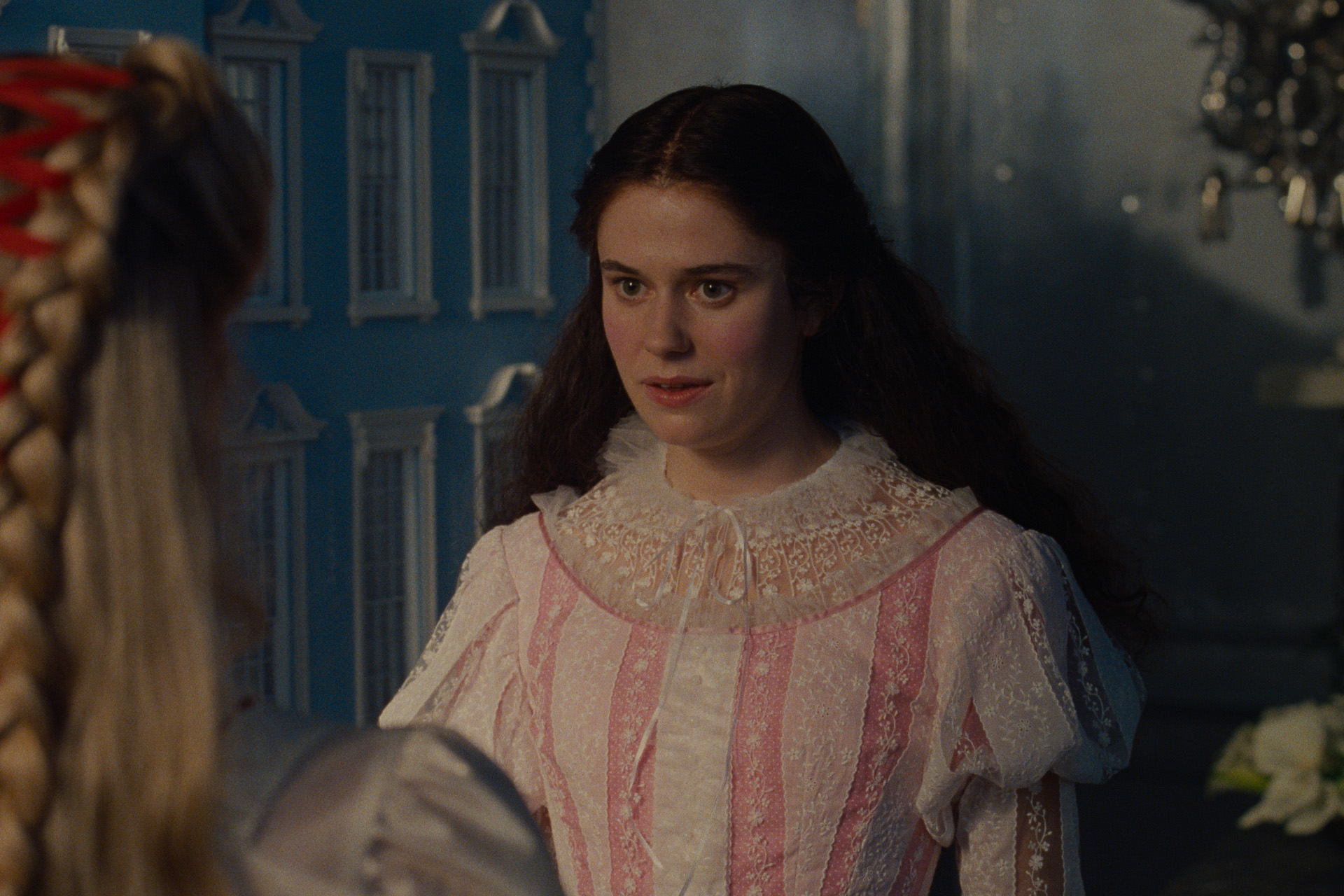
Alison Oliver as Isabella Linton in Wuthering Heights (Warner Bros)
The Dolls House
And at the very end of the room, at the head of the dining table, sits one the dolls house. Davies has described the feature as the starting point for the design of Thrushcross Grange; a miniature replica of the home, each room in the dolls house is a snapshot of the actual life-size space. (And it even has a dolls house inside, just like the real dining room.)
While a bit odd by today’s tastes, a dolls house wouldn’t have looked out of place in a late Regency home. ‘Historically, dolls houses with this level of design and craftsmanship were never created as toys, but exquisite exhibitions of grandeur and taste,’ explains Lucy Clayton, co-founder of the Kensington Dollshouse Company. ‘So the placement of a dolls house in a principle room at Thrushcross Grange sits within this tradition.
‘It’s something that makes people gasp with delight,’ she adds. ‘You see that in the scene where Cathy [Margot Robbie] and Isabella [Alison Oliver] interact with the dolls house, exclaiming, “how extraordinary”. In my experience this is a universal response to a world rendered in miniature.’
So why the dining room? For exhibition’s sake, of course. ‘A formal dining room is a great opportunity to create a room that is more whimsical than elsewhere in the home,’ says Ali. ‘Much like a downstairs loo, it can exist slightly apart from the daily flow of domestic life. Because it is used differently, it allows for bolder, more theatrical choices.’ Like an intricately designed dolls house.
Wuthering Heights is in UK cinemas now.