


Why The Best Interiors Are Made To Order
By
3 months ago
The designers, makers and craftspeople behind some of the most striking interiors reveal the secrets to creating something extraordinary
The most seductive interiors are shaped through specially commissioned pieces, where collaboration, ambition, skill and a willingness to take risks transform ideas into something extraordinary. The more bonkers the idea, the more beautiful the result, finds Hatta Byng.
How To Commission Your Own Extraordinary Interiors
Commissioning something unique for a project and working with highly skilled craftspeople to achieve something special is where interior design gets exciting. It is this art of pushing beyond the expected that lifts something out of the ordinary. ‘The more ambitious the commission, the more wonderful the result,’ says Mathew Bray of decorative arts specialist MBMC Studios. With a 60-strong team of draughtsmen, prototypers, robotics experts, artists, leatherworkers, carvers, glassblowers, finishers and more, Bray and his business partner Matthew Collins pull off incredible feats for an international client list.
Interior designer Rachel Chudley laughs at herself for the work she creates in bringing her often ‘bonkers, off-the-wall’ ideas into reality. ‘Every time we consider if there is an easier way to do things, we realise making special things requires extra energy and effort,’ she says. ‘We’re gluttons for punishment.’
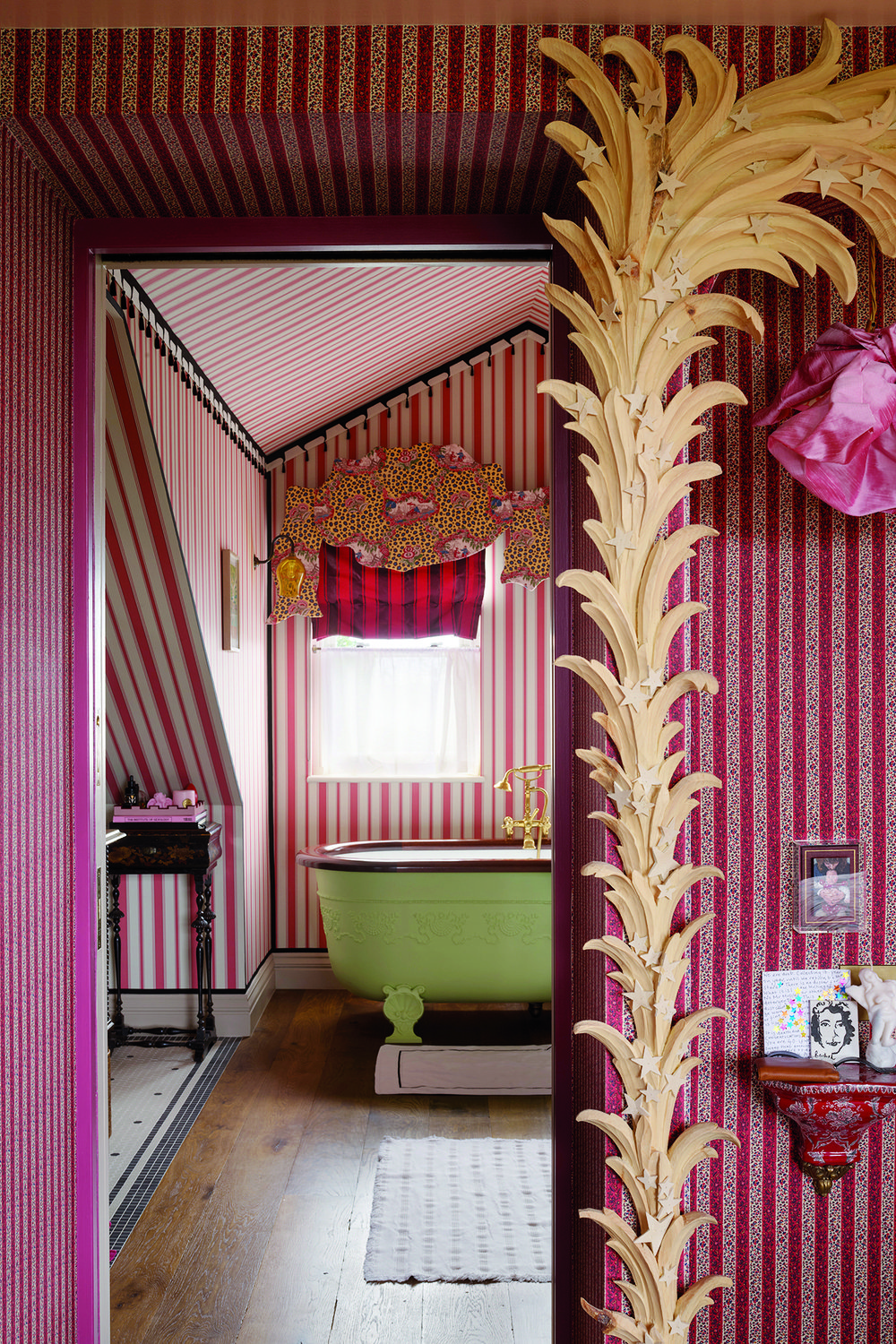
Rachel Chudley enlisted master carver Matthew Pack to create a canopy of acanthus fronds to frame a bed. (Simon Upton)
The Power Of Collaboration With Craftspeople
Chudley and I discuss two acanthus fronds decorated with stars she commissioned from master woodcarver (and a restorer for the V&A) Matthew Pack to frame a canopied bed. Carved from a single piece of wood, it was a labour of love – but it is a relationship that has continued, with some wonderful results.
I’m not suggesting we all need to be outlandishly original when it comes to commissioning – but we can achieve an element of surprise, create something beautiful and perfectly tailor something to the space, our tastes and our needs. ‘In a world where there is so much readily available and many furniture brands offer design services, we owe it to our clients to bring this depth to what we do,’ says Charu Gandhi, founder and director of Elicyon. Her interiors may be calm to the eye, but a recent crib sheet for a client listed 280 individual suppliers; many different crafts and materials are knitted together in her projects, where up to 80 per cent is bespoke.
Nicole Salvesen, co-founder of Salvesen Graham, relishes the creativity that working with makers can bring – the nuances that their skills and expertise in materials and finishes gives to the end result. She shows me a handpainted wallpaper she created with de Gournay for her chalet in Switzerland, inspired by an antique book of plant specimens. Creating a room for WOW!house 2026, where she and Mary Graham were effectively their own client, saw them pushing this to the max, designing a carpet, bespoke trims, a wall finish with MBMC Studios, and so on. ‘The more we commission the more we see where we can push – and where we should stand back – to get an exciting result.’
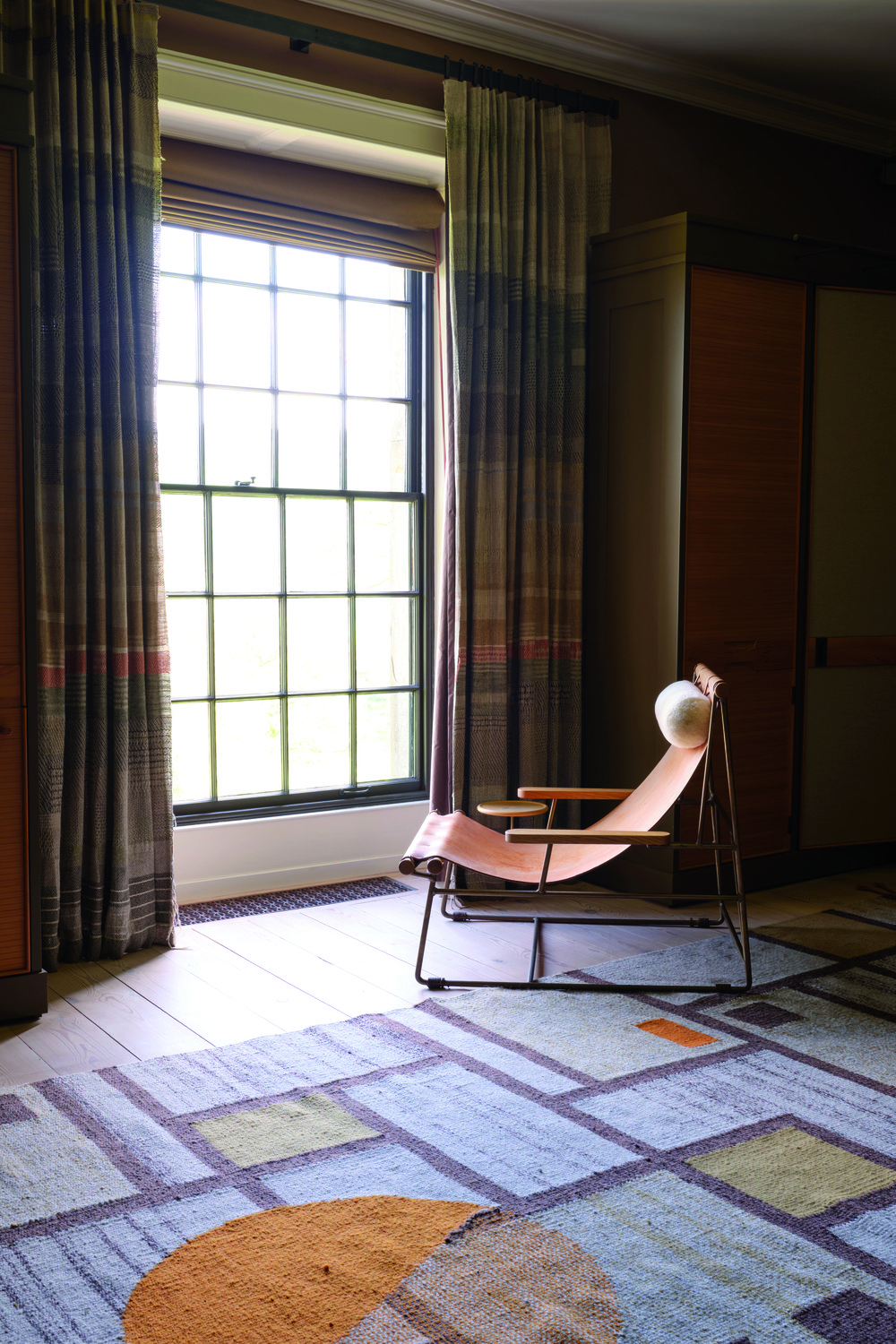
For his own home, designer Jonathan Reed persuaded textile artist Catarina Riccabona to weave curtains to reflect the landscape outside. (Beth Evans)
From Sketch To Extraordinary Piece
For designer Jonathan Reed, working with craftspeople to realise his ideas is central to his design process. While he was sketching a map of his Yorkshire Dales farm for a discussion with National Parks, a distinctive Clive Bowen pot on his desk prompted an idea for a ceramic map for Reed’s sitting room. It was technically terrifying and Bowen brought in his son Dylan – also a slipware potter – to help. It was an experimental process: four of the panels cracked in the kiln and had to be remade. The handover was in a car park in Skipton, and when Reed got home, another panel had cracked. But it’s all part of the piece’s story.
Almost nothing for Reed is bought off the peg: even the cleat for a blind is likely to have been designed by him, improving and tailoring its form exactly to the project. He is adept at working with skilled people to create something entirely different to their normal output. These might include sculptural but surprisingly contemporary oak furniture by Robert Thompson – aka Mouseman – complete with the signature little carved mouse poking its head out somewhere. For the curtains in Reed’s own house, he persuaded the textile artist Catarina Riccabona to weave fabric by the metre for the first time, drawing on the colours of the landscape outside.
James Morris of Sculpsteel, whom Reed has worked with for years on everything from TV stands to coffee tables, enjoys solving the engineering challenges Reed brings him.
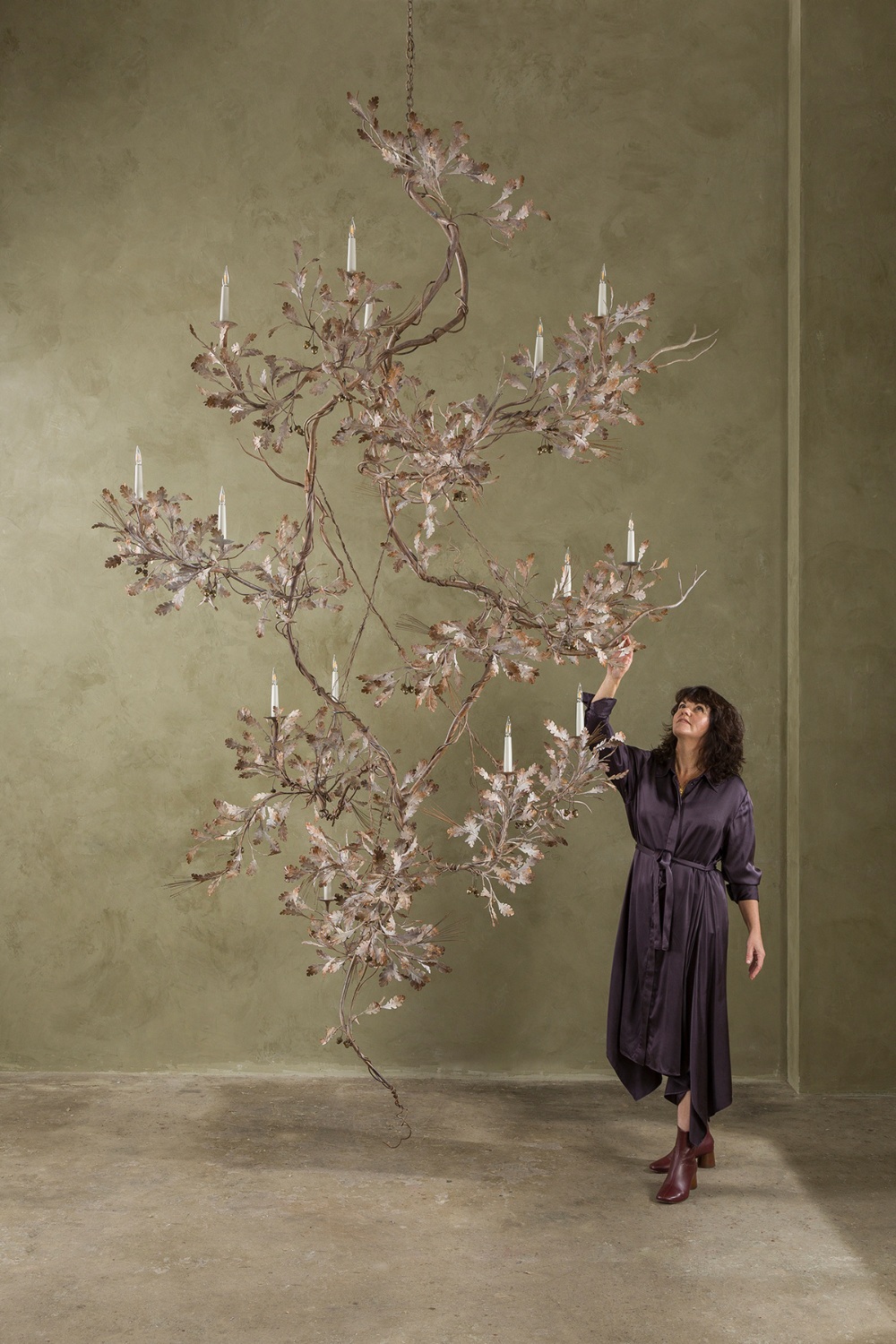
Cox London is working on a version of its oak leaf chandelier that will ‘run wild’ down three floors of a domed hallway
Making It Real: Workshops & Site Visits
Often, the creative process and collaboration is as much a part of the joy as the end result. Reed acknowledges the risk that something may not live up to expectations – that the maker could have an off day, or that in scaling up from a sample there is potential for failure. It can be a leap of faith, but this element of risk delivers the beauty. ‘It is the imperfection that makes something extraordinary,’ he tells me, ‘making a house so much more alive than one full of replicas.’ His brief for Sculpsteel for a pivoting, rusted steel coffee table consisted of a 30-second sketch and a conversation or two. The client did not see it until it arrived at its destination in South Africa, but it is the piece their guests always talk about. ‘If you invest in the dialogue with a craftsperson it is highly unlikely you’ll be disappointed,’ Reed says.
Craftspeople and multidisciplinary studios like MBMC and Rupert Bevan all stress the importance of getting clients to their workshops and away from the computer. This is when possibilities really come to fruition. Gandhi says she will go to a joinery workshop four or five times in the course of a project to check progress and discuss details. She has learnt not to overdraw, to leave room for conversation, and to give the maker space to add his knowledge and expertise. Chris Cox of Cox London shares what can happen when you see the space you are creating for. He is currently working on an iteration of the studio’s bronze oak leaf chandelier for a house in France: the piece will ‘run wild’ down three floors of a domed hallway so you walk through the branches as you transcend the staircase. The design process started with a trip to the house and subsequently saw four very large samples flown in crates to Paris, with at least 12 people involved in the making of each piece.
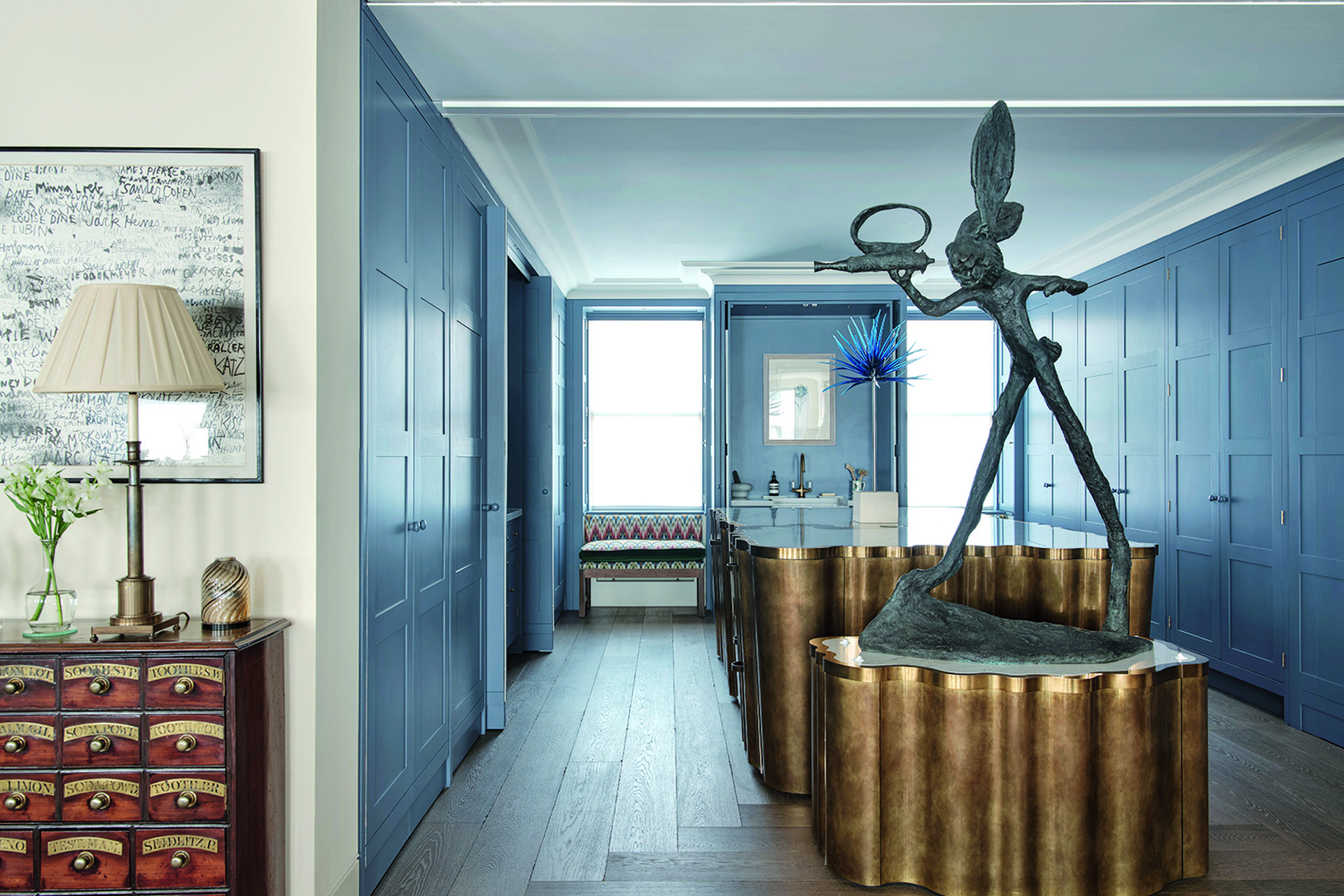
A brass-wrapped kitchen island by Rupert Bevan for Cindy Leveson.
The Joy Of Pushing Boundaries
‘It’s all in the relationship with the client,’ Rupert Bevan says of the journey each project takes him on. ‘The greatest ones are when you are not frightened to say what you think, and you get the best out of everybody.’ Many of the people MBMC work with arrive with very detailed drawings, but the studio can also work to a sketchier brief, leaning on the skills of its own team to develop and prototype often incredibly complex pieces so there is no room for disappointment. As Mathew Bray says: ‘The buck stops with us to pull it off.’
So, enjoy the ride. You can draw on the mastery of the most traditional of craftspeople for the most contemporary interiors. Recently talking to master plasterer Philip Gaches in front of the intricate friezes and swags he has made at Castle Howard, I find out he is flying to New York the following week to work on a plasterwork tree canopy for a loft in Brooklyn. When Rachel Chudley turns up to the late Robert Kime’s favourite upholsterer Roy Coles with ‘another crazy sofa idea’, she says he just laughs – but is completely up for it.
The Art Of Commissioning: A Seven-Step Guide
1. Visit the workshops to understand what’s possible, and then again during the design and making process if you can.
2. Don’t be afraid to go with the sketchiest of briefs. Many workshops can develop these with ease and provide you with something to sign off.
3. Invest time in the conversations between you and the maker.
4. Talk about costs up front, so you all know what to expect. With experimental projects, be clear about who shoulders the cost of any failures.
5. Lean into the craftsperson’s expertise in the design process.
6. Take a leap of faith and enjoy the process.
7. And if that’s a step too far – and if budget allows – sample and prototype as far as you possibly can.
This article first appeared in Country & Town House Interiors 2026/27.