


Karl Lagerfeld’s 18th Century Manor House Has Hit The Market
By
2 hours ago
Plus, where else the designer owned homes
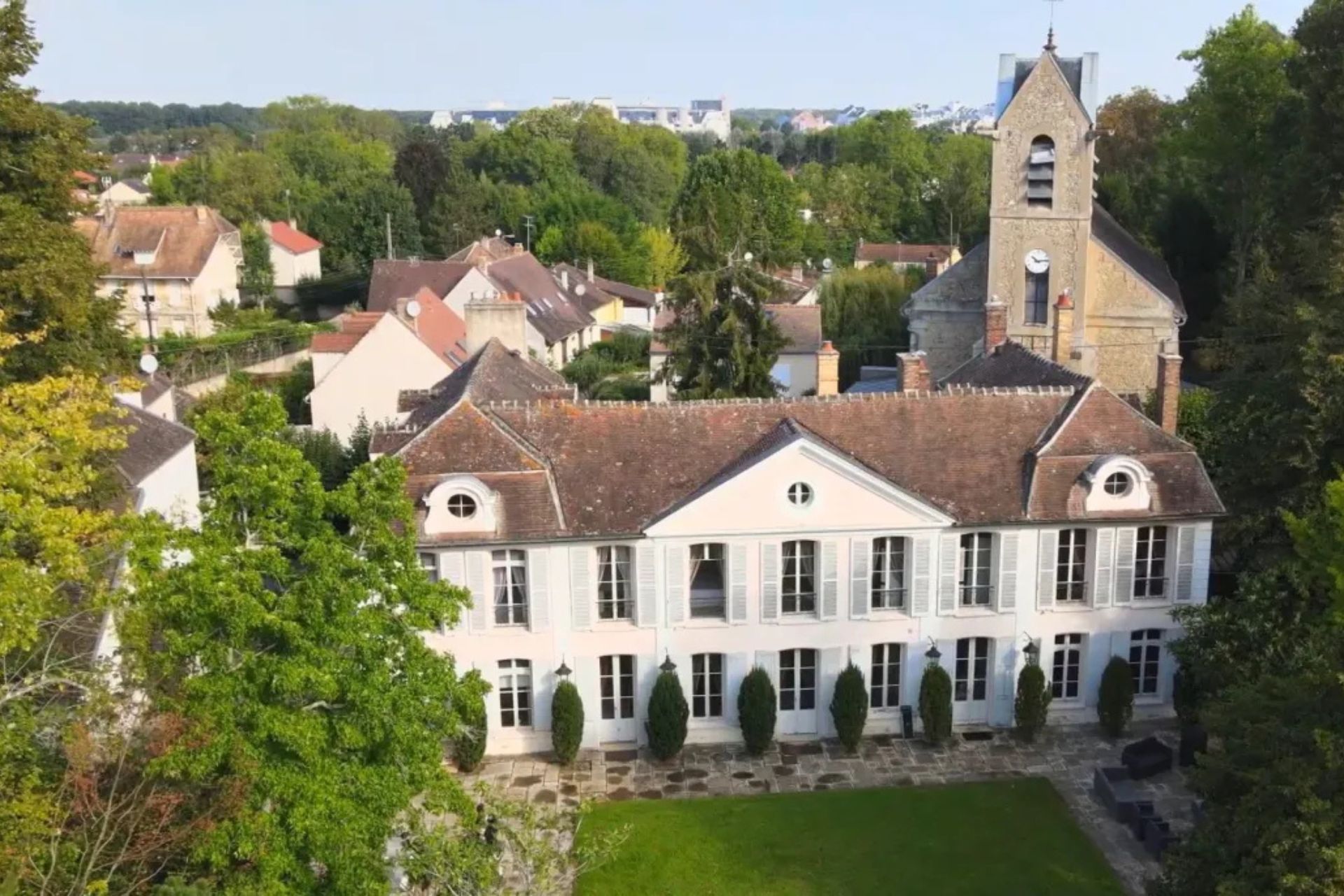
The former creative director of Chanel, a fashion powerhouse and lover of monochrome – the late Karl Lagerfeld certainly left an impressive legacy on the world of fashion. And even if you’ve never managed to get your hands on any of his designs, now’s your chance to buy up his former home.
Inside Karl Lagerfeld’s Home: Manoir Du Mée-Sur-Seine
Siebbi, CC BY 3.0 <https://creativecommons.org/licenses/by/3.0>, via Wikimedia Commons
Located just outside Paris, Lagerfeld’s impressive Manoir du Mée-sur-Seine (perhaps unsurprisingly) played host to many lavish parties, photo shoots and fashion shows during the designer’s ownership.
Built in 1749, the property was first owned by the Fraguiers, a notable French family considered to be aristocratic up until the 1789 revolution. Residing there until the early 20th century, the mansion then served as the weekend home of Renée Saint-Cyr, a French actress renowned for her impressive portfolio of 1930s and 40s films.
Much like Lagerfeld, she hosted many elaborate dinner parties at the home for her glamorous circle of friends from the worlds of Parisian theatre and film. Despite these similarities between her and Lagerfeld, when she later sold her property to the designer he completely redecorated the home – a move that inevitably feels a little offensive when you’re regarded as one of the world’s top tastemakers.
Described as the most homey of Lagerfeld’s rumoured 20 residences, during his ownership this pastel pink property was a fusion of neo-baroque styles, drawing on everything from the Gustavian aesthetic, the Martine school of design, and 1940s furniture. Though the manor house backs onto an estate, it still boasts 500 sqm of living space, a 184 sqm guest house, and extensive landscaped grounds including a considerable front lawn.
While living in the property, Lagerfeld slept in a bedroom covered with a chintz fabric based on Louis XVI documents and created a room on the ground floor inspired by early 20th-century French fashion illustrations and decorative arts. It was during his stay here that Lagerfeld grew close with the ‘mad-cap’ Princess Diane de Beauvau-Carons who became the property’s part-time resident and de facto hostess; her bedroom featured an 18th-century pattern from La Manaque, Paris, on the bed, windows, sofa and walls.
But Princess Diane wasn’t the only royal to make herself at home here. Following Lagerfeld’s residence, the property was bought up by Princess Caroline of Monaco (the daughter of Grace Kelly) in 1998. It served as the main home of the princess and her husband, Ernst August, Prince of Hanover, for six years until Princess Caroline sold the mansion in 2014 to one Patrick Morel. The children of the royal couple attended a local school in Mée, a commuter town about 30 miles southeast of Paris, and learnt to ride horses in Bois-le-Roi, near Fontainebleau. A drawing by Caroline’s daughter, Princess Alexandra of Hanover, can still be seen on a beam in an upstairs room.
Under Morel’s ownership the house was used as the setting for the 2018 French film Enchantées. Ernst August’s former study was transformed into a meeting room, and his two cars, which he left at the house for years after they sold it, can also be seen in some scenes.
On the market for €2.7m. Find out more at lesnouveauxconstructeurs.fr
Where Else Did Karl Lagerfeld Own Homes?
An Art Deco Apartment In Paris
Born in Hamburg, Lagerfeld first made the move to Paris in the 1950s. Throughout the 60s and 70s the burgeoning designer lived with his mother in an Art Deco style apartment at Rue de l’Université place.
A Parisian Baroque Dream
Upgrading from the apartment he shared with his mother, in 1977 Lagerfeld moved into the 18th-century Hôtel de Soyeux. Lagerfeld lived on the first floor which he decorated with lavish Baroque interiors: think gilded gold furniture, damask wallpapers, fabrics handwoven in Lyons and a bed duplicated from the Palace of Versailles. Of the nine-room Parisian lair, André Leon Talley wrote: ‘The entire place (and Lagerfeld’s mental condition) might best be described as a Versailles complex.’
A Monte Carlo Flat
The designer bought up this Monte Carlo apartment in Monaco around the 1980s. Inspired by the Memphis school of design, the playful interiors were dreamed-up by Ettore Sottsas in Milan. Key features include a giant playpen in the living room which was once a boxing ring designed by Masanori Umeda of Tokyo, a bedsheet decorated with comic book characters, plus plenty of bold furniture.
A Futuristic Paris Home
‘Modern is modern,’ Karl Lagerfeld told Vogue in 1992. ‘My dream is one day to build a very modern house. I don’t know why, because I have enough houses already, but I dream of it.’ And in 2012 that dream was realised in his Parisian apartment on the Quai Voltaire. Done-up in a highly futuristic, avant-garde style, the flat is all minimalist forms, reflective surfaces and matte-black furniture. Though Lagerfeld described it as a purely functional space (somewhere to sleep, shower, and work), it sold for double its asking price at $10.8 million in 2024.
Two Roman Rooms
Dreamed-up by Lagerfeld, alongside interior designer Andrée Putman, it’s no wonder that his 90s Rome apartment was done up in his signature monochromatic black and white colour scheme. Spending significant time in the city due to his work with Fendi, Lagerfeld is believed to have also owned a pied-à-terre in Rome which featured Viennese Secession style decor.
Château de Penhouët In Brittany
An 18th-century château dating back to 1756, Lagerfeld secured this home at an auction in 1974. Complete with a grey slate roof, orangerie and chapel, the gardens are said to be designed by Louis XIV’s landscape architect, André Le Nôtre. During his 20-year residency Lagerfeld oversaw several significant renovations, perfecting the home for Queen Elizabeth The Queen Mother’s visit in the summer of 1990.
A French Riviera Villa
Villa La Vigie is a Belle Époque villa built in 1902, situated on the Pointe de la Veille on the French Riviera. Prince Rainier III of Monaco gifted it to Karl Lagerfeld on the condition that he restore it, and so Lagerfeld poured an estimated €12.7m into its renovation, filling it with art, sumptuous furnishings and rich fabrics.
Pavillon de Voisins, Louveciennes
A neoclassical mansion from the 1850s located about 10 miles west of Paris, this property was added to Lagerfeld’s portfolio in 2010. Serving primarily as an entertaining and work space, with a design studio on the first floor, it sold at auction in 2025 for €4.7 million ($5.5 million).
A Home In Biarritz
Lagerfeld first saw this 1920s home at a party in the 50s and dreamed of owning it ever since. Eventually buying it up in the 90s, it was described by those close to him as one of his most comfortable and beloved homes – a fact probably helped by the 100-acre park and Lagerfeld-designed swimming pool. Rendered in a palette of chocolate brown and white, it was filled with Jean-Michel Frank furniture.
A Villa In Hamburg
Named after his long-term companion Jacques de Bascher, Villa Jako was bought by Lagerfeld in the early 90s. Located in his hometown of Hamburg, the designer filled it with objects from the Swedish Grace design movement.
A Pied-à-Terre In New York City
Often in New York City for work, Karl Lagerfeld owned a luxury apartment at 50 Gramercy Park North which he purchased in 2006 for $6.69m, later selling it at a loss when he gave it away for just $4.5m in 2012.
A House On Lake Champlain, Vermont
In 2008 Lagerfeld purchased a historic Greek Revival brick home on Lake Champlain in Grand Isle, Vermont. Though drawn to the 1840s property (where he hosted a Chanel campaign shoot) for its Emily Dickinson style, reports suggest that he never officially moved in
An Office In Paris
Though Lagerfeld didn’t officially live at his Parisian office in Saint-Germain-des-Prés, reports suggest that he would often sleep over after a hard day’s work. Now transformed into a private residence, the former office can be rented on a short-stay basis. As part of the experience, visitors get to see the city through Lagerfeld’s sunglassed-eyes with an itinerary of the designer’s favourite Parisian spots and hidden gems.