


Claire Luxton On Transforming Murrayfield Stadium With Her Art
By
5 months ago
‘We have challenged, shifted and recreated a new narrative for this stadium that no longer stands solely for men's victories but also for female ones’
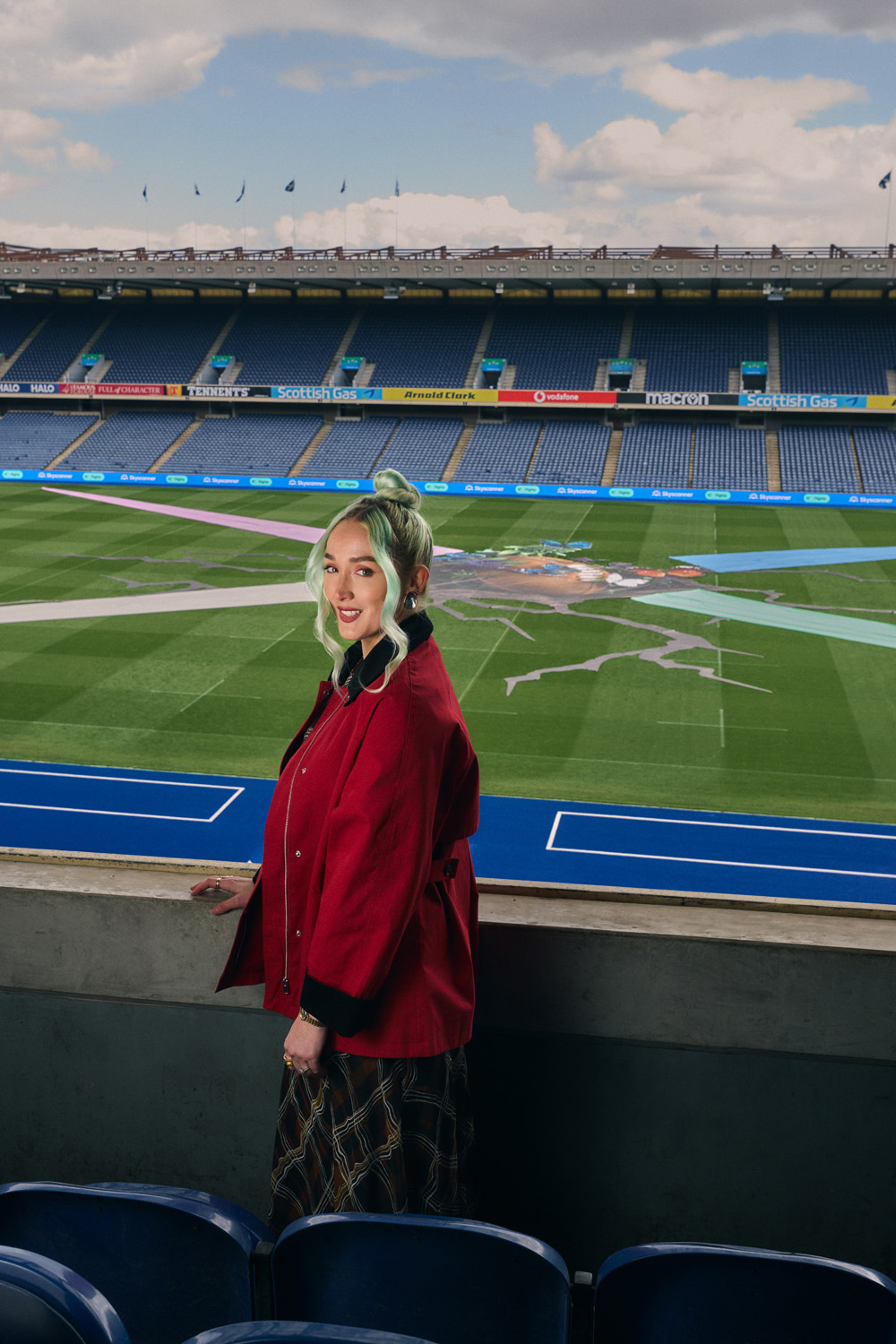
Earlier this month, a couple of records were broken. For one, Scotland’s women’s rugby team was welcomed to the Scottish Gas Murrayfield Stadium for the Scotland v England fixture in the 2026 Guinness Women’s Six Nations (Saturday 18 April) – marking the very first time the women have played in the main stadium. For two, the largest ever crowd for a women’s Scottish sporting event flocked to the Murrayfield to witness the action. And for three, fine artist (and creative mind behind Country & Town House’s unforgettable July/August ‘23 cover) Claire Luxton presented her largest public artwork to date, celebrating the milestone with flair.
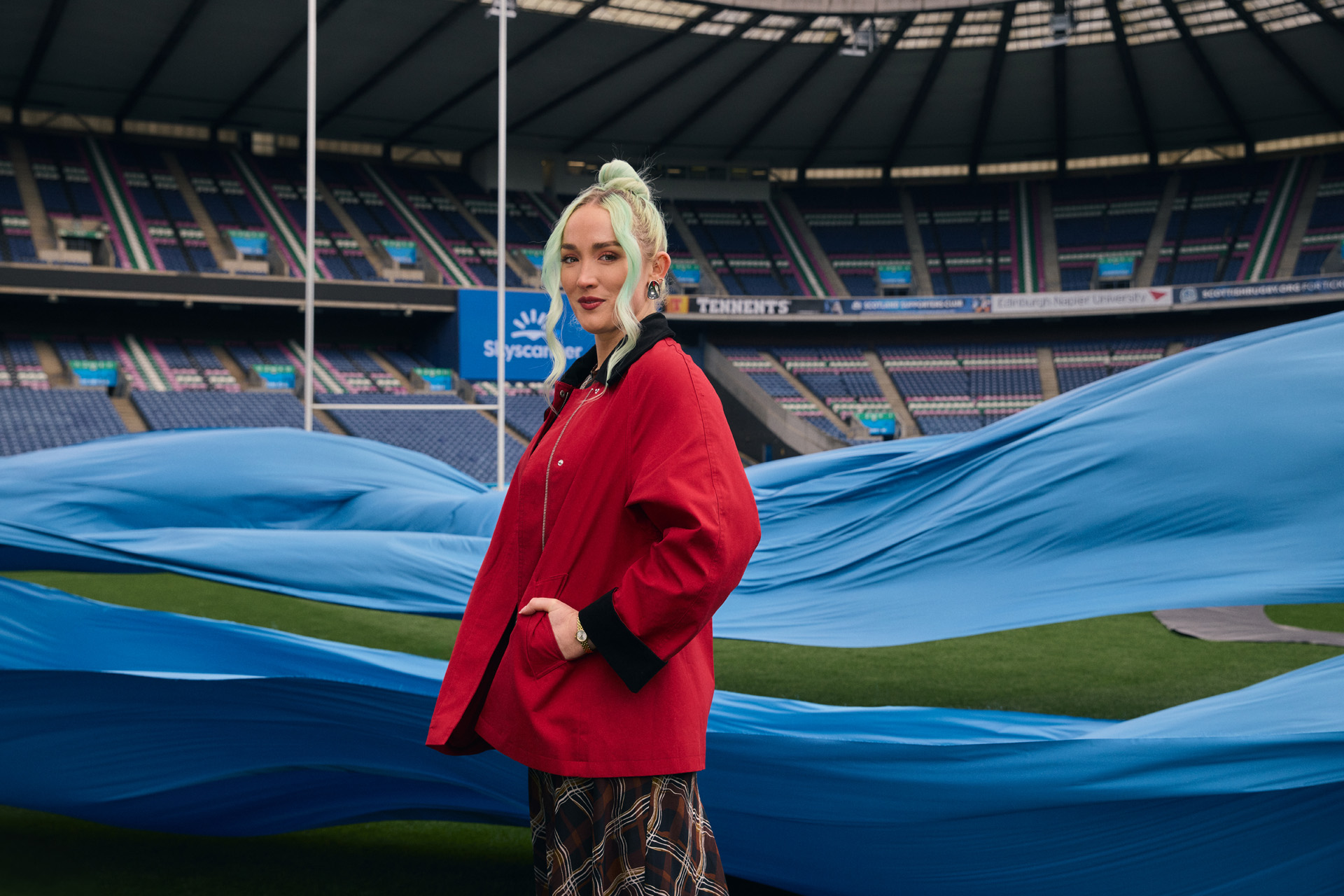
Picturing a rugby ball exploding onto the pitch, adorned with flowers and butterflies, the piece is titled ‘Now We Arrive’, and supports Luxton’s continued effort to bring women’s voices to the fore, using art as her conduit.
How did ‘Now We Arrive’ come about? Below, read Luxton’s conversation with art entrepreneur and MTArt Agency founder and CEO Marine Tanguy, where they delve into the project and its genesis.
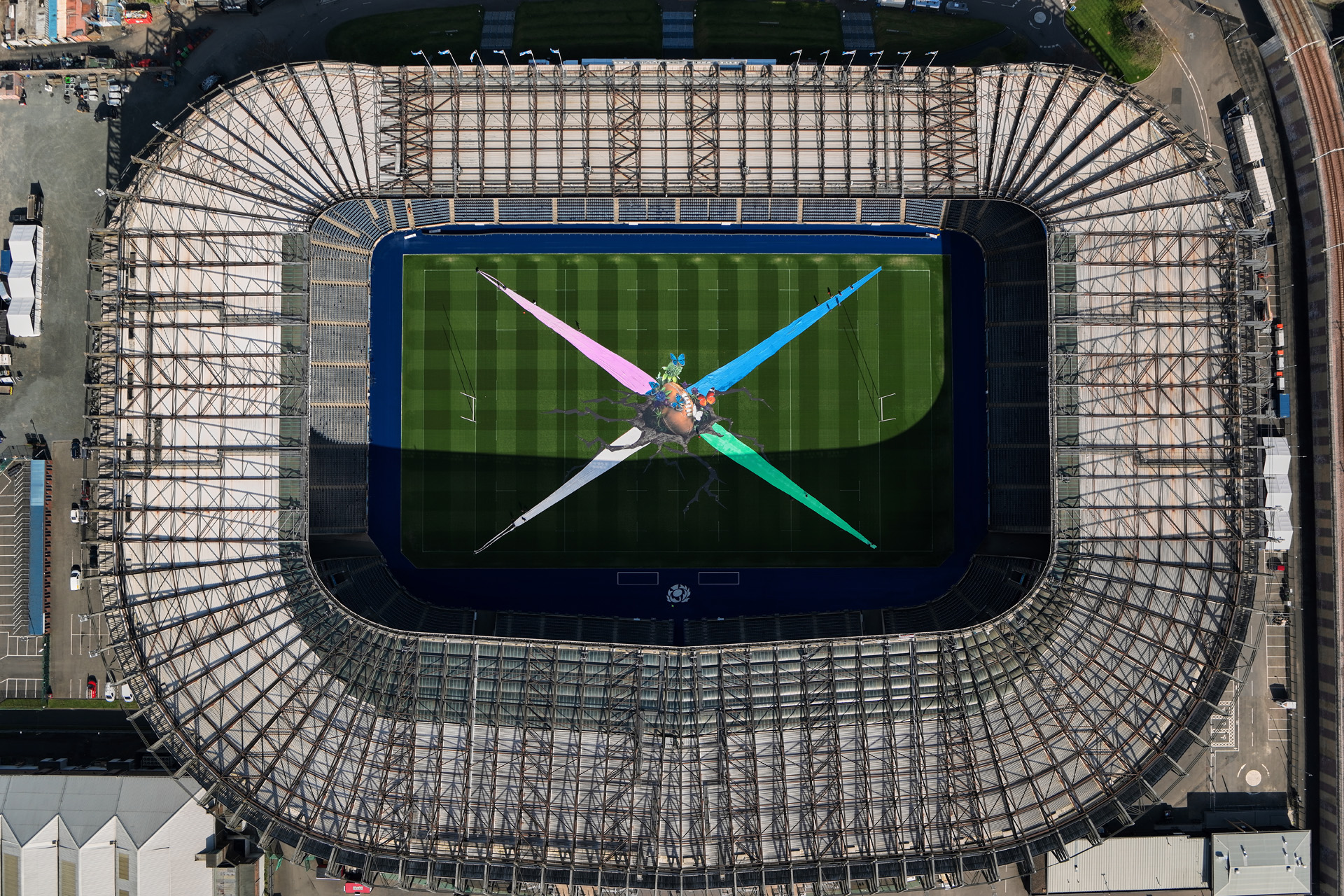
‘Now We Arrive’ is Claire Luxton’s largest artwork to date. (© Stem Studios)
In Conversation: Claire Luxton & Marine Tanguy
As fine artist Claire Luxton takes her phone to ring art dealer Marine Tanguy, she is sitting in the middle of her countryside studio in East Sussex, surrounded by her artworks. Her studio is set within an old unit on a breathtaking farm, and every morning she walks through the farmer’s fields to get to the studio.
Almost serendipitously, Marine herself is sat in Manchester Square, an 18th-century garden in Marylebone, facing the Wallace Collection. Marine and Claire have shot many times in this park. Marine is soaking up the April sun before she heads to yet another public art installation at Borough Yards with her artist, Hanna Bennihoud, that evening.
View this post on Instagram
Marine Tanguy: I wanted to take us back to the day when the idea was born, on a sunny afternoon in July 2025 at the Skyscanner office.
Claire Luxton: It was another beautiful day. You turned up on your yellow bicycle at the Skyscanner office. I loved the idea from the start, as it was such an exciting opportunity to tell this powerful female narrative through the female gaze, through a modern lens. As a female artist, to be given such a big platform and a big stage (a stadium!) to create something on this scale was really meaningful. When we were in the Skyscanner offices and started talking through ideas with Tom, the global creative director of Skyscanner, I could see we were about to break ceilings and push boundaries both artistically and narratively.
MT: As you know, the research that we lead is on representing our gender more truthfully in our cities. And in fact, we just published a paper with University College London – where your art is on the cover – that specifically advocates for new visual narratives for women in our shared spaces. Public art projects are the perfect execution of this vision so it felt like the perfect opportunity to do so here. We also live in a very specific moment as female sports’ attendance is on the rise. This game became the highest ticket sale ever recorded in the stadium. What a victory!
CL: Indeed, what an incredible momentum to be a part of! I felt that this narrative could be universal. I remember discussing the need to visualise us, all of us as women, when speaking to the director and producers who actually documented and filmed the whole process (who are also an amazing female team, Jade Ang Jackman, & Kit ’n’ Kat). It felt so meaningful to be given a voice and become the voice of the incredible women’s rugby team, and celebrate how far we’ve been able to come.
MT: The project was also in support of the UN Women UK, can you tell us more about this collaboration?
CL: When you work on public art, which is always so close to my heart, you end up working with and collaborating with lots of different people. To be able to see my artwork, the memory of the largest piece of land art I ever made, as the symbol that is now worn on a T-shirt supporting the UN Women UK, is a dream come true. It gives another level of amplification to the project. Teamwork brings something bigger than all of us individually, that is bigger than me sitting in my countryside studio making the artwork, as with all of these people coming together, we bring a much more universal visual narrative to life. That’s the strength of public art: it takes a story and puts it on a global stage in which other people can be a part of, all the while bringing new eyes and voices to the table.
(© Charlotte Cullen)
MT: And I love that because for us, the vision of the artist is essential to society. The artist very much inspires people and is a core centre to our world, especially today in the mess we are in. I love participatory projects so deeply. Suddenly, the resonance of the work, the conversations created around the work, are much bigger and they go beyond the realm of the art. It unites us.
CL: That’s why public art – and large-scale art – matters. The stadium as a (huge!) venue brings people that may have never stepped into a gallery, and opens up our sector to wider audiences, and yet, suddenly, we are all experiencing this together. It’s beautiful.
MT: Yes, I agree entirely.
CL: Despite having delivered many public art projects, you never fully grasp the sheer scale of the audiences you are going to reach, especially with historical milestones like these. When we launched the project, it went viral! People told me that watching the video made them teary. The emotion I poured into this project was visible to others, and how special to share that through art. You never can predict exactly how others will respond to your own emotions, and yet, every time I feel held by these reactions. It’s a collective experience around a piece of art.
MT: I read somewhere that the happiest people are the ones who get to conceive an idea and then, not too long after, see it becoming. I feel this daily with our projects, and how lucky we are to have these jobs. It’s so nice to remember that July meeting now that we just launched the project. I can never get tired of launching these projects and seeing people connecting with them, it shows that the power of conversation through art is very much alive.
CL: Yeah, I completely agree. It’s not something that’s easy to put into words, because every time you do something, it’s new, it’s fresh, it’s conceptual. You have to get people to trust you along the way, because, with this artwork in particular, it was over 2,000 square meters of fabric in a sporting venue. And the artwork had to speak to everyone all at once.
View this post on Instagram
MT: Love that. Tell me more about the symbolism behind the artwork itself.
CL: The artwork is made up of three sections. At its centre is a fine art photograph that creates an optical illusion. A rugby ball appears to have crashed into Murrayfield Stadium, cracking it open. From this emerge thistles, one of Scotland’s national symbols and closely tied to the rugby team, along with butterflies, which are central to my practice. For me, they represent rebirth, the balance between strength and fragility, and the duality of women. I learned that female rugby players’ bodies are often under scrutiny, so I wanted the work to be less literal and more symbolic of their strength, resilience and teamwork. That idea extended into the unveiling, with large swathes of fabric erupting from the centre in four colours drawn from Scotland’s heather landscape, Skyscanner branding, the butterflies and the earth. Volunteers brought these elements to life, reinforcing the sense of teamwork. The third component was a series of large cracks that enhanced the central illusion. Up close, the work felt tactile, with a strong sense of movement and energy. From above, especially in drone shots, it came together as a striking image across the Murrayfield pitch.
MT: I love that. It’s so hopeful. I know that both you and I are big believers in the power of hope through public art. In fact, HOPE was the first piece we launched together when we started representing you six years ago. I always think that so much of your art is about hope, and we live in a time where we so deeply need that collective sense of hope and positive news. We have challenged, shifted and recreated a new narrative for this stadium that no longer stands solely for men’s victories but also for female ones and seeing all these young girls attending the game warmed my heart on the day.
CL: I agree. And just as a lovely anecdote to finish, the day before installation, we were in the stadium laying everything out to make sure everything would go smoothly. There was a small April shower, and a faint double rainbow appeared right in the middle of the stadium where the artwork was going to be installed. Apparently, no one there had ever seen that before. So for me, it felt like a little sign, a rainbow of hope right where the artwork would be.
MT: That’s really nice.
Stay up to date with Claire’s work at claireluxtonart.com and on Instagram, @claireluxtonart