


Francis Spufford On Fantasy, Female Leads & Filmic Thinking
By
32 minutes ago
Nonesuch by Francis Spufford is published today, 26 February 2026, by Faber & Faber
In 2016, award-winning non-fiction writer Francis Spufford turned into a novelist. His debut, Golden Hill (2016), won the Costa First Novel Award as well as three other book prizes. Its successor, Light Perpetual (2021), was longlisted for the Booker. And now he’s back: C&TH‘s Book Club pick this month is Nonesuch, out today (26 February 2026), a dazzling wartime fantasy centring on an ambitious woman taked with conquering an occult plot by time-traveling fascists, all backdropped by the chaos of the London Blitz.
It’s the first of a pair, with the sequel Arcady due in 2027. Before that, here Belinda Bamber delves into Nonsuch with the author.
Interview With Author Francis Spufford
Belinda Bamber: What’s the story?
Francis Spufford: A historical fantasy set during the London Blitz, in which a ruthlessly self-reliant young woman must prevent magical fascists from using an ancient time-machine embedded in the stones of the city to change the course of the war – while coping with the unscheduled accident of falling in love.
BB: How did it begin?
FS: Several different places at once, which is normal for me. Things begin to fascinate me at multiple spots round the horizon of my imagination and then converge. This time those spots included the rackety and complicated life of my grandmother in the 1930s, which she hinted at but wouldn’t enlarge on. Also, my interest in the temporary expansion of liberty for women during the war, magical compared to what came before and after. Then a kind of architectural fixation on the Art Deco time before the world turned to modernist glass and concrete, which strikes me as in some ways the last age of enchantment for city life.
BB: Why did you write it as a fantasy?
FS: I thought: what if the enchantment was literal? What if the statues on the roofs of the City of London, the stone ostriches in carved coats of arms or the ladies with weighing scales on Victorian banks or the winged twentieth century gods of telephone exchanges secretly moved and lived, and could open perilous gateways to another world? And off I went.
I’ve been a devoted reader of fantasy since childhood, when the Chronicles of Narnia represented a kind of ‘essence of book’ to me. I love the way fantasy opens the space of possibility. There are some stories – some aspects of our shared world, wonderful and terrible – that only fantasy can do justice to. Reinventing the Blitz as a fantasy isn’t a way of taking the Blitz less seriously. It’s a way of bringing out something that was really there.
BB: What is ‘Nonesuch’?
FS: It’s both a tease and a kind of paradox. There was a real Tudor palace called Nonesuch, said to be even more gorgeous than Hampton Court but sold to pay off the gambling debts of one of Charles II’s mistresses. A place of famous beauty lost in time. Linguistically, the word points two ways at once. It can mean incomparable, in that ‘no other such’ fabulous thing exists, or it can mean mythical, that there is literally ‘no such’ thing, like the phoenix or the unicorn. I like that doubleness, and it seems right for a place that trembles on the fragile edge between existence and non-existence. The ‘Nonesuch’ that Iris and her enemy Lall are trying to reach doesn’t have a physical address in our world. It’s an absolute, a place outside time from which all times can therefore be reached. The Renaissance alchemists in the story who forced open a back door into it, by rather nasty means, and built the dangerous bridges Iris and Lall are trying to cross, called it ‘Nonesuch’ as a code word. Its actual identity is left as a puzzle for the reader…
BB: Your books feature intelligent, independent, combative women characters, such as Tabitha in Golden Hill. Why did you decide on a female lead for Nonesuch?
FS: It’s taken me a while to dare to write a novel with a woman as the sole viewpoint character. I grew up with 1980s feminism and I find it an odious contradiction that some men who desire women and enjoy their intelligence, strength, independence, wit and combativeness, should so often end up loving those women in ways that stifle, limit, wear down or even erase those qualities. I am not claiming to be a male-feminist hero, but here’s a basic moral maxim: in life, you shouldn’t love someone in a way that fucks up what you admire about them. And in fiction, I want to write women as characters who are spiky, un-ideal, interesting, and resistant to patronising gazes coming from anyone, including me.
This is not straightforward because of my being, you know, a man. I am looking at women’s lives from outside, observing and deducing and sympathising rather than actually knowing, with tropes as deep as sinkholes all around waiting for me to fall into them. But it’s as exciting as it is difficult, a kind of mental travelling I am really going to miss when I’ve finished the sequel to Nonesuch and have to stop being Iris at last. Iris is really, really different from me.
BB: Was Iris inspired by your wonderfully-named grandmother, Nancy Gwendolen, who’s on the dedication page?
FS: My grandmother was devoted to being ladylike in some ways: she’d conceal Proust under copies of Antique Collector, lest anyone suspect her of being too clever. But she also had a certain wildness. As well as running off with Mr Spufford, who her family loathed, she collected a large number of interesting men over the years. Iris’s shamelessness is a rose thrown in her direction.
BB: Why do you tag her in the dedication as ‘not a good girl’. What’s the moral judgement here?
FS: ‘Good girls’ were good and ‘bad girls’ were bad by the double standard of the time, in which men and boys were allowed to be sexually adventurous and self-possessed but women and girls weren’t. Real good and evil have nothing to do it.
BB: How difficult is it to write sex scenes? I like the way Geoff’s clumsy inexperience doesn’t impede the powerful connection between him and Iris, who’s more worldly. You describe their lovemaking as transformative, almost another portal.
FS: There are so many ways to write badly about sex, pitfalls everywhere: too flowery, too porn-y, too mechanical (your characters become medical diagrams), too soft-focus (the reader can tell you’re embarrassed), too creepily enthusiastic, too clichéd, too lech-y. (Yech.) And yet – sex is a really important part of being human. My personal checklist for not giving up goes something like this: lead with moods and emotions not with acts and anatomies; stay faithfully inside the character’s viewpoint and don’t turn into an external eye, or a camera; be true to what it’s like being in a body; do justice to how often feelings are mixed; use fresh but not bizarre language; remember sex is often funny; remember it’s an important part of the way a character can change.
BB: You have talked of ‘coming out’ as a Christian, and you’re married to an Anglican vicar who is now the Dean of Chelmsford. Does being a man of faith make you feel vulnerable as a writer?
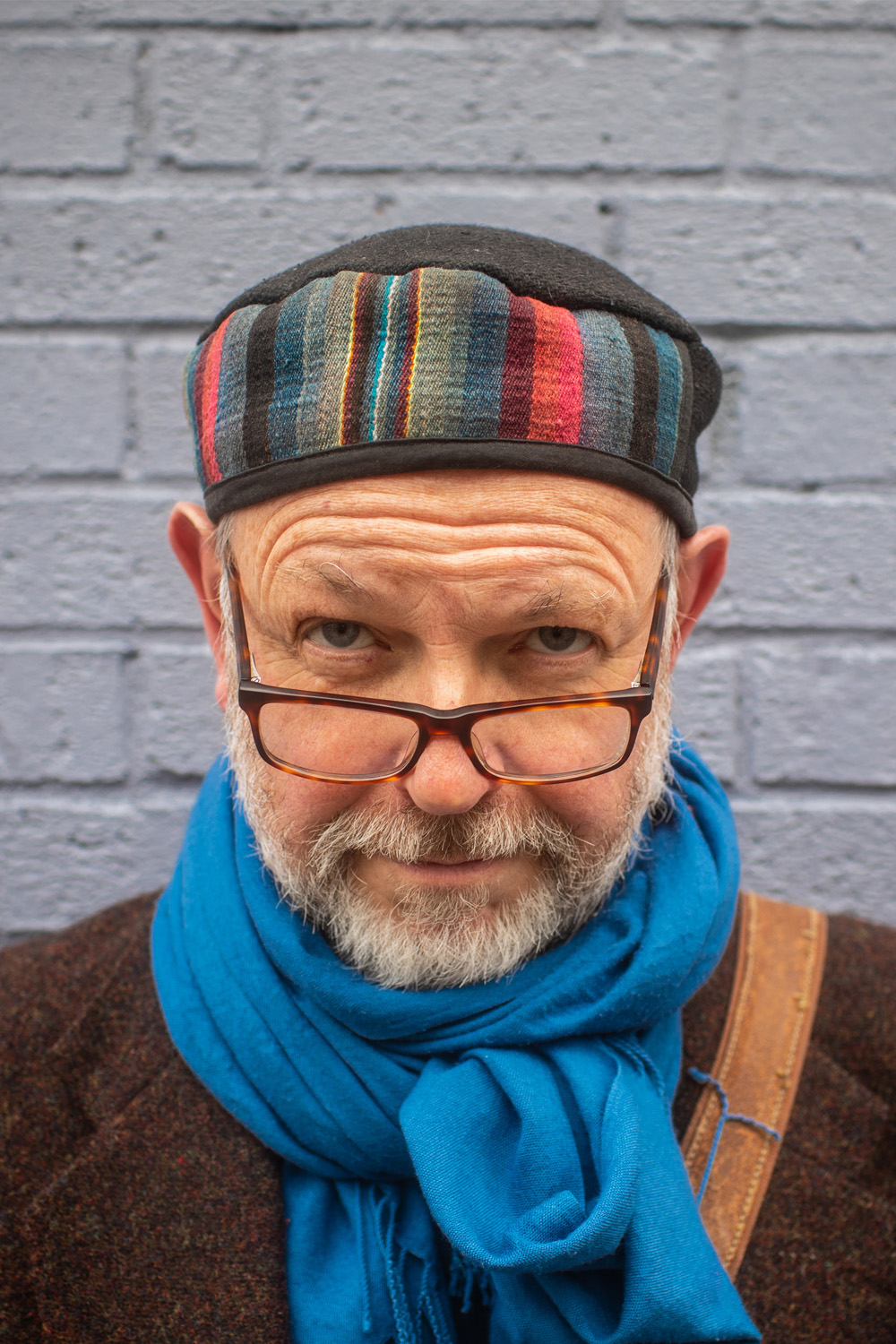
FS: Honestly, no. I had the advantage of getting well-known before I outed myself, and people who liked my work went on liking it. Very occasionally I come across someone who thinks I must be a representative of darkness, shame, superstition and unreason, but mostly people seem content to see my faith as an amiable personal quirk, like my hats.
BB: Is there a parallel between an act of faith and how Iris takes risks, continually stepping into the unknown?
FS: Kind of. What Iris has to face on the dangerous, sometimes terrifying journey to Nonesuch draws on both sides of who she is: Iris the analyst, the strategist, the calculator of opportunities, and also Iris the greedy, the reckless, the taker of short cuts, the connoisseur of unsuitable men. (Until she meets Geoff.) Leaps of faith call on people’s whole histories, not just their tidy virtues.
BB: Does Nonesuch have an underlying Christian message, comparable to Narnia?
FS: With Nonesuch I wanted to re-imagine Christian cosmology, as C S Lewis, Tolkien and ‘The Inklings’ of 1940s Oxford did, but without the sexism or bachelor distaste for women’s lives. Lewis famously left his character Susan out of the Narnia books’ happy ending, for being too interested in ‘lipstick and nylons and invitations’. Iris is very interested in all those things, though she’d rather be wearing silk if she can get it. It is not an accident that her middle name is Susan. But as a writer, you need to make sure the reader can ignore any theological subtext and still feel that the story makes a complete whole. So Nonesuch does have some Christian stuff going on, but I’ll leave it for readers who want it to discover on their own…
BB: Nonesuch and your earlier novels Light Perpetual and Cahokia Jazz are preoccupied with what-ifs and sliding door moments. Why are you interested in the idea of stopping or refracting time?
FS: We live in time. We can’t help it. We travel forward ceaselessly into the future, second by second till death stops the clock. But our experience of time is much more complicated and contradictory. Time speeds up and slows down, aligns into intense significance for the three minutes of a song or blows by unmeasured in weeks of indifferent white noise. Memory selects the past, rearranges it, loses it, finds it again, stitches together moments years apart to make new meaning. There are ways in which only fantasy can do justice to parts of how we feel time, to show us directly the what-ifs that invisibly surround our lives. Fantasy ain’t true, but it is true to our nature.
BB: Was the redemption storyline of Nonesuch fuelled in any way by the loss of your sister and your sense of powerlessness over her fate?
FS: Not consciously, though there are parallels in the story. I lost my little sister when she was 20 – to a genetic disease that’s now essentially curable – though I never let myself long to go back in time and change her fate. It would be too painful. But I needed Iris to have something inside her that was broken and never mended, and I suppose I reached for what I know. Sisters. Brothers. Mortality. Once you’ve had it happen, it’s permanent material. Part of the world’s gravitational field. I haven’t seen my sister in thirty-six years, and I miss her.
BB: If you could go back in time, what would you change?
FS: Leaving aside the big, painful, real junction points of my life, and also the daydreams in which I use a Tardis to drop off antibiotics for John Keats and the Bronte sisters – I wish I’d dared to start writing fiction twenty years earlier, at thirty instead of fifty. So much to write now, so little time
BB: Iris’s quest in Nonesuch involves releasing angels trapped in stone. Is there a parallel sense of human spirits trapped in our bodies?
FS: If anything I was going for a contrast. Our bodies are not envelopes in which we are trapped, they are us, and our souls, if you want to use that language, are our essential forms, the us-ness of us, which necessarily reflect all the bliss and sorrow of which the body is capable. But the angels of Nonesuch, as I’ve imagined them, are genuinely bodiless. They are clouds of spirit-particles, travelling free together like murmurations of birds. And for them, being forced into a body is entrapment; it’s being enslaved and controlled and held down by hideous and unnatural weight, like being dressed in lead clothes would be for us. Rapey; horrific. The statues they animate are stone prisons for them, and they are understandably angry about it.
BB: Is it significant that Iris’s guiding angel, Raphael, is a protector and healer in Islam and Judaism as well as Christianity?
FS: Yes, but also because in Christian (and Jewish and Muslim) folklore he’s the one of the big three archangels who isn’t associated with telling Mary she’s pregnant (Gabriel) or fighting the war in heaven (Michael). Therefore he (or she, or it) was available for the story I wanted to tell. I put out a casting call, and Raphael turned up, shining blue and inducing headaches by being fractal and kaleidoscopic and impossible for the human eye to grasp.
BB: When did you realise you had the storytelling gift?
FS: I know I have a very story-shaped mind. Ideas interest me because of the possible stories in them; I read history looking for a kind of story-logic; my curiosity about other people comes out in stories. When I was a non-fiction writer, I was a very storytelling one. But I didn’t dare to start producing completely invented stories until quite late on, and even now I sometimes trip myself up and fall back into a nonfictional deference to what really happened. Then I have to remind myself – I did when I was writing Nonesuch – that I’m allowed to take what I’ve learned about television in the 1930s, and wartime finance, and daft occultism, and make new irresponsible things out of them. Well, ‘irresponsible’. Responsible to the kind of truth-telling story does, not to the kind we want from history.
BB: Nonesuch gave me the bliss of total absorption that made me a bookworm as a child. Which fantasy writers take you to that place?
FS: My head’s full of all the classical names – Ursula Le Guin, John Crowley, Guy Gavriel Kay, Diana Wynne Jones, Philip Pullman – but this, right now, is also a very good moment for new fantasy, and you can put me down as a devoted fan of Alix Harrow, Kelly Link, Tamsyn Muir and (obviously) Susanna Clarke.
I’m delighted Nonesuch returned you to that early state of reading bliss. It’s how I read as a child and as a teenager and it still seems to me the fundamental goal of any book: to transport the reader by being so rich and vivid that you forget time, bills, obligations, tasks, and look up from the page to find it’s two in the morning.
BB: Which other novels have given you a portal into understanding life in a new way?
FS: Many, over the decades. In my 20s, Alasdair Gray’s 1982, Janine, in which redemption and change turn out to be possible within a gross and comic hellscape of a mind. In my 30s, Pat Barker’s Regeneration novels got me thinking about masculinity, as a thing in itself and not just a default state for human beings. Then in my 40s, Penelope Fitzgerald in The Blue Flower and The Gate of Angels, gentle and merciless at the same time, showed me that the tragic and the comic come hopelessly twined together in life. In my 50s I found George Eliot again, and learned from Middlemarch that the idea of a novelist being able to sympathise with absolutely all of her characters might be impossible but wasn’t absurd. And through my next ten years, I can see that Jane Gardam’s Old Filth trilogy is going to keep me company.
BB: The historical rise of fascism in the 1930s that you describe in Nonesuch reminds us of the alarming resurgence of the far right now, in the 2020s. What key lesson from the past has been missed?
FS: Oh God, take your pick. That fascism doesn’t have to make sense as an ideology, it just has to hoover up a mass of resentments into a narrative of blame. That fascism wants everyone to sink into passivity and perceive it as inevitable because its symbols are saturating public space, like swastikas on public buildings and St George’s flags on every roundabout. That fascism is defeated not by argument but by a sufficiently powerful counter-story of hope and decency and laughter.
BB: Has anyone bought film rights to your novels?
FS: Golden Hill has been optioned. Nobody’s picked up any of the others yet – cough, hint – but I think they already work on the page in a film-like way. Nonesuch isn’t quite so explicitly built like a movie as Cahokia Jazz, which I wrote as if I was transcribing a black-and-white gangster flick just for me. But I was able to see every scene of Nonesuch while I was working on it, shot by shot, frame by frame, angle by angle. The thick shadows of the blacked-out streets, the falling pink flares of incendiary bombs, the bias-cut silver sheath of Iris’s mermaid dress. Oddly, I usually don’t have a very definite sense of the characters’ faces. I’ve been living them from the inside. I know what they are like, not what they look like. So I don’t do imaginary casting while I’m writing. It’s something to daydream about afterwards – and now I have a gallery forming in my head of elfin blond men to be Geoff, and decisive, determined-looking women to be Iris, gazing at the world and liking what she sees.
BB: Are you glad to have the chance to stay with Iris in the sequel, and when will it be out?
FS: When I’ve finished Arcady, the sequel to Nonesuch, I will miss the imaginary company of Iris and Geoff, and particularly Iris, more than I can say. One of my discoveries, after daring late on to write novels, is how the characters live in your head all the time you’re writing. Not just when you’re at a desk, with your fingers on a keyboard or on a pen. All the time, as noisy and distinctive presences. When you finish, there’s relief and satisfaction, but also a kind of grieving, because suddenly they’re gone. Arcady should be finished some time in 2026 and be out in 2027. And that’ll be great, but also… sad.
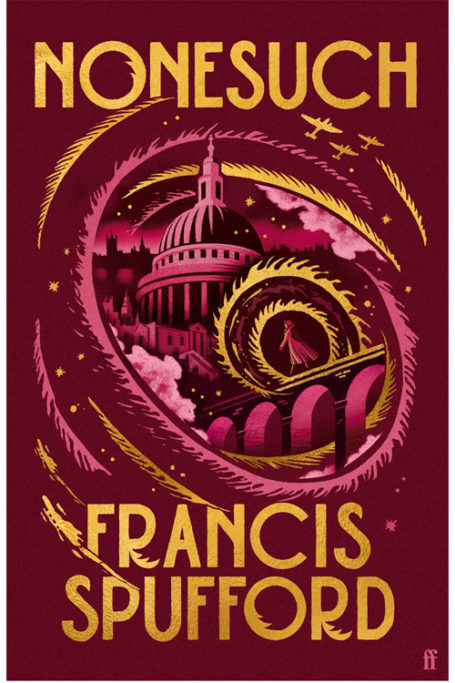
Nonesuch by Francis Spufford
Faber & Faber, hardback, £20