



Celebrities Are Becoming Death Doulas – But What Does That Mean?
By
5 months ago
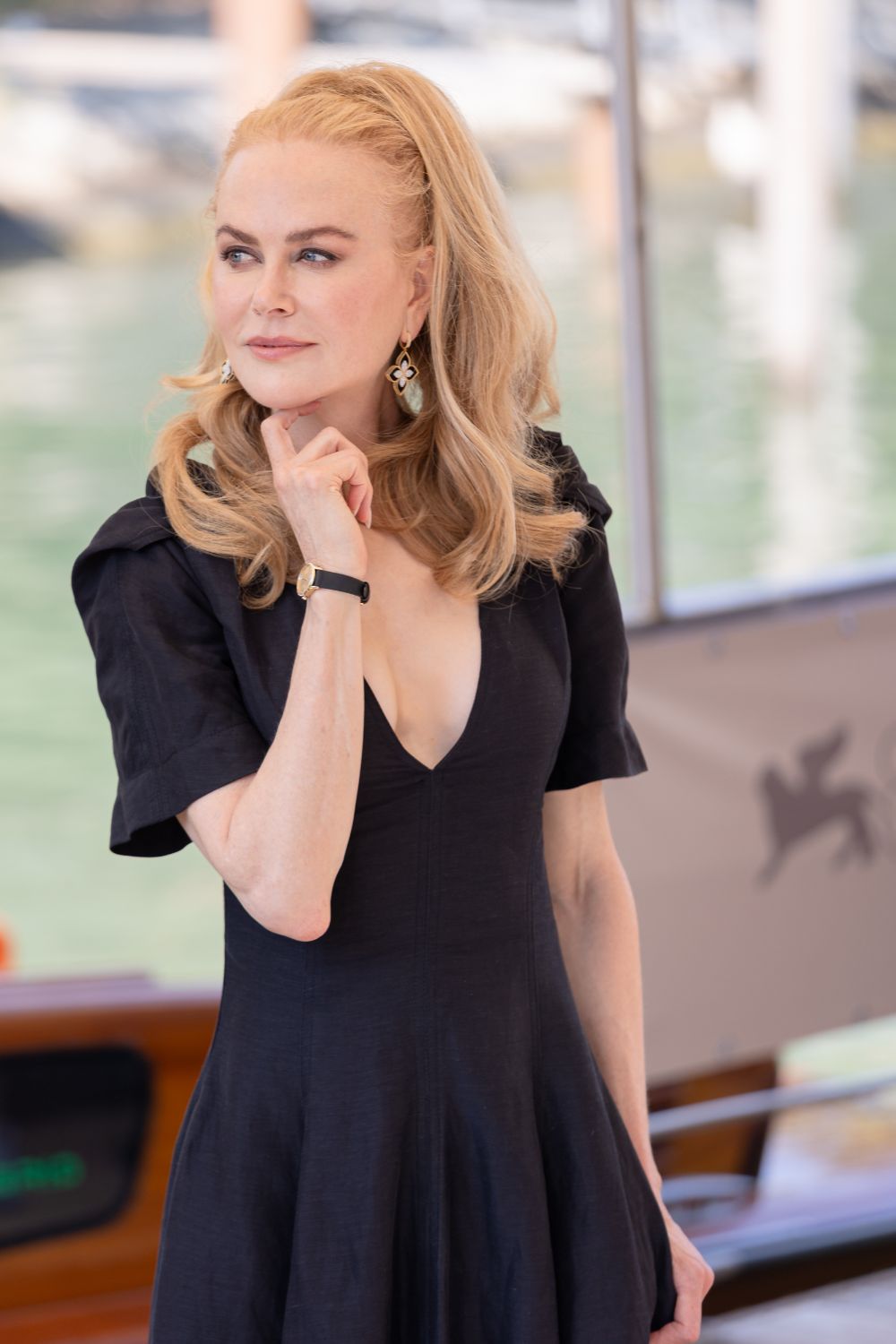
Nicole Kidman is the latest star to become a death doula
The chairs were arranged in a horseshoe and a grieving family filled them, all eyes turning to the young woman who had just walked through the hospital door. In 2018, 27-year-old Dr Emma Clare had just days of training under her belt and felt her stomach drop.
She had almost talked herself out of coming. Someone had seen her post on social media about a foundation course she’d just completed in end-of-life doula training and reached out to her out of the blue. Their dad was dying in hospital and they asked her to come and sit with them.
She had said yes, feeling ‘like a fraud’. But sitting at the head of that horseshoe, she discovered something that would reshape her entire life. The family needed someone to listen and to hear what each of them was carrying, to answer the questions no one else had thought to address. Why had their loved one stopped eating? How do they sort out their finances? Simple things, human things, that the medical system had left hanging in the air.
‘That’s the whole point,’ Dr Clare says. ‘You’re not an expert. You’re just another human being.’
Dr Clare is now a chartered psychologist and chief executive, of End of Life Doula UK. She is also part of a movement that is suddenly going mainstream.
Death Becomes Her
Image courtesy of Omega
Last month, Nicole Kidman revealed she had trained as a death doula following the loss of her mother Janelle in September 2024. Speaking at the University of San Francisco, the Oscar-winning actress described how she discovered she had the temperament for the role, and spoke about her desire to help others through the pain she had experienced herself.
She told journalist Hoda Kotb at a HISTORYTalks event: ‘It’s really fascinating, it’s very beautiful, and you have to be a certain personality to be able to do it, but I found out that I’m actually that personality.
‘It’s very important to me,’ she continued. ‘There is always suffering in life, right? But if there [are] people there who can help with that and can help those final stages be less painful, you can feel the connection and the love, then that is a lovely thing to be able to do. So that’s what I’m exploring.’
Kidman definitely wasn’t the first and probably won’t be the last powerful woman to turn her attention to those at the end of their life. Granddaughter of Elvis Presley and Daisy Jones and the Six star Riley Keough completed her training to become a death doula in 2020 after losing her brother. Chloé Zhao, director of Hamnet and Nomadland also completed her training earlier this year, telling the New York Times that she has been ‘terrified of death [her] whole life… And because I’ve been so afraid, I haven’t been able to live fully. I haven’t been able to love with my heart open, because I’m so scared of losing love, which is a form of death.’
For Kidman, it was her own experience of grief that inspired her to help others. ‘As my mother was passing, she was lonely, and there was only so much the family could provide,’ Kidman said to the San Francisco Chronicle. ‘Between my sister and I, we have so many children and our careers and our work, and wanting to take care of her because my father wasn’t in the world any more, and that’s when I went, “I wish there was these people in the world that were there to sit impartially and just provide solace and care”.’
What Does A Death Doula Do?
Though the term is now dominating headlines, the role itself is harder to define than you might expect. Dr Clare describes it as ‘filling the gaps in people’s existing support network’.
What those gaps look like depends entirely on the person. ‘They might have lots of friends and family they can talk to when they’ve been given a terminal diagnosis or maybe they’re just in later life and they’re starting to think about death. Or maybe they have lots of people who can rally around and do practical things. There’s lots of admin that comes at a really bad time towards the end of life and still all the practical things that come with running a house,’ says Dr Clare. A doula steps into whichever of those spaces is empty. They are connectors too, pointing families towards other services when a need falls outside their remit.
At an already overwhelming time, families can find themselves navigating advance care directives, power of attorney arrangements, NHS systems, funeral home paperwork, and decisions around burial or cremation, often simultaneously and with very little guidance. A doula can help decipher all of it.
For Dr Marian Krawczyk, an anthropologist and programme lead for the End of Life Studies MSc at the University of Glasgow, this is an underappreciated part of the role. ‘It’s not just about the emotional support or the accompaniment or even the spiritual needs,’ she says. ‘Often it’s these very technical bureaucratic aspects that need support that people just don’t know about. You have to know how to navigate multiple systems and end of life doulas are emerging within exactly that context.’
The Call To Care
Spending day after day in the presence of people who are dying may seem emotionally overwhelming. It’s natural to wonder why anyone would choose this path. Yet for many doulas, their work is often shaped by their own encounters with loss and grief.
Dr. Krawczyk’s journey reflects this reality. As she explains: ‘I think I come to it the same way everybody else does – personal experience. When I was younger, my sister died when she was 30 from cancer, and she died in a palliative care ward, which was still somewhat uncommon, because I was in the mid 90s. This was in Vancouver. And then, a few years later, my brother also died from cancer, and he was American and living in the States, and he died in a high intensity care unit, and so, those experiences were very different and I think as a way to better understand my own experiences and my own grief.’
Her experiences highlight the impact that end-of-life care environments can have, not only on the person who is dying but also on their loved ones. The doula training programme allowed Dr Clare to reflect on how easily people drift through life without pausing to question what really matters, describing a culture defined by urgency and disconnection: ‘It enables people to live more authentically. I think it’s so easy in our society as well. You just get swept along, don’t you? Like there’s a lot of urgency and a lot of rushing and a lot of not really being present with things and not thinking about your wider life is how I am living aligned with my values and how I want to live and thinking about your mortality.’
Dr Krawczyk adds that this reflects how people are trying to make sense of death outside of medical settings. ‘We don’t, I think, collectively want dying to be just a medical event,’ she says. ‘It’s a social event.’ She notes how people are increasingly looking for guidance to help make sense of something that can otherwise feel opaque and overwhelming.
Dr Clare echoes this, challenging the idea that end-of-life care belongs primarily within institutions. ‘We think that dying is a human, community, social event with a very important medical component that needs supporting – not the other way around,’ she says. In reality, she points out, most of a person’s final months are spent away from formal services. ‘Ninety-five per cent of the time they are with their friends, their family, their pets, their faith groups, or community groups. And that’s the space that doulas work in.’
It is also a space that cannot easily be replicated by systems alone. ‘No matter how much money you throw at services, they can never fill those gaps,’ she says. At the end of life, what people seek is connection, something that by its nature resists being formalised.
The Kidman Effect
Within the world of death doulas, Nicole Kidman’s decision feels both significant and in some ways entirely familiar. ‘It’s great for our movement to have awareness there,’ says Dr Clare. ‘Because I do think that a lot of people would benefit from our role, they just don’t know it exists.’
Historically, the profile of a doula has been quite fixed. Dr Krawczyk explains how the movement particularly in the UK, US and Australia has largely been made up of ‘older, white, relatively well-to-do women’ (much like Kidman) albeit with some notable exceptions, including author and well-known death doula Alua Arthur.
‘Talking broadly, most people that do the role are women,’ Dr Clare notes, ‘about 10 percent of our membership are men. But it is changing.’ Dr Clare hopes that the increased number of men training as doulas reflects something wider. ‘I hope it’s a reflection of that just changing more broadly — to recognise that caring is a human thing, not a gender-specific thing.’ It is also beginning to broaden in other ways. “I do think younger women are being drawn to it more now,” Sr Krawczyk points out
If the people are changing, so too is the visibility. And this is where Kidman’s impact has been immediate. ‘We had a big spike during the pandemic,’ says Dr Clare, ‘of people both needing support and wanting to become a doula. And this Nicole Kidman spike is the second big one we’ve seen. Since she said that… we’ve had probably a month’s worth of enquiries in four days.’
For Krawczyk, this is the effect of visibility. ‘Every movement needs spokespeople, whether intentional or not.’ Alongside names like Riley Keough and Paris Jackson, Kidman’s involvement suggests the movement may be reaching a cultural tipping point. ‘We’re humans and humans are social creatures,’ she says. ‘When we see what appears to be desirable… that gives validity.’
Kidman represents a very familiar story, just from a very visible perspective. She’s someone standing at the edge of loss and deciding to step towards it, rather than away.