


‘It’s About Choosing Life’: Monica Dolan On Her New Parkinson’s Film Onwards & Sideways
By
26 minutes ago
We caught up with the actress to talk Parkinson's, parking scenes and why she'll never switch off The Holiday
You’ll know Monica Dolan’s face, even if you can’t quite place her name. The BAFTA-winning actor has stolen scenes in everything from A Very English Scandal to W1A, and there’s much more in the works.
There’s Elsinore (out on 29 January, and starring Andrew Scott), the Oscar-pipped tale of Ian Charleson’s Hamlet performance while dying from AIDs. Then there’s The Lost Children of Tuam, the chilling and horrifyingly true tale of amateur historian Catherine Corless, who discovered that the bodies of 796 infants and young children who had died in an Irish children’s home had been abandoned in an old sewage tank rather than treated to a proper burial.
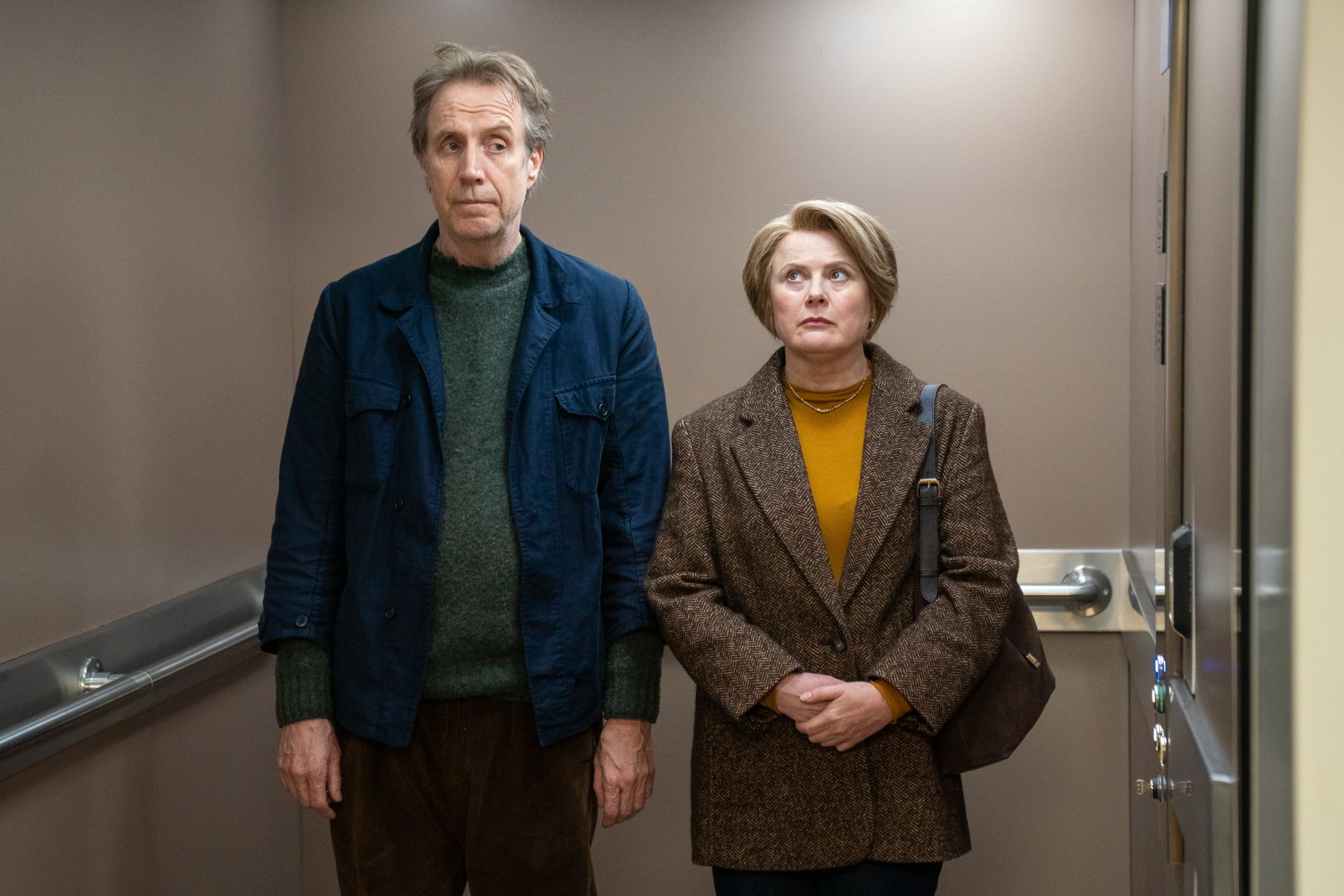
The newest release is Onwards & Sideways, directed by John Madden (Shakespeare in Love) and written by Paul Mayhew-Archer. It follows two strangers, played by Rhys Ifans and Laura Linney, who meet on the day they are both diagnosed with Parkinson’s. From that point on, an unexpected friendship unfolds, offering both humour and emotional depth in equal measure.
Dolan plays Liz, a tactless but big-hearted presence with a surprising side. We caught up with the acclaimed British actress to find out more about her new role.
Q&A: Monica Dolan On Onwards & Sideways
Hi Monica, can you give us an elevator pitch for Onwards & Sideways?
It’s about two people – one’s a music composer, and one, played by Rhys Ifans, is a deputy headmaster – who meet on the day they’re both diagnosed with Parkinson’s disease. They have quite different attitudes to it and to how to manage it, and it’s the story of how they do that, and of their friendship.
It’s a story about human connection, but I also found it very optimistic. It’s to do with keeping your brain alive – mental health as much as anything else. Lighting up the parts of your brain keeps it growing for all of us, but even more so if you’ve got Parkinson’s. They do that through dance and different activities. It’s about choosing life, I guess.
How would you describe your character, Liz? How did you go about building her?
Very quickly, because I’d just come off another film! But when I read the script, I instantly thought, ‘I know exactly who Liz is.’ She’s tactless and very caring, but unthinking. Then, about two-thirds of the way through the film, a whole other side of her is revealed, which was very interesting to shoot. I love it when characters surprise you, and Liz certainly surprised me with what she’s able to see.
When I first read it, I thought, this is a really unusual film – I don’t quite know how to place it. Then, as soon as I finished, I burst into tears. When I had my meeting with John Madden about playing Liz, he said that was quite a common response. I think there are a lot of films lately that don’t really take us by surprise. Too many people have read books about how to write a film, so truly surprising films are quite rare.
The film has real weight and sadness, but also moments of lightness, hope and community. How did you find the balance between the two?
A lot of that is down to the director and the writer collaborating well and knowing the tone before you start. You take your guidance from the director, and there is no better director than John Madden.
Then it’s about playing the truth. Sometimes the truth might be extreme and you can go further with it, but if you’re playing the truth and it’s well written, the comedy and the sadness will come out. Paul Mayhew-Archer is the best artist-craftsman at writing situation comedy. Rather than something built on gags, a situation can be funny or sad from moment to moment – it just changes. His writing is nuanced, so you just follow it.
What research did you do? How familiar were you with Parkinson’s going in?
I wasn’t familiar with it at all. There were people with Parkinson’s contributing to the film on camera and off, and Laura Linney and Rhys Ifans, who I loved spending time with, had to do an awful lot more research than me.
The thing about Liz is that she doesn’t know much about it at the beginning, so if you’re on a journey with her, you’re learning as you go. If I’d known all about Parkinson’s beforehand, it wouldn’t have been that helpful – a lot of the time she’s learning about it while making assumptions and having preconceived ideas.
The main thing I had to do, quite quickly, was learn to speak reasonably like Rhys, because our characters come from the same place, and I’d just come off a film where I had a West of Ireland accent. Rhys actually came to my dialect session on Zoom to help, and he recorded all my lines for me. He was incredibly busy, so that was enormously generous of him.
What was the atmosphere like on set? Did the mood shift between the sadder and lighter scenes?
If it doesn’t affect the mood, then there’s a problem – because that is the mood. You’re creating an atmosphere, and with John you feel very included. I know that’s an odd thing to say, but when he’s directing you it feels really personal, intimate and very caring. You feel quite fathered. You feel very safe.
He’s also extremely subtle. He’ll have you playing with tiny nuances. He would develop small things, not necessarily things everyone else in the room could hear. You feel like you’re having a really special moment of creativity, which makes you less self-conscious. You’re working on something in a very delicate way with someone who cares so much about what they’re doing and is so good at it.
Are there any standout moments from filming you’d like to share?
Sometimes you have to do quite technical scenes, like parking a car in a particular place. We spent at least a day – it might have been two – in a hospital car park, and in real life hospital car parks are really awful! I think it was one of my first scenes. I was driving Rhys’s character to the hospital, trying to find a parking space, then getting out and having a big argument with Laura.
It all looks the same in a car park, but you’ve got to end up in a particular place, and there was a lot of waiting around because sometimes there were stunt drivers. Then you have to be really ready to let rip and lose your temper. I had a fantastic chat with Laura in the tent while we waited. It was really fun to play because you can let go, but you have to concentrate on your driving. You think, ‘I really nailed that’, and then someone says, ‘Oh, you forgot to put your seatbelt on,’ and you have to do it all again.
How do you live a life in balance?
It depends on the production. On this one I felt incredibly well looked after and very safe. When I saw it was John and Hilary, I thought, ‘I’m really going to be taken care of’. It’s much easier to switch off when you’re not worrying about things that are probably someone else’s job to worry about. I absolutely loved switching off there. I had a couple of days’ break between two lots of filming, so I stayed in Norfolk by the beach. Everything about where we were staying was relaxing, and the people were kind – you don’t always get that.
I know productions need to save money, but it really is something to be valued. If actors feel safe and looked after, they feel like they can play; otherwise, you’re a bit nervous. The other actors were staying in the same place too, and as soon as I’m with other actors, I feel okay. They’re my tribe.
Anything else in the pipeline you can tell us about?
Apart from Onwards & Sideways, I’ve got two other films out. The main one is The Lost Children of Tuam, which is on general release at the moment. I play an extraordinary woman called Catherine Corless. In 2014 it came out in the news that nearly 800 babies had been found in a sewage tank in the west of Ireland. She was doing an evening history class, was asked to research a local topic, and thought, ‘Oh, I’ll do the old mother and baby home’ – and that’s what she discovered.
The other is Elsinore. The thing I love about it is that it really celebrates actors. Sometimes we get a bit of bad press or get trivialised, and it just really celebrates them. It fills my heart. I went to the premiere with Linda, who I play, so that was a really lovely evening.
What Monica Dolan Is Loving Right Now
I’m currently watching…
The Celebrity Traitors, of course.
What I’m reading…
Careless People, which is about Facebook – a fascinating read. I’m also reading Kidnapped by Robert Louis Stevenson, which I got free on Kindle. Every night I take the dog out for a wee for exactly six minutes, and I read during that. I used to do social media at that time, but now I read. It’s in very tiny bursts, but it’s very earthing and really helps you relax.
The last thing I watched (and loved) was…
Two films at the London Film Festival: Clio Barnard’s I See Buildings Fall Like Lightning, and Carol Morley’s Seven Miles Out. They’re both directors I absolutely love and have worked with before.
What I’m most looking forward to seeing…
Heart of the Beast, the film with Brad Pitt. A friend sent me the trailer and said it made him think of me and my dog Velma, so I’m planning to go to the cinema with him. I’d love to see it with Velma in the room! I’m sure it’s a great film, but partly it will just be a nice evening.
Favourite film of all time…
Today, I’m going to say The Mission.
Favourite song of all time…
‘Love and Affection’ by Joan Armatrading.
An artist I always have on repeat…
That’s a difficult one. I quite like Burt Bacharach.
My ultimate cultural recommendation…
Everyone should see The Square.
Cultural guilty pleasure…
Whenever The Holiday comes on TV, whatever time of year, I have to carry on watching it until the end.
Onwards and Sideways will be released in UK cinemas from 6 November and will air on BBC iPlayer and BBC One later this year.