


Why Are Non-Religious Parents Sending Their Children To Catholic School?
By
52 minutes ago
Atheist families are embracing these traditional schools with open arms – but not for the reasons you might think
An apocryphal tale once circulated in Catholic public schools about a headmaster’s conference. The headmaster of Eton proclaims: ‘We educate our boys for life.’ A second headmaster, shrouded in capacious black robes, rises. ‘At our school,’ he announces, ‘we prepare our boys for death.’ That headmaster was a Benedictine monk, reputedly the head of Ampleforth College, the North Yorkshire boarding school often labelled the ‘Catholic Eton’.
The days of the monk headteacher, following public scandals involving Benedictine Catholic boarding schools, are long over – and no longer do Catholic public schools only educate Roman Catholics. At Ampleforth, for example, 65 percent of its 415 students are Catholic. Matthew Burke is chairman of the Catholic Independent Schools’ Conference (CISC) and head of Beaulieu Convent School in Jersey. ‘It is the third school I have led, and about 30 percent of pupils are Catholic. That is among the highest numbers,’ he says.
This change reflects new openness in the church to other faiths post Vatican II, the council that modernised Catholicism in the 1960s. Today, pupils of all denominations attend schools founded in Europe to educate English Catholics whose faith was outlawed in post-Reformation England. Up to the age of 16, these Catholic schools are obliged to devote ten percent of curricular time to the study of religion; at GCSE, this includes teaching about Islam, Judaism and major world faiths.
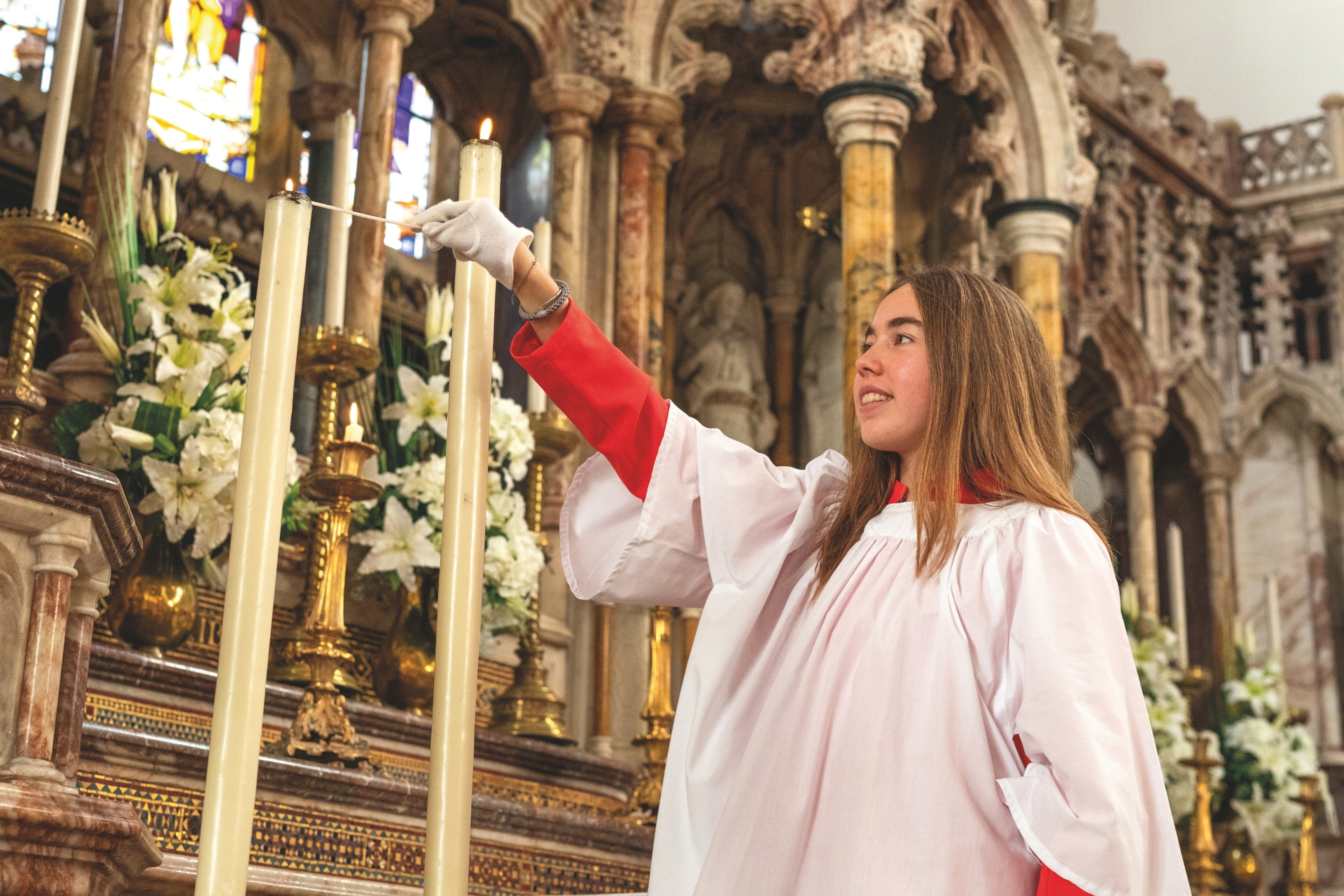
All 687 pupils at Stonyhurst – whether Christian, Muslim or non-believers – engage daily in the Examen
What’s The Draw?
For non-Catholic parents, one of the appeals of a Catholic education is that schools impart ‘a sense of right and wrong’, says Burke. That moral compass, he adds, is ‘anchored in something that has been around for centuries rather than the character of individual headteachers’. Essentially, ‘Catholic education is values-driven. It’s an education of the whole person’. What does that mean? ‘We are not simply looking solely at academic outcomes [but rather] the type of person a child might become.’
‘Quant je puis’ – ‘as much as I can’ – is the motto of Stonyhurst College, whose former pupils include Sir Arthur Conan Doyle, inventor of Sherlock Holmes; Sir Mark Thompson, CEO of CNN; and professional cricketer Liberty Heap. Nestled in Lancashire’s Ribble Valley, Stonyhurst has a ravishing setting: a 16th-century, Grade I-listed entrance building is reached via a long drive flanked by lawns and lakes. When French revolutionaries compelled the priests of the Society of Jesus – better known as Jesuits – to leave the school they had founded in Saint-Omer in 1593, they resettled at Stonyhurst Hall, the property of their alumnus Thomas Weld. Jesuit priests no longer teach or govern Stonyhurst or its prep school St Mary’s Hall, but all 687 pupils aged three to 18 – whether Christian, Muslim or non-believers – engage daily in the Examen, a reflective practice developed more than 400 years ago by the Jesuits’ founder, St Ignatius of Loyola.
‘It is a time just to stop and be still which, on a very basic level, is important for wellbeing,’ explains Fr Christopher Cann, headmaster of Stonyhurst St Mary’s Hall. ‘For Christians, the Examen means reviewing the day with God. Jesuits believe God is in all things.’ For the non-Christian, it is a time for self-review: what are pupils grateful for? What has gone well so far that day? What might they improve tomorrow? This reflective pedagogy permeates the classroom, where lessons frequently deploy artefacts from Stonyhurst’s on-site museum. Treasures include Shakespeare’s First Folio – of which only 235 still exist globally – and Mary, Queen of Scots’ prayerbook.
Ultimately, the school aims to form compassionate global citizens. Pupils engage in charitable initiatives and partnerships with Jesuit communities in countries such as Mozambique and Zambia – experiences that ‘really do set young people on fire, giving them a sense there is a deeper meaning to life beyond themselves,’ says Fr Cann.
Community And Morals
Some 220 miles south is Downside School in Somerset, which can trace its origins back to 1606 when exiled English and Welsh monks founded the Benedictine community of St Gregory the Great in Douai, France. In 1814, they moved to Stratton-on-the-Fosse and the remaining monastic community departed Downside Abbey just over 200 years later, in 2019.
Like Ampleforth, Downside’s ethos derives from The Rule of St Benedict, a sixth-century guide to God-centred community living. ‘“Listen carefully” is the first line of The Rule,’ says Mike Randall, interim head of Downside. ‘Listening is the start point of a Benedictine education.’ In an age of social media intolerance, ‘pupils are encouraged to listen to one another in discussions; not to listen to respond, but to listen to understand. That allows them to engage thoughtfully with ideas,’ says Randall, who gives a copy of The Rule to every new member of staff. He wants its principles – humility, patience, responsibility – to ‘translate naturally into the classroom’.
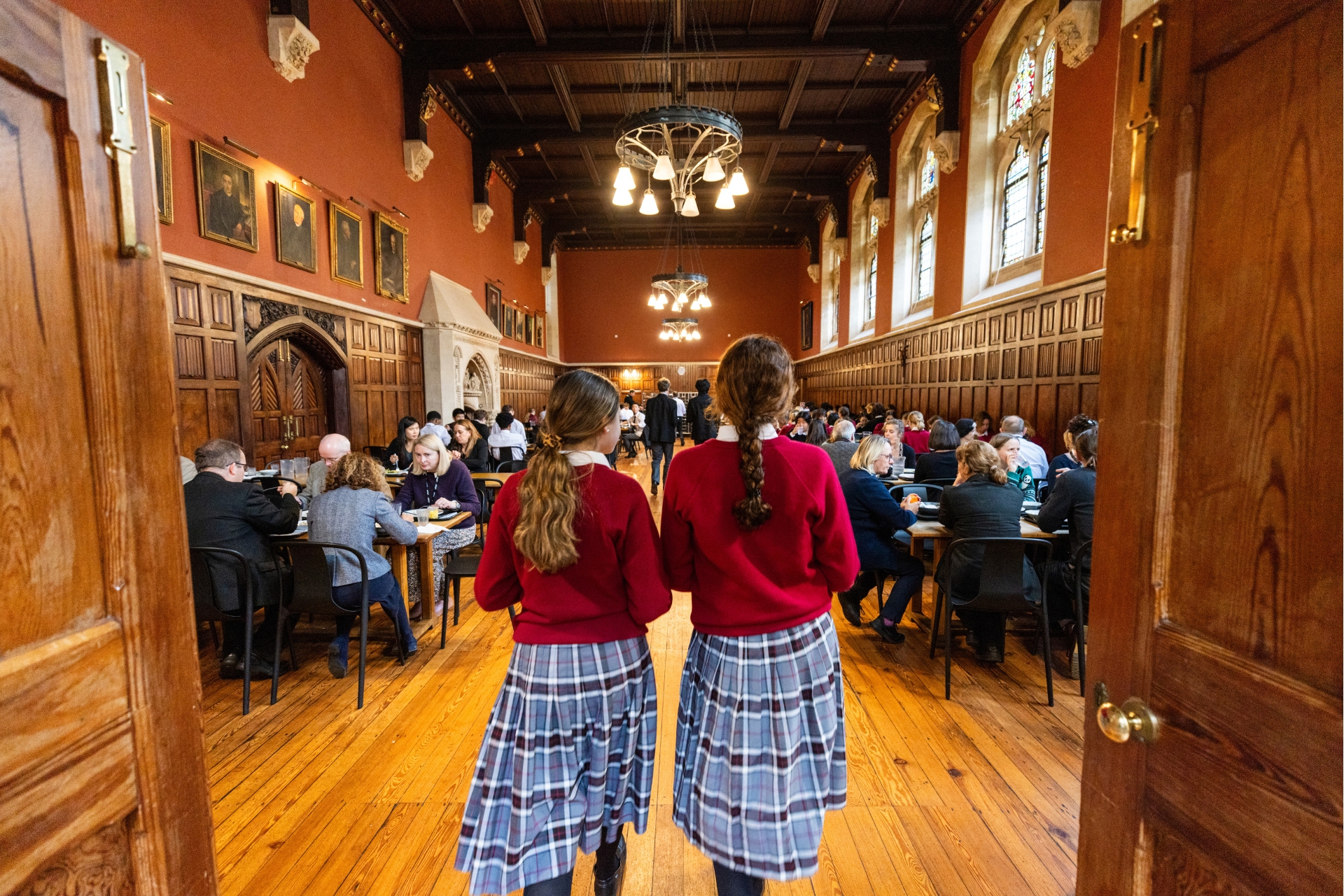
Almost half of Downside’s 300 pupils are non-Catholics
Almost half of Downside’s 300 pupils are non-Catholics, and their parents say that they value ‘the calm rhythm of the school life’. A third voluntarily lead Lectio Divina (‘divine reading’) groups reflecting on passages from the Bible, and 70 percent of the boys and girls are boarders. ‘The world can feel fragmented for young people,’ says Randall. ‘Families appreciate Downside’s clear moral framework and sense of community.’ This is one in which a book is placed by the bedside of every new pupil by the school librarian, older pupils join a soup run for the homeless in Bath, and those of all ages deliver reflections in the abbey church.
Downside, which is non-selective, is in the top one percent of UK schools for value added at GCSE and in 2025 was in the top five percent at A level. At its Benedictine peer in North Yorkshire, Ampleforth, there is no one type of pupil, observes head Jon Mutton. At his school, pupils learn about ‘who they are [and] what gifts and talents they have to offer to this world’. No longer governed by monks, Ampleforth is operated through a trust separate from the monastery. Safeguarding is a priority at the school; all those who teach there, including Benedictine monks, must pass DBS checks. ‘We are a monastic school,’ says Mutton. ‘Sunday Mass is the highlight of the week.’ Leavers often report they will miss the ‘stillness’ of Ampleforth Abbey Church, where the monks gather daily to pray in Latin.
A ‘Beacon Of Hope’
Ampleforth recently surveyed parents of non-Catholic students who previously attended other boarding schools. ‘The strong emphasis on religious teaching set the tone for what parents were looking for,’ Mutton says. ‘There is less pressure here than in schools that have a big focus on exam league tables. We never see our students as commodities.’ For some parents, that is ‘a beacon of hope’, he adds.
In west London, St Philip’s School educates boys aged four to 13 in a culture of ‘strong, clear and timeless’ values, says headmaster Alexander Thomas. St Philip’s opened in 1934 at the request of priests from the Brompton Oratory in Kensington, with whom the school still retains informal links and where several pupils sing weekly as part of the Oratory Junior Choir. Today, two-thirds of the 100 pupils are non-Catholics and the school’s traditional values ‘unashamedly’ based around the family draw parents of all beliefs and none, says Thomas. ‘It’s a nurturing place,’ he says. ‘Boys require boundaries and confirmation of what is right and wrong. But there needs to be more carrot than stick. Young boys respond very well to encouragement.’
Each boy is encouraged to ‘commend’ other pupils for kindness. ‘There’s a strong moral code here,’ says Thomas. House captains are selected based on good behaviour, and pupils must apply in writing for roles as reading prefects, who foster younger boys’ literacy. Twenty percent of the timetable is devoted to sport in the school’s 30-acre playing fields in Barnes. ‘Boys need to get outside and run off their energy if you are going to get them to focus in the classroom,’ adds Thomas. ‘Fun’ is a core school value; after all, the school’s patron saint, Philip Neri, founder of the Congregation of the Oratory, was famed for his love of practical jokes.
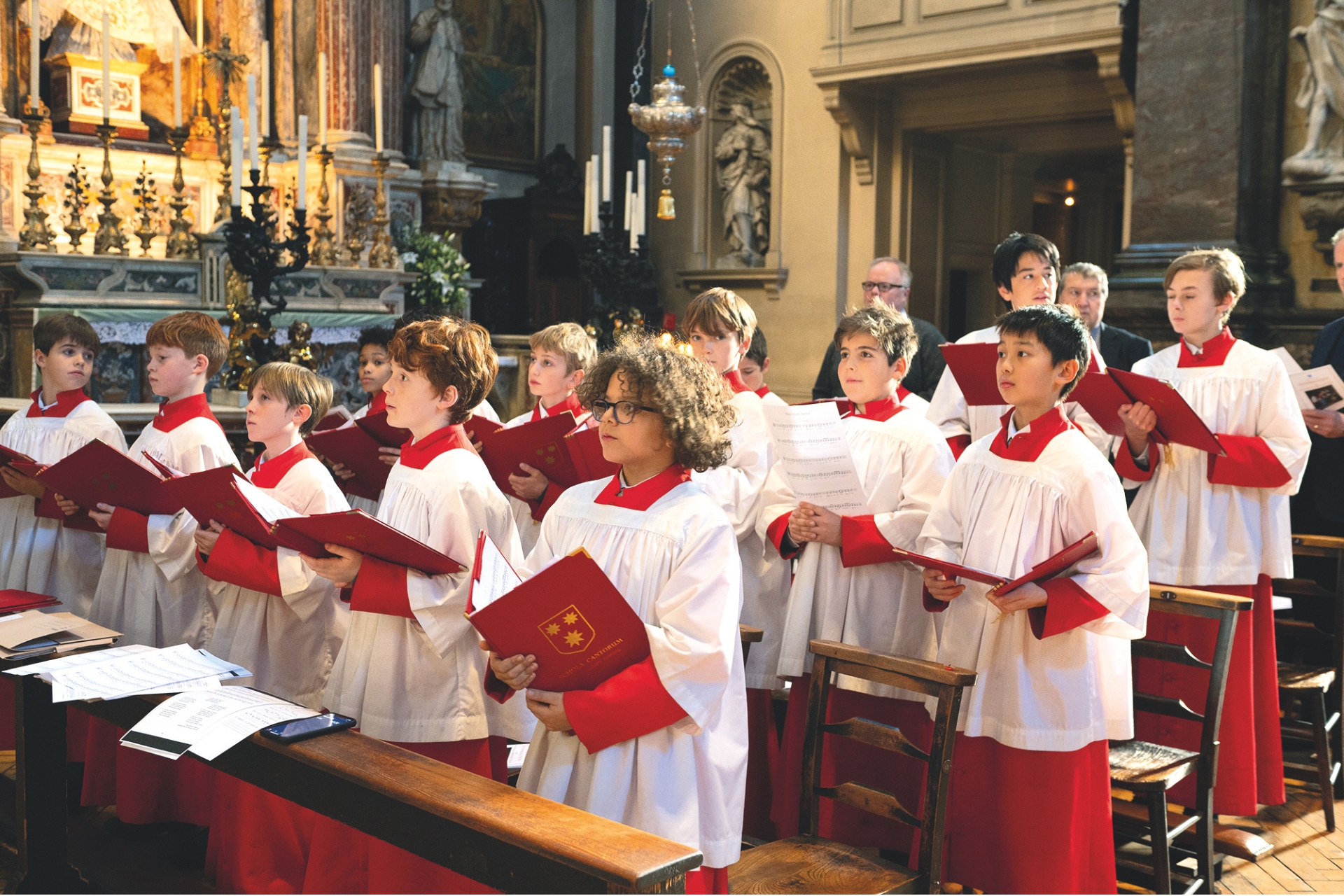
Two-thirds of the 100 pupils at St Philip’s School are non-Catholics
What Does The Future Hold?
Down in Hampshire is Catholic priest Fr Simon Everson’s Farleigh School, where 104 of the 437 pupils are Catholics and 30 percent of pupils are boarders. A former Anglican and married with children, Fr Simon describes how Farleigh involves parents ‘as much as possible’ in their children’s education. Curiosity, rather than crushing children into a mould, is key. ‘I always say to children, “We have no idea who you are going to be,”’ says Fr Simon. That discovery is the ‘purpose’ of Farleigh. ‘We look to the inner fabric of who pupils are.’
What Farleigh offers, he explains, is ‘Mediterranean Catholicism that is warm and generous’. As at Ampleforth, Stonyhurst and Downside, Sunday Mass is compulsory for boarders and every child is told that, as a child of God, they have inherent dignity. ‘It is gratifying when children delight in what someone else has done,’ observes Fr Simon. He remembers a girl who left a ‘pianothon’ because she made a mistake and her friends encouraged her to return. She did, ‘and played flawlessly’. Parents often tell Fr Simon they choose Farleigh after meeting current pupils and hearing their experiences of the school.
While these Catholic schools have weathered the difficulties of late, others across the country have been forced to close. According to the Catholic Education Service, in 2024 England and Wales had 86 Catholic independent schools. By 2025 this had reduced to 80 – a fraction of the 2,053 schools in the Catholic state sector. All are subject to the Catholic Schools Inspectorate evaluating their sense of mission, religious worship and community engagement. That focus can ease home life, too: Randall was recently telephoned by the mother of a new student, saying, ‘My daughter is helping her brother with his homework. She’s put the washing on. This is a different child to the one who left me eight weeks ago.’
Randall wants Downside leavers to be ‘thoughtful, grounded, confident’. That, he says, ‘is what most people want for their children, regardless of religious background’.