


The Land of Thirst: Inside the Fight to Save South Africa’s Great Karoo
By
11 seconds ago
Groups are uniting to battle the threat of fracking in one of South Africa’s last great wildernesses, says Annabel Heseltine
There’s a bent wild olive tree, crooked and gnarled, on a hill in South Africa where yellow grasses drift towards far-off mountains rising like pyramids. There, a lion roars, spooking a black wildebeest who, swinging his bushy white tail, runs with his herd, a black and white ribbon streaming through a vast landscape where the air sings with ancient tales and vast plains bathe in a big blue sky.
I can almost hear John Barry’s theme music but this isn’t Karen Blixen’s Out of Africa. It is Samara Karoo Reserve, comprising three lodges and 67,000 acres of wilderness in the Great Karoo, a huge belt of desert-like brush known for its harsh climate stretching across a third of South Africa and named ‘Land of Thirst’ by the Khoisan.
Rain is scarce and life depends on fragile underground aquifers. Hidden silently beneath ancient rocks are rich shale gas reserves whose vulnerability to fracking has united Khoisan communities, conservationists and landowners in protest.
From Failed Sheep Farm To Rewilding Success
When Sarah Tompkins and her husband Mark arrived in 1997, ‘it was dry and dusty with nothing but tumbleweed and the odd sheep,’ she recalls over dinner at the first lodge she built to introduce guests to Samara’s remarkable story. Decades of overgrazing had exhausted the soil.
But where others saw a failed sheep farm, the Tompkins saw possibility. Buying the farm and 10 others, they removed fences and livestock, rested the land and embarked on one of South Africa’s most ambitious rewilding projects in one of only 36 global biodiversity hotspots.
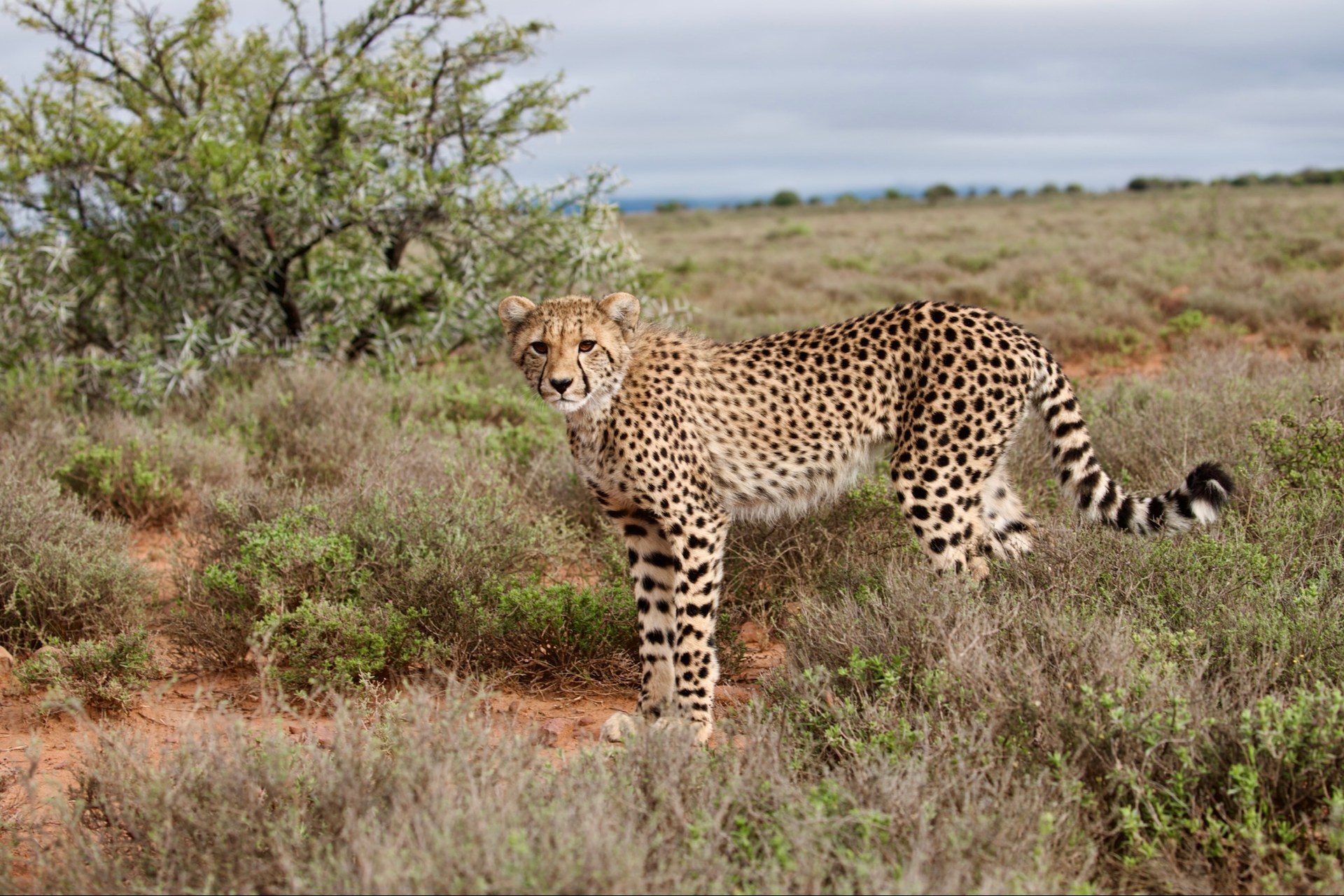
Working with leading conservation scientists, Samara reintroduced first antelope, then, in 2003, cheetahs, which had been absent for 125 years. They were followed by elephants and the arid-tolerant sub-species of the endangered black rhino, and then in 2019, 200 years after the extinction of the black-maned Cape lions, Samara shuddered again to a king’s roar.
With the return of the apex predator, Samara’s ecosystem could breathe naturally – but its greatest achievement isn’t just in reintroducing iconic species but in the messaging of how, when given a chance, nature returns.
Among The Cheetahs
Sleeping under canvas at Samara’s remote Plains Camp, I woke to birdsong drifting through mist and baboons barking from distant kopjes. After shooing away opportunistic vervet monkeys waiting to steal my breakfast, I joined my guides Christiaan and Michael for a walk on the veld. Michael carried a telemetry receiver but I was so focused on avoiding thorny bushes that I almost missed its urgent beeps.
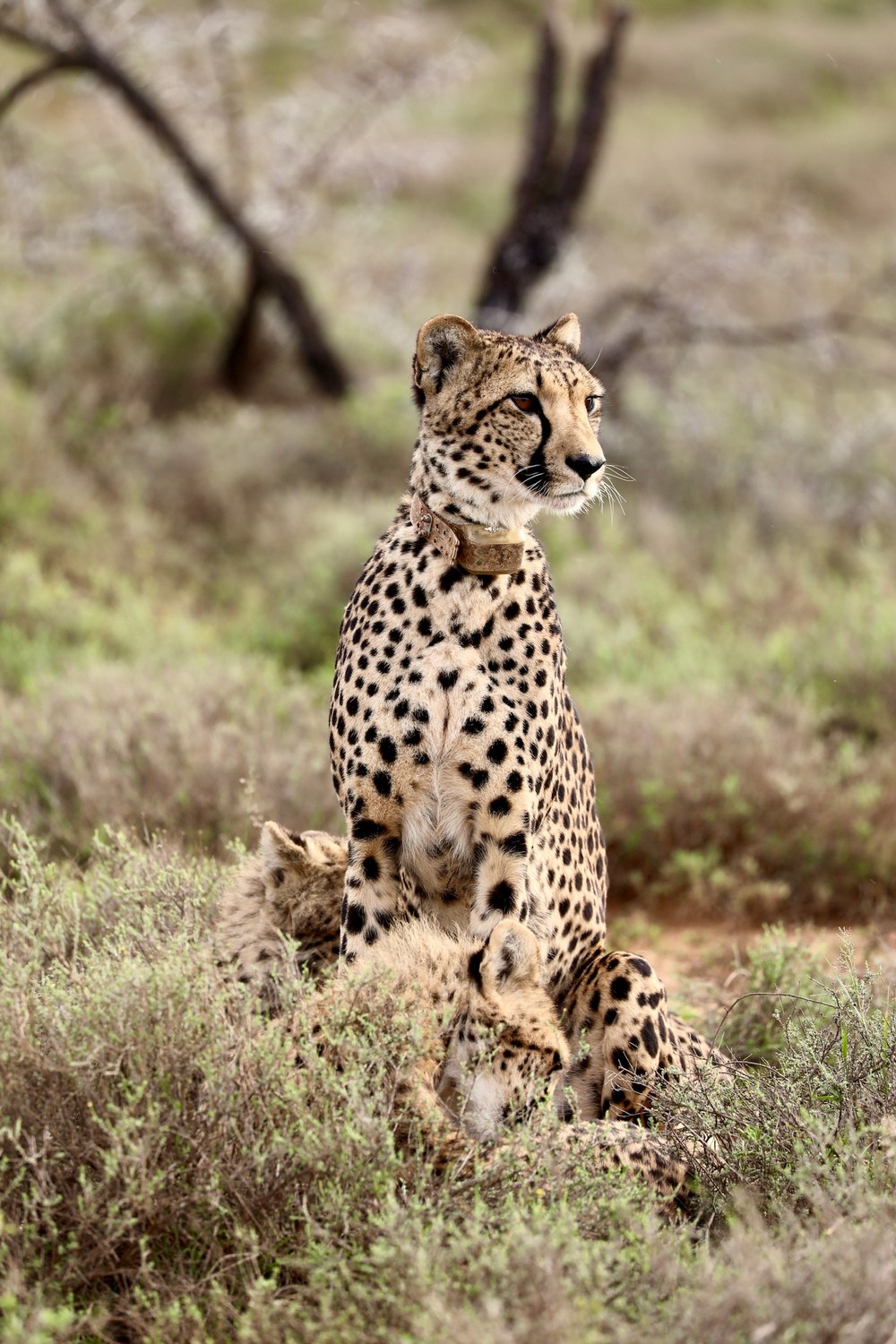
The next moment the world fell away. I looked up. Five pairs of amber eyes with tufted spotted ears were observing me calmly. Only when their mother stretched and stood up did they move. As one, her grown cubs followed weaving a path towards, through and past us, finally melting away into a trembling haze. I did a double take. Had I really just stood among five wild cheetahs?
The mother cheetah, named Naledi, is the granddaughter of one of Samara’s greatest conservation successes, Sibella. Badly injured, Sibella had escaped the hunter’s gun to become South Africa’s most important contribution to the Endangered Wildlife Trust’s metapopulation management programme and star of a National Geographic documentary. Raising 19 cubs to adulthood, she has given birth to nearly two and a half percent of its cheetah population.
The Khoisan & The Medicine Cupboard
Every sighting tells a story, even the medicine cupboard at my feet. The Karoo’s remarkable biodiversity and Samara’s unique location, which straddles five of South Africa’s nine biomes, includes plants used for generations by the Khoisan. Recognised now as South Africa’s First Nation, their intimate knowledge of this harsh landscape stretches back millennia.
Spekboom plants stabilise fragile soils, and herbs treating stress, diabetes and even cancer are shown to me by Karel ‘Pokkie’ Benadie, Samara’s legendary tracker and one of South Africa’s 21 Icons, a project inspired by Nelson Mandela that celebrates the exceptional individuals who have shaped modern South Africa.
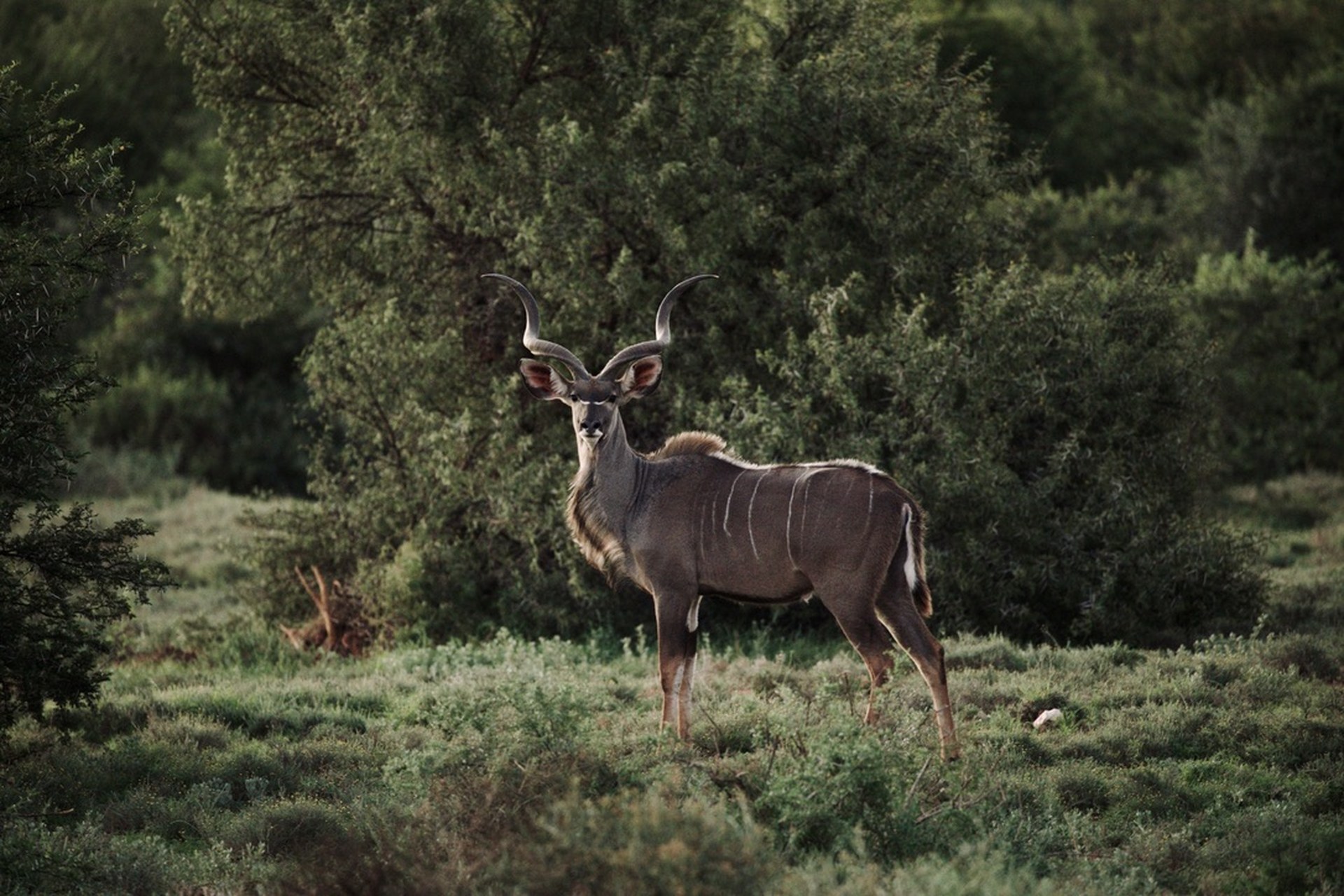
But I am distracted. Pokkie’s eyes never stop flickering, watching for a broken stem, a footprint, the shifting breeze. I wonder what he can see which I cannot; the great springbok migrations of yesteryear, or the quagga, gone forever. Or maybe through the bush, an eland, the largest antelope now also returned, its clicking knees echoing Khoisan click language, his body recorded in ancient San rock cave paintings.
‘The eland is not just food to the San but symbolises a sacred embodiment of the divine, representing ancestral journeys and reminding us of our role as custodians of the land,’ wrote Dr Willa Boezak, author of Struggle of an Ancient Faith: the Khoi-san of South Africa.
A Mega Living Landscape
‘Conservation begins and ends with people,’ said Mandela, and works best at scale. To this end, the Tompkins and their daughter Isabelle have partnered with SANParks, regenerative farmers and landowners to create a Mega Living Landscape, committing a million hectares of land to conservation, and connecting with the people calling the Karoo their ancestral home.
Shortly after their arrival, Sarah Tompkins sought out Daantjie Japhta, school principal, local mayor and a voice for the local Khoikhoi community. She wanted Samara to be integrated into the local community – but following the fracking threat, it evolved into an unexpected alliance.
As well as supporting Vuyani Safe Haven – a home for vulnerable children and young people in the Karoo – they are teaching schoolchildren about biodiversity restoration, wildlife tracking and conservation careers. Most of Samara’s employees come from Graaff-Reinet, where youth unemployment is 60 percent with associated problems of teenage pregnancies and substance abuse.
Twenty years ago, lodge and community project manager Anneley Swemmer took a bus to work at Samara in the scullery. ‘I never forgot my roots,’ she says. ‘If we can create opportunities for young people, that’s where hope begins.’ And hope is what the Karoo needs.

The Fracking Threat
Beneath these ancient plains, vast shale gas deposits have attracted repeated interest from energy companies intent on hydraulic fracturing threatening the Karoo’s fragile ecology where annual rainfall may only be 50 centimetres. ‘The impact of drought can be irreversible,’ Sarah tells me. ‘Our groundwater recharges very slowly. Once it’s damaged, there’s no quick fix.’ Historic evidence suggests contamination is inevitable.
In 2009, she appointed local lawyer Derek Light to oppose fracking proposals and commissioned scientific research while supporting a growing movement led by Khoisan leaders. ‘They’ve been marginalised,’ says Light. ‘They were the original people of this area but they don’t get the recognition they should at any level, national or otherwise.’
For Japhta, the issue goes beyond conservation. ‘Water is sacred and an ancient right. Animals die because of development. Fracking breaks rocks, contaminates water sources. Without water, nobody can survive. These people are money-mongering.’
The Karoo is his people’s identity, a living cultural landscape braiding ancient rock art, sacred places and wildlife. Increasingly, Khoisan communities are using internationally recognised indigenous rights to insist on proper consultation before developments can proceed.
‘This is rape of Mother Earth,’ said Khoisan leader Princess Joan Burgess who chairs the Khoisan committee set up in 2012. ‘But they don’t listen to us. They should consult us, but they don’t because they know we will say no,’ says Japhta, who once a month leads his people barefoot through the Kasoi nature reserve. ‘Walking barefoot releases stress. Our women lie on the bare earth when they want to speak to the ancestors.’
The Tug Of The Wild
That evening, sitting overlooking the veld and watching the mountains vanish into a lilac haze in a silence so profound it melted my senses, I felt the tug of the wildness. It’s a raw feeling of vulnerability, a connection, perhaps with all our ancestors.
A lion roared. Two centuries ago, that sound vanished from the Karoo. Today it echoes again across plains where cheetahs hunt, rhino browse, and the eland clicks. Communities are rediscovering their connection with the land and uniting to protect one of South Africa’s last great wildernesses.
In the ‘Land of Thirst’, conservation isn’t just about protecting what the eye can see, but what lies between us and our soul, and in the earth beneath us.
BOOK IT
Annabel travelled to the Samara Karoo Reserve with Journeys With Purpose. JWP will return to Samara with a small group in the near future. Privately hosted journeys from £12,000 per person, including full board, game drives and all activities but excluding flights, for seven days. journeyswithpurpose.org
Annabel’s one-way flight from London Heathrow to Cape Town had a carbon footprint of 1,133kg of CO2e (ecollectivecarbon.com)