


Jeremy King Finally Speaks: The Dramatic Ousting From Corbin And King – And How His Reign Lives On
By
8 months ago
New Simpsons in the Strand embodies the spirit of Le Caprice, says King
Legendary restaurateur Jeremy King is back doing what he does best – turning venerable rooms into adored restaurants. But, what happened after his dramatic ousting from Corbin and King? For the first time, he sets the record straight with William Sitwell.
Interview: Legendary Restaurateur Jeremy King
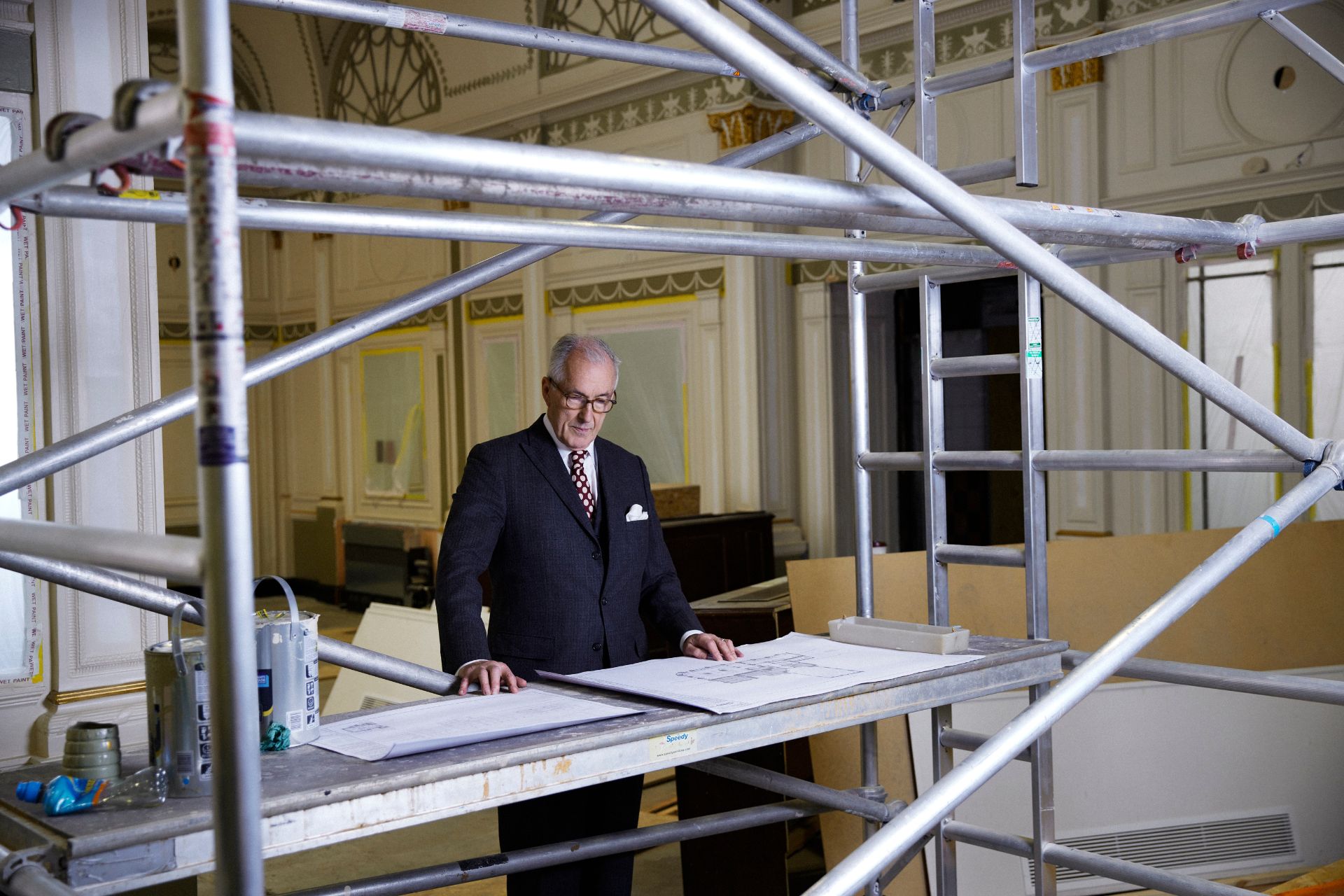
Credit: Chris Floyd
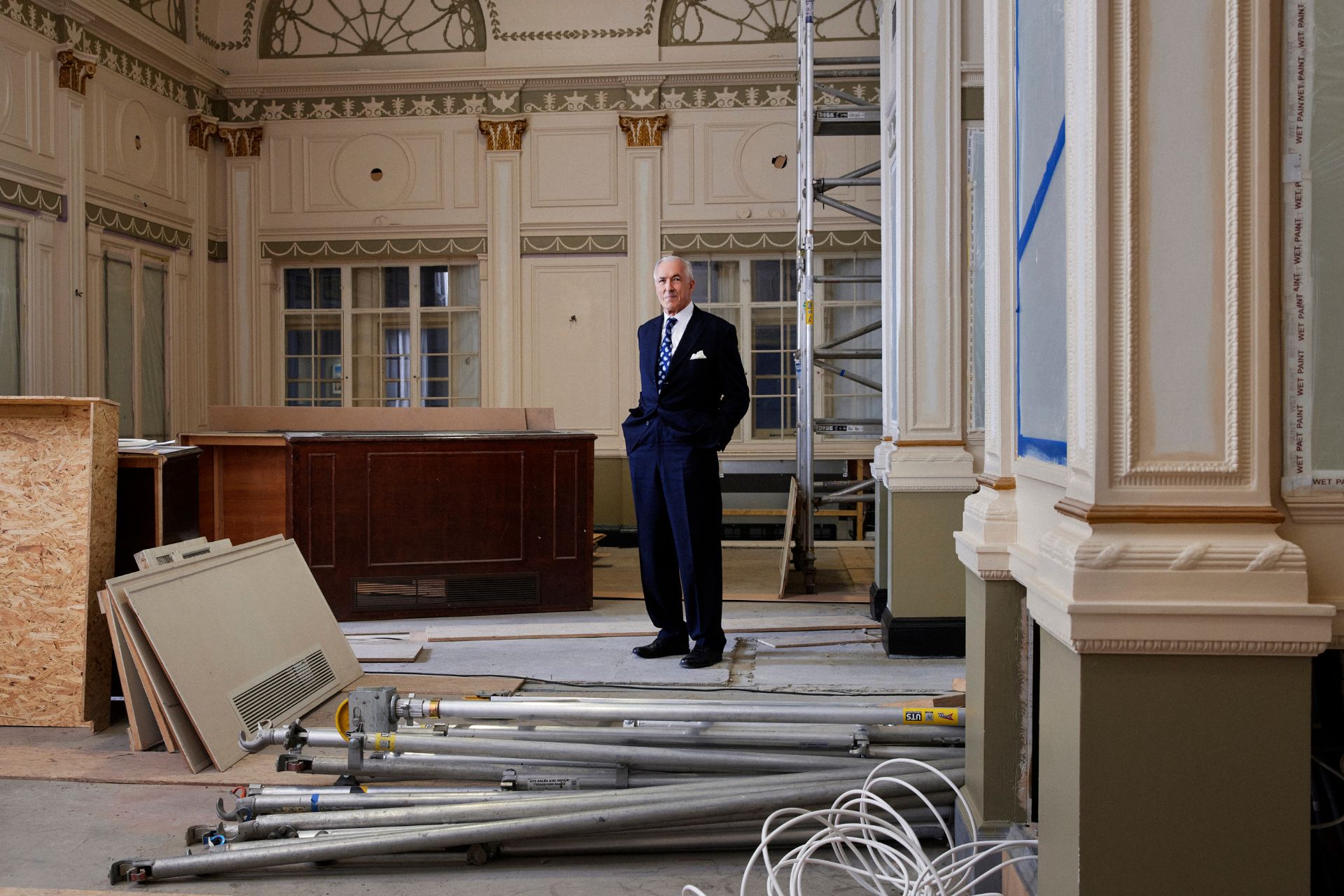
Jeremy King sits across from me on a cheap chair, by a dusty table, in a half-finished dining room in central London. In a few weeks this will be the Assembly Room, one of the capital’s grandest private events spaces. A dining room, a ballroom or a wedding location, it’s one of several wondrous parts of the great restaurateur’s latest project, Simpsons in the Strand.
Dressed impeccably as ever, today in a thick three-piece tweed suit, the man who has overseen some of the UK’s most famous restaurants is doing what he loves the most: gearing up to open a place.
And this wise 70-year-old is both contemplative and energised and, as we speak, I’m clutching his recent autobiographical book, Without Reservation. It is both a treasure trove of anecdotes and a manual on running restaurants.
But for the man who created such gastronomic titans as The Ivy, Le Caprice and The Wolseley I have, first, one fundamental question and a need to address the elephant in the room of his career. It’s a subject he has declined to address in interviews and brushes over in his book. That is, his scrap with Minor International.
Twenty years after King and his long-term business partner Chris Corbin had sold Caprice Holdings to Luke Johnson (who later sold to Richard Caring), Minor International became investors in Corbin & King, which had establishments such as The Wolseley, The Delaunay, Brasserie Zédel and Colbert. Minor is a Thai multi-national company with a focus on hospitality and when they invested in Corbin & King, industry observers, people like me, assumed they had an eye on rolling out the brand, doing a Richard Caring (an Ivy in every big town, branches in Dubai, et al).
And that is exactly what, in 2022, Minor attempted to do. But, to put it mildly, King didn’t like it. ‘I found myself in a massive dispute [with them],’ he writes. Minor attempted to put the company into administration to wrest control, King fought back by seeking finance to acquire the business himself but didn’t succeed. Minor was not thwarted. ‘I was stripped of my phone, my laptop, my email accounts – everything – and unceremoniously but effectively thrown out onto the streets.’
The big question being, how on earth did he not see that coming? King breathes in, brushes dust off his sleeve, waits for a builder to exit the room and, for the first time, prepares to tell me.
I wonder if this charming man is about to dispense a lesson in humility. His profession is, after all, one of extraordinary complexity. King, born in Burnham-on-Sea, in Somerset, was a shy but bright child who won a scholarship to a West Sussex boarding school at the age of nine. The son of a man whose company made protective coatings for buildings, he went to Cambridge University before entering banking, a profession he quickly regretted, quitting it for a job at Joe Allen, the Covent Garden establishment beloved of theatre and royalty.
Within 15 years, as he puts it, ‘We [King and Corbin] had the Ivy, it really was the restaurant of the 90s, it was extraordinary.’
It was also a manifestation of his philosophy to, as he explains, ‘create restaurants that people actually want to go to.’ It’s why this most famous of restaurateurs doesn’t attract Michelin stars, his approach to food and service being the opposite of what the late, great critic Adrian Gill would call the ‘50-thank-yous’ meal, where the diner spends much of the time thanking a waiter for their interruptions.
It’s not surprising that such places became iconic although King also states that his approach to creating places is, he says, ‘reactive. I’m not a proactive person. I’m stirred. I see somewhere – a restaurant should be determined by the building – and I say, “Oh yes”, and my mind kicks in.’ And, he adds, ‘the fun is the creating, the fun is seeing it come to fruition. You see, it’s easy to open a restaurant – the difficulty is running them.’
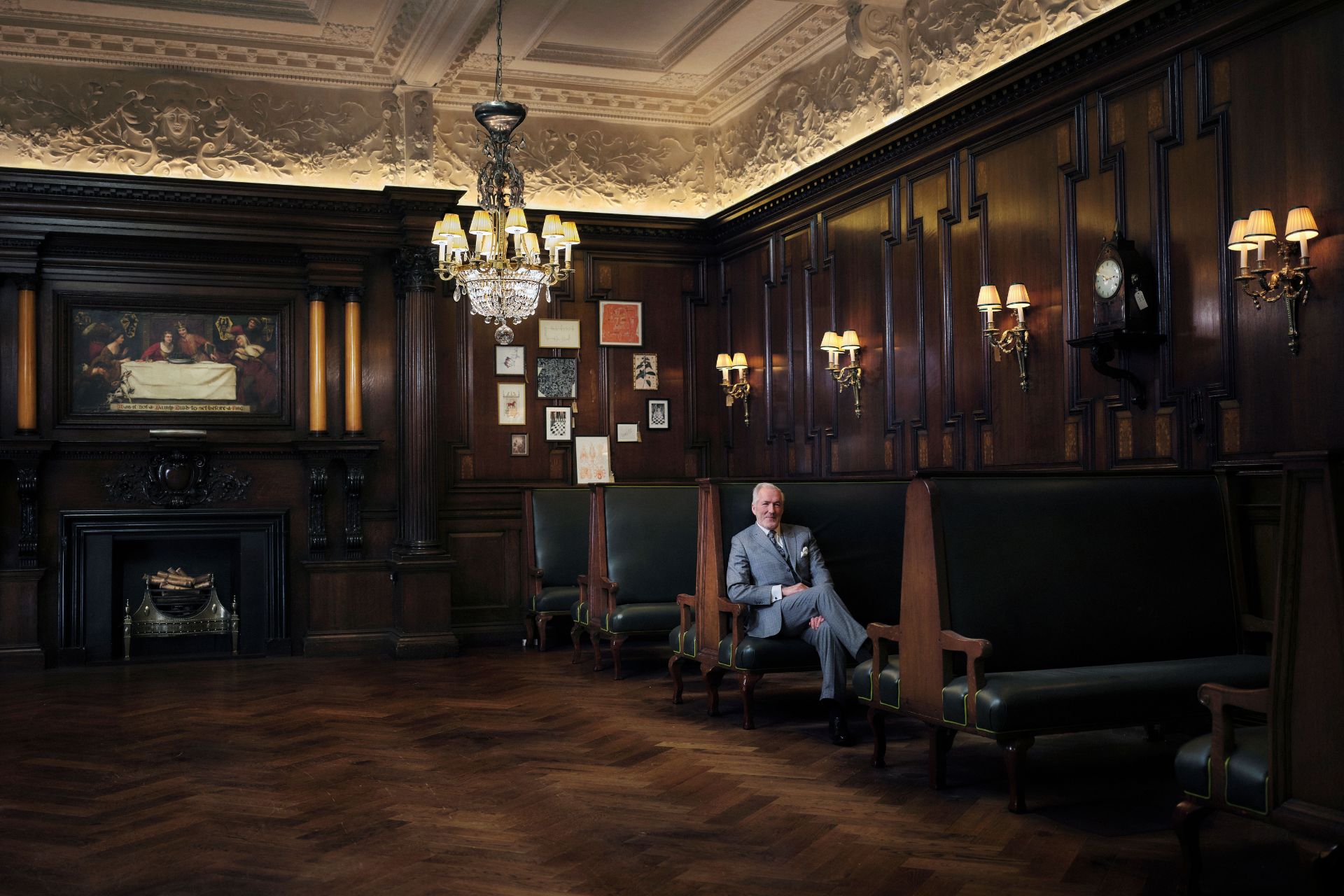
Credit: Chris Floyd
As we talk I take particular note of his sage advice for how to deal with some of the difficulties. ‘You must invest to make money, rather than cut costs,’ he says, ‘the cost of an extra waiter compared to what they can generate is massive.’
‘It is most important that a restaurant is suitably capitalised to see out problems,’ he tells me, citing an example of having a quiet night and the next day, ‘the suits come in, look at the numbers and cut the staff. The next night you’re full. And screwed.’
‘But don’t be in thrall of the money,’ he adds, ‘you must maintain control. Restaurants go wrong when they are controlled by the board.’
Speaking of which, it’s time for that revelation.
‘When I came across Minor, we were looking at different investors,’ he reflects, ‘and what attracted me was they theoretically understood hospitality. They said they would love to buy a position in us. But I said, “No”, as all they’ll want to do is roll out my restaurants and it’s not going to happen. They promised and promised that that wasn’t the case. I reiterated that my fear was they wanted to roll it out. They said, absolutely we are not going to do it. I said that even if I came to you in three years and said (which I wouldn’t), “I want to roll out ten Colberts”, then you must say, “No”. I asked them. “Can you live with that?” and they said “Yes”.’
But Minor did of course, fairly quickly, announce an intention to roll out The Wolseley. King says, ‘It would be fair to say they couldn’t curb their natural desire to expand. I have some sympathy because they panicked during Covid.’
King said, no, and assumed his position would sustain because, ‘they controlled the purse, but I controlled the company.’ However, he concedes one area of what he calls, ‘naivety’: that ‘they were able to renew the loan note, which meant they had control.’ The killer blow was to put the firm into administration. King lost. ‘It was insult and ignominy and, yes, I regret that we got into that position but it was then an emancipation’.
And today that emancipation is a joy to behold, with Le Caprice reborn as Arlington, The Park in Bayswater and now Simpsons. The latter a vast mix of restaurants and bars centering on The Grand Divan with its famous trolley and, with vast sums spent on a total refurb, as King puts it, ‘So people who knew it can come in and say, “Yes, that’s how it was”.’
I, of course, ask King about the current travails in hospitality (so-called government death taxes) which he acknowledges but says, ‘I remember dealing with the IRA hanging bombs in the grates of one of my restaurants, so I can deal with things like rates and Ozempic.’
And with a reflective book out and the emphatic opulence of Simpsons, is this place his swansong? ‘Is this my apotheosis? Is this my last restaurant?’ he asks, ‘Well yes. Until I find the next one.’