


Meet The Chef Behind BBC One’s Flaming Feasts, Chris ‘Flamebaster’ Roberts
By
6 months ago
And what to expect from the new food series
The BBC’s latest food series, Flaming Feasts, promises to taste-tour viewers across the lengths of Wales, as firebrand chef Chris ‘Flamebaster’ Roberts cooks dramatic dishes en plein air. We get to know the chef turned broadcaster ahead of its release on BBC One, 28 March.
Interview: Chris ‘Flamebaster’ Roberts
Talk to me about Flaming Feasts, what’s the elevator pitch?
So Flaming Feasts comprises six episodes in which I cook and travel around Wales. In my career, over the last few years, I’ve been very lucky to meet my food heroes from all over the world, but I’ve not done much of this in Wales. So this brings me back home. You can expect a celebration of Welsh produce – with a bit of smoke and fire. We’ll meet the fishmongers, growers, harvesters, these rock stars, and find out the hard work that goes into making food locally.
Flaming Feasts comes out 27 March, for BBC One Wales, and then BBC One for the rest of the UK on 28 March, on the slot after Saturday Kitchen. Which is cool, because when I was making it, I never thought it’d be seen outside of Wales.
Where in Wales are you from?
Caernarfon, so on the north coast of Wales. Overlooking the sea. I grew up here, it’s quite unique. We’ve got Snowden, five minutes away, so where the mountains meet the sea, with woodlands, lakes and rivers on the doorstep, too. And for a chef that makes an amazing pantry of ingredients.
Would you say Welsh food has been overlooked historically?
Our food identity definitely needs to be stronger. We’ve got the best produce, like up there among the best in the world, but so much of it is exported out of Wales. In Caernarfon, there is this one amazing coastline, but nobody in north Wales eats seafood. For example, we used to produce 70-80 percent of Europe’s mussels in the stretch of coast you see here, but locally you can’t even buy them. That industry has fallen off since Brexit, and the hope is that we can get people who live nearby more aware of our own produce.
We’re known for our national dishes like cawl soup – which is a very hearty roots-and-veg soup – Welsh cakes and rarebit. But we’re way more than that. We have some incredible chefs, here and then spread across the UK. My friend Tomas Parry, who is the chef behind Brat and Mountain, for example, is bringing Welsh produce to his restaurants and getting massive audiences to try it. He’s really supporting our suppliers.
But in a way I’m jealous of places like Cornwall where, from the outside, the people who live and grow up there are totally connected with their producers. I want more of that relationship for us in Wales.
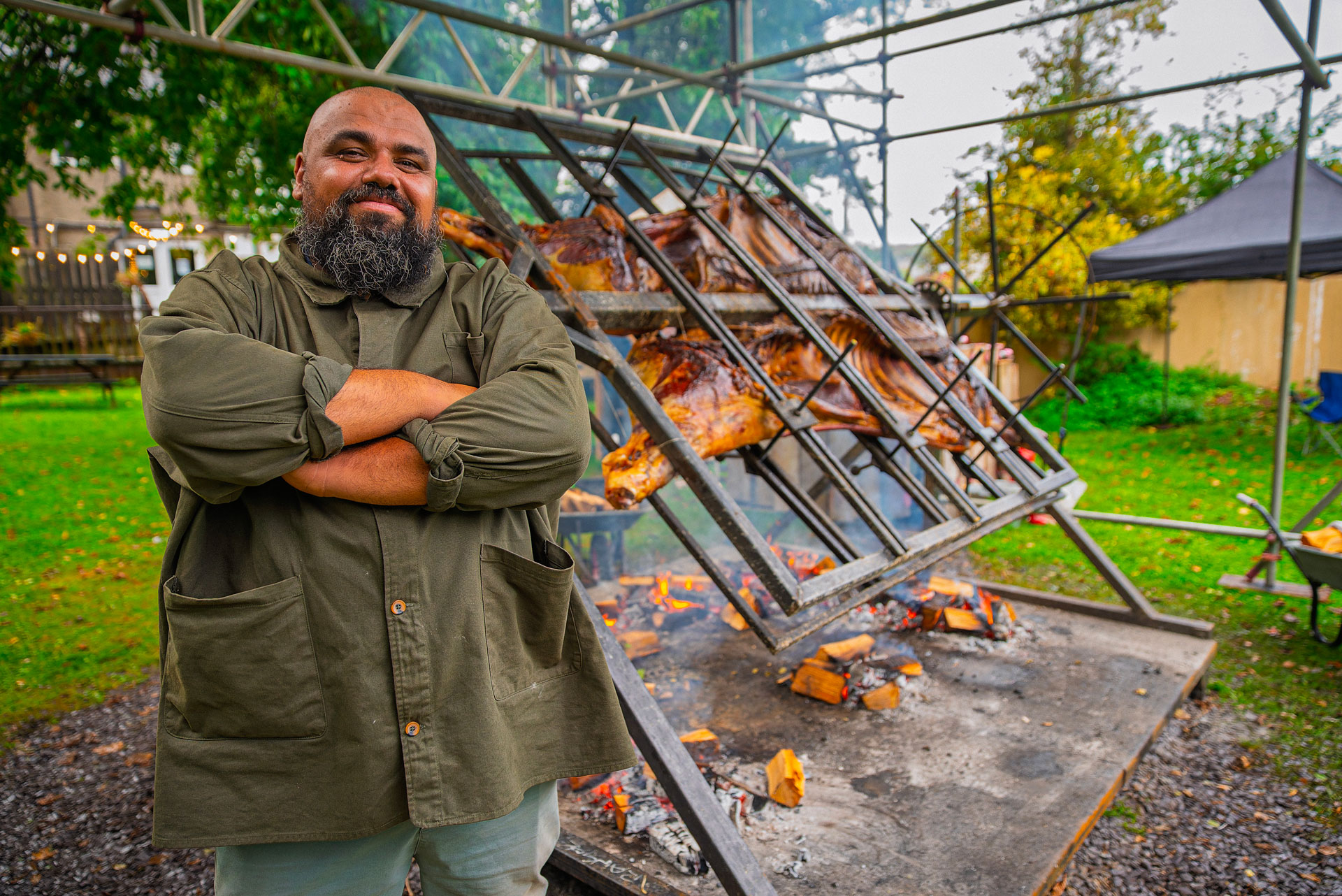
A whole-cow cookout took Chris 30 unsleeping hours to set-up – and later fed 300. Image courtesy of BBC
You’re best known for your fire cooking set-up. Can we expect a lot of dramatic flamebasting in the show?
Yes – and a whole-cow cook, too. I did one in Llanberis, in honour of whole-cow cook that happened in 1954, which fed 1000 people after the end of rationings. Three people who came to my cookout in the series were there as children in 1954, and they remember it so strongly even in their 80s – like dunking bread into the drippings – so it quickly became more than a stunt. I’m hoping the kids who came this time will get a similar experience; vivid memories to take forward for future generations. We fed 300! But it was very hard, I was cooking the cow for 30 hours at the fire, and I couldn’t even go to sleep.
And has the fire ever gone wrong?
I’m self-taught cooking with fire, so… yes. I’ve learnt through messing up. Burning food, too. The more you cook with fire, though, the more you begin to pick up on how you’ll need to adapt to variables like the wind and rain. And that’s before you get into how you can create different smoke profiles with woods and charcoals.
What got you into fire cooking in the first place? Any food heroes?
My dad visited a Welsh-speaking colony in Patagonia, deep in South Argentina, in his youth. He went for the fishing but he’d come back and tell me all these stories about how they cooked there. Their style of cooking over fire, like sea trout cooked on crosses above flames. And then a few years ago, I remember watching the first series of Chef’s Table and seeing the episode about chef Francis Mallmann in Patagonia. All my dad’s stories came flooding back. From there, I started a food festival that celebrated Snowdonia’s mountain lamb, and it snowballed from there.
It’s that you get to use all of your senses, sight, smell, sound, feel, [taste]. And it’s that it draws people in, fire is a magnet. With good music and good booze, fire-cooked food is just cool.
During filming, what was the best thing you ate?
The best meal was at Annwn, Matt Powell’s green star Michelin restaurant. It’s in this tiny town, it’s just Matt and his wife, and the food is phenomenal. He’s a real talent; specifically I ate a Tempe lobster, bathed in butter and an oil made from old lobster shells.
Is there a Welsh ingredient you think is criminally overlooked?
Laverbread, which is a bread made with boiled down seaweed. Traditionally, you’d have this fried with some oats with your full Welsh breakfast. It’s so savoury, with a subtle hint of sea flavour, and it pairs well with beefs (like a surf and turf). I think it’s not very nice on its own, but eating it as a flavour enhancer, like with a grilled turbot or with cockles grilled over the fire… Perfect. It’s the same seaweed species as Nori. We nod to it in the show; many people outside of Wales don’t know you can get it here.
Are there any real wow moments in the series that we can look forward to?
I had a go at coracle fishing. It’s an ancient means of fishing rivers – a tiny boat, so small I’ve got washing baskets that are bigger – which is only now practised by a handful of people. There’s a type of trout – sewin – that can only be caught across a five week-long season, and to catch them you go out as a pair on a duo of coracles, and hold a net between the two boats. You’ve got to do it with no lights, so at night, and silently. They caught two sewin, which I then cooked in a salt bake the day after. And I got to have a go! I weigh 25 stone, so I was wobbling around like a drunken duck. And I fell into the river. It’s worth watching, it’s quite funny.
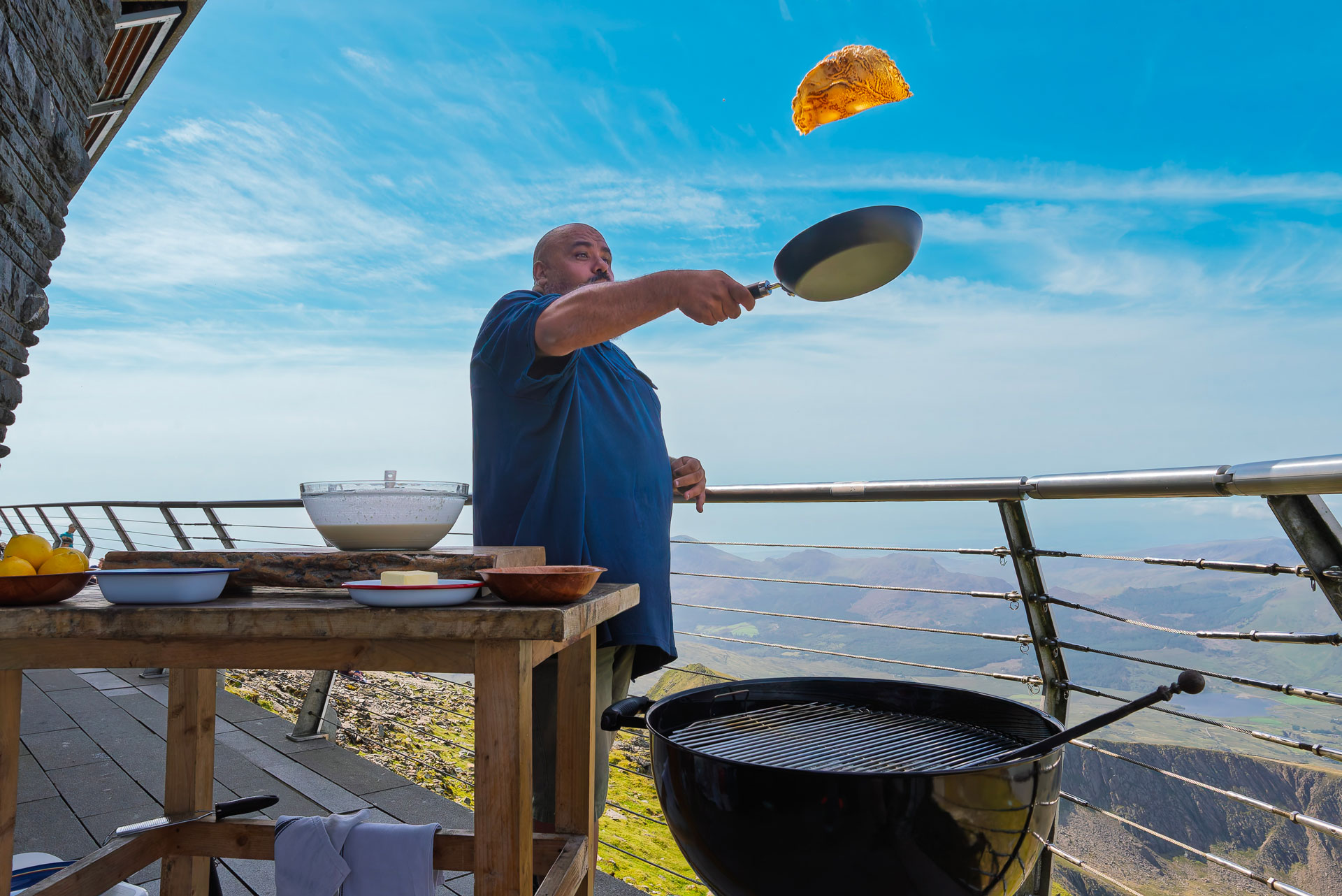
Another dramatic foodie moment – pancake flipping on Snowdon. Image courtesy of BBC
Quick fire:
My go to throw it together dinner… With four young kids, we make a bland one-pan dish that will please everyone, but that can be pimped up with condiments. Chicken korma, bolognese, the usual.
Everyone should visit this restaurant… Mercat Negre in Majorca. It’s in Palma’s market and primarily serves a lot of raw fish, but has a total heart and soul.
The cookbook I turn to the most… Niklas Ekstedt’s Food From Fire. When I first started experimenting with fire, that was the one. He’s a Swedish chef that pioneered fire-cooking. And of course I got Francis Mallman’s Seven Fires after that one scene in Chef’s Table.
My all-time food television show… Keith Floyd’s shows, and also Two Fat Ladies. My mates were watching Teenage Mutant Ninja Turtles while I was binging those shows. They’re the best.
Watch Flaming Feasts on BBC One at 11:30AM on Saturday 28 March (or a day earlier on BBC One Wales, at 7:30PM). bbc.co.uk