


How Britain Is Learning To Live With Too Much (& Too Little) Water
By
3 months ago
From drought to flood, our relationship with water – and how we manage it – must change. Meet the farmers implementing radical solutions
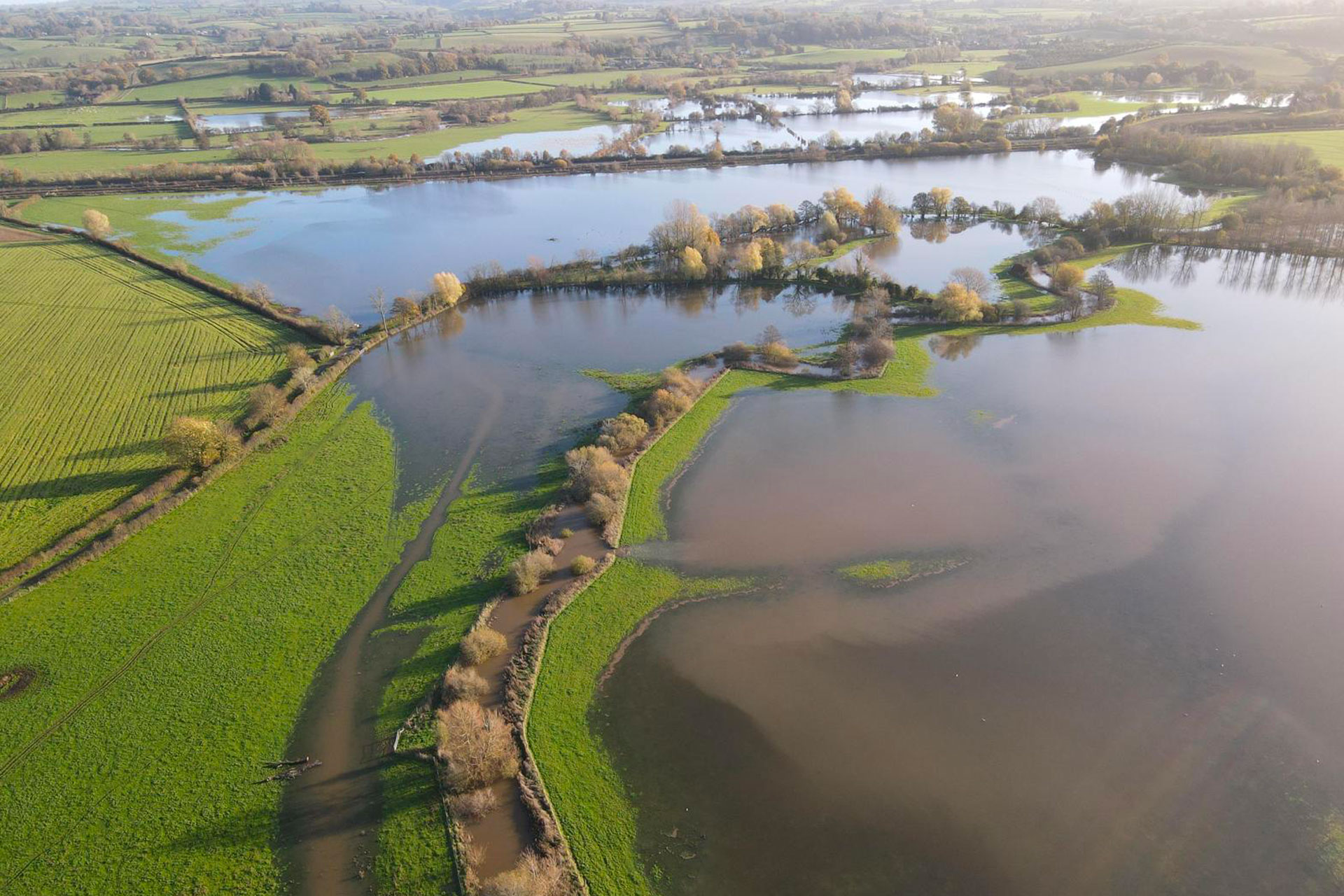
I was recently awoken by the loudest dawn chorus I have ever heard. When I told my host, she said the surround-sound birdsong was the work of local Stroud farmer, Peter Clifford, who had blocked the drains on the arable field behind her house. Wheatland had turned into wetland, and the birds were back.
Clifford is not alone. Across the UK, those who manage land are choosing radical ways to hold water on it. They have good reason. While government ministers and corporate boardrooms have focused attentions on greenhouse gas emissions and carbon footprints, a water crisis has been unfolding in plain sight.
In a country with a reputation for rain, there is grim irony in facing the reality of both running out of water and then being drowned by it. But as the last five years brought one record-breaking weather event after another, this is now the story of Britain’s water supply. Our complacency that the tap will always turn on leaves us woefully underprepared. Last summer nine million people were placed on hosepipe ban, a restriction that came a year after downpours flooded 5,000 homes. The Environment Agency has warned that without urgent action, England faces water shortages of five billion litres a day by 2055, a third of our current daily use. Meanwhile the insurer, Aviva, predicts the number of homes vulnerable to flooding will rise by over a quarter by 2050, warning that surface water flood risk in densely populated urban areas such as London and Manchester is now so high it may render homes uninsurable.
While the government presses ahead with plans to build 1.5m new homes by 2029, one in nine in flood risk areas, it has simultaneously committed £10.5bn in flood defences. With two reservoir projects being fast-tracked in Cambridgeshire and Lincolnshire at a combined cost of £4.8bn, the cost of our water crisis is climbing. Now pioneering farmers and land managers are suggesting the government may be looking, and spending, in the wrong direction. Instead, the solution may be right under our feet.
How Healthy Soil Could Solve Britain’s Flooding Problem
Andy Cato, regenerative farmer and co-founder of field-to-plate food business Wildfarmed, is clear the answer lies in the soil. ‘Healthy soil acts like a sponge,’ Cato says. Wildfarmed works with Professor Andrew Neale, a soil microbiologist at Rothamsted Research, whose work found that increasing soil organic matter by just one percent can improve the water-holding capacity of some soils by 354,000 litres per hectare, the equivalent of a 200-acre farm absorbing 7.5 Olympic swimming pools more water. ‘This is the one affordable route to better flood and drought resilience,’ says Cato. ‘It’s not difficult and can happen quickly. We just need to make it viable for farmers to do it.’
It seems a false economy, then, for a government facing annual flood bills of £2.4bn and rising to scrap the modest payment rewarding farmers for soil management from its 2026 sustainable farming incentive. With public payments shrinking, Wildfarmed has found a solution in the private market. It now facilitates a growing number of water companies to make direct payments to Wildfarmed growers in their catchments, who must all comply with third-party audited standards that regenerate soils while improving water quality, ranging from £75 to £250 per hectare. One, Affinity Water, claims that for every £1 invested into regenerative farming they receive a £6 return. Given The Rivers Trust’s declaration that not one of England’s rivers is now in good health, paying to prevent pollution rather than bearing the cost of cleaning it up is just good economics. ‘It’s a spectacular three for one deal,’ says Cato. ‘Managing soils to hold water means they also hold more carbon, and the plants doing the work measurably increase biodiversity. All of which comes with a resilient food system thrown in for free.’
Floodplains Are Being Restored, Not Drained
While some farmers are improving soils to prevent flooding, others are embracing it. For decades, war-time government grants saw natural floodplains drained to improve agricultural production. Lasting long into peacetime, in the 1980s at their peak 111,000 hectares of land was drained each year, an area the size of Greater London. That same land is now flooding towns downstream, and the state is paying again, this time to put some back. So enthusiastic was the reception to DEFRA’s £37m Species Recovery and River Restoration programme that it was oversubscribed. Of 56 projects submitted, three have moved from planning to delivery, the largest being the Evenlode project, led by Tim Coates, executive director of the North East Cotswolds Farmer Cluster. Comprising over 140 farms, it is restoring more than 3,000 hectares of habitat, slowing winter flooding, and holding water and nutrients on flood meadows, all backed by a £100m finance model blending public money with private cash.
View this post on Instagram
Near the Welsh border a similar project has brought some 50 landowners together in an effort to change not just land management, but narrative. The Wyescapes project is well timed. This April, the largest pollution lawsuit ever brought in the UK reached the High Court after 4,500 residents brought a group action against industrial poultry producers and Welsh Water for pollution to the River Wye. Wyescapes offers a solution to restoring a river that has become an environmental lightning rod. Planned over 30 years, it includes 2,000 acres of new floodplain meadow, 220 acres of new wetland and the reversion of 1,385 acres of arable land to grassland. The objective, says programme manager Max Eckert, is to ‘achieve a more natural exchange of water between land and river, slowing the flow of water in heavy rains and providing water resources when it is drier, all while producing food.’ It will be funded through a blended finance model, including credits for nutrient reduction, biodiversity net gain and ‘Volumetric Water Benefits’, which measure the value of increasing water storage on farmland.
One member, Ben Andrews, a fourth-generation tenant of 600-acre Broadwall Hall Farm who organically farms beef, cereal crops and vegetables, is clear the environmental pressures upon farmers are complex. Fields that once grew potatoes and brassicas now regularly sit under five feet of water from October to April. ‘They are no longer financially viable as farmland,’ says Andrews. The security offered by reliable income from programmes such as Wyescapes, he says, ‘is really important’ for those paying agricultural rates on unfarmable land. Completing a Nuffield Scholarship on agriculture’s role in the causes and solutions of flooding and pollution, Andrews points out that paying farmers to restore floodplains reaches far beyond the field, protecting local infrastructure and business from flooding and saving insurers sizeable sums.
Could Beavers Be The Answer To Britain’s Flooding And Water Crisis?
View this post on Instagram
Another unlikely saviour is making its way into the fray. Hunted to extinction in Britain some 400 years ago, beavers have long been championed as natural flood engineers. Their dam-building does what hard infrastructure cannot: slow, store and filter water, but at little cost. Up until the 1970s, government grants saw rivers dredged, straightened and channelised to improve agricultural production. The fast flowing water increased erosion, exacerbating downstream flooding and obliterating habitats like oxbow lakes, reed beds, wet meadows and bankside woodland that meandering rivers had taken millennia to develop. Now escapee beavers and rewilders have proved their point. Between 2013 and 2016, 13 beaver ponds on the River Otter added 18,000 sq/m of water storage, holding an additional one million litres of water. During storm events, water took longer to pass through the system and flood flows reduced by up to 60 percent. The first official wild beaver release in England took place in Dorset in March 2025.
Urban Gardens And Cities Need To Catch Up
While 85 percent of the UK population now lives in urban areas, the idea that flooding is a rural problem is misplaced. Some 42 percent of city gardens have been paved over, a figure that worries insurers picking up the flooding tab when heavy rainfall has nowhere to go. The Environment Agency’s national flood risk assessment indicated a 43 percent increase in the number of properties at risk from surface water flooding in 2024. Meanwhile, Labour’s new homes are still being planned without mandatory water harvesting or greywater recycling requirements, when lightly used wastewater is filtered and reused for toilets or garden irrigation, despite hydrology experts calling for the roll out of drainage solutions that mimic nature, such as roofs or ditches filled with plants.
Urban dwellers may have much to learn from efforts being made in our countryside, adapting techniques into their city equivalents with porous pavements, green roofs and tearing up astroturf. But benefits go beyond reduced insurance and water bills, as the curlew, snipe, redshank and cranes that now visit Peter Clifford’s wetland show. Almost a third of all wild birds have been lost in Britain since 1970. After 50 years of silence, being woken by the dawn chorus not just in Stroud but Southwick may become the metric that really matters.