


David Mumeni On Open Door & The Future Of The Arts
By
2 months ago
Access, opportunity and the arts today

For all its talk of talent and merit, Britain’s arts industry still comes at a cost. From drama school application fees to unpaid early-career work, the price of entry often determines who gets to take creative risks and who is priced out.
Founded nine years ago, Open Door was created to address that cost of creativity, supporting aspiring actors and behind-the-scenes creatives who don’t have the financial backing traditionally required to enter the profession. And to shine a light on this, the charity is supported by a group of high-profile ambassadors, including Emilia Clarke, Woody Harrelson, Riz Ahmed and David Morrissey, to name a few.
‘Open Door has always been about positivity and championing talent,’ founder David Mumeni tells me. And next up that positivity will come in the form of The Big Valentine’s Comedy Shindig, an evening hosted by Joe Lycett at Theatre Royal Haymarket on Sunday 15 February. ‘The Big Valentine’s Comedy Shindig is a way to celebrate – bringing people together, having fun, and showing that supporting access to the arts doesn’t have to feel heavy,’ David says.
He continues: ‘The funds we raise will go directly into giving talented young people access to higher education and training, hands-on workshops, theatre trips, mentoring, career guidance, and support for breaking into the television, film, and theatre industries. It’s about turning that energy into real tangible opportunities.’
Ahead of the event, we sat down with David to talk about access, opportunity and the future of the arts.
MORE: Chelsea Arts Festival Is Back For 2026
Q&A: David Mumeni, Founder Of Open Door
Open Door has been running for nearly a decade. What prompted you to set it up?
It’s flown by! I set up Open Door because, back in 2017, the barriers to drama school were enormous. Audition fees alone were often over £50 per school, then there were multiple rounds, travel costs and sometimes overnight stays for final recalls. Depending on where you lived, the process could easily cost close to £2,000 before training had even begun. And that’s before you factor in cultural capital.
At the same time, the industry was openly complaining about the lack of diversity among drama school graduates, while also acknowledging how expensive it was to apply. I thought, ‘Why isn’t anyone practically doing something about it? We’re just all talking about it all the time!’ I thought I may have the solution. I’d spent years working with young people in a range of settings – from youth theatres to schools – and I kept meeting incredibly talented young people who didn’t even know these institutions existed, let alone how to apply or afford to audition. I’d already supported a few people into drama school on an individual level, and I began to ask myself how I could do this at scale.
I loved my own drama school training, and it never sat right with me that students from similar backgrounds to mine were so underrepresented. The majority of students I trained with were privately educated, and I wanted to challenge that imbalance in a meaningful, simple and practical way. Open Door was born out of that need.
For people unfamiliar with drama school applications, what costs are involved before training even begins?
When we started, the costs were close to £2,000. Open Door’s existence highlighted the barriers that had been in applicants’ ways for years. Our partner drama schools have done fantastic work to reduce barriers, such as offering free auditions and fee exemptions for applicants from lower-income backgrounds as well as covering travel costs for recalls. But there are still structural barriers that remain. Many applicants from more privileged backgrounds can afford private tutoring, high quality acting classes, and specialist workshops, all of which are expensive. We provide all of this for free. Our aim is to level the playing field and give our participants the same access and opportunity as their more privileged peers.
A huge part of privilege is cultural capital. They go to the theatre to see world-class work at leading venues, helping them develop their taste and confidence. There’s often an unspoken working class mindset of not belonging in these spaces and institutions. We work hard to shift that – so when they walk into an audition room, they feel there is a place for them so they can do their best work.
We also offer therapy to those who need it. This is vital support and often inaccessible due to long NHS waiting lists and high private costs. We cover a free acting and behind the scenes programme, travel to and from sessions, one on one tutoring, and provide access to industry professionals. All of this removes practical and psychological barriers, allowing talent — not money –to be the deciding factor.
Open Door supports both performers and behind-the-scenes creatives. Why was it important to look at access across the wider industry?
Although I’m an actor, it was always important to me that Open Door didn’t focus solely on performance. If we’re serious about access and change, it can’t just exist in one part of the industry – or only in London. Design, technical theatre, stage management, and other behind-the-scenes roles shape the work just as much as the people on stage. If those spaces remain inaccessible, then the culture, decision-making and creative ideas stay narrow. Diversity of lived experience leads to a wider range of ideas, stories and ways of working and ultimately makes the work itself stronger and more relevant.
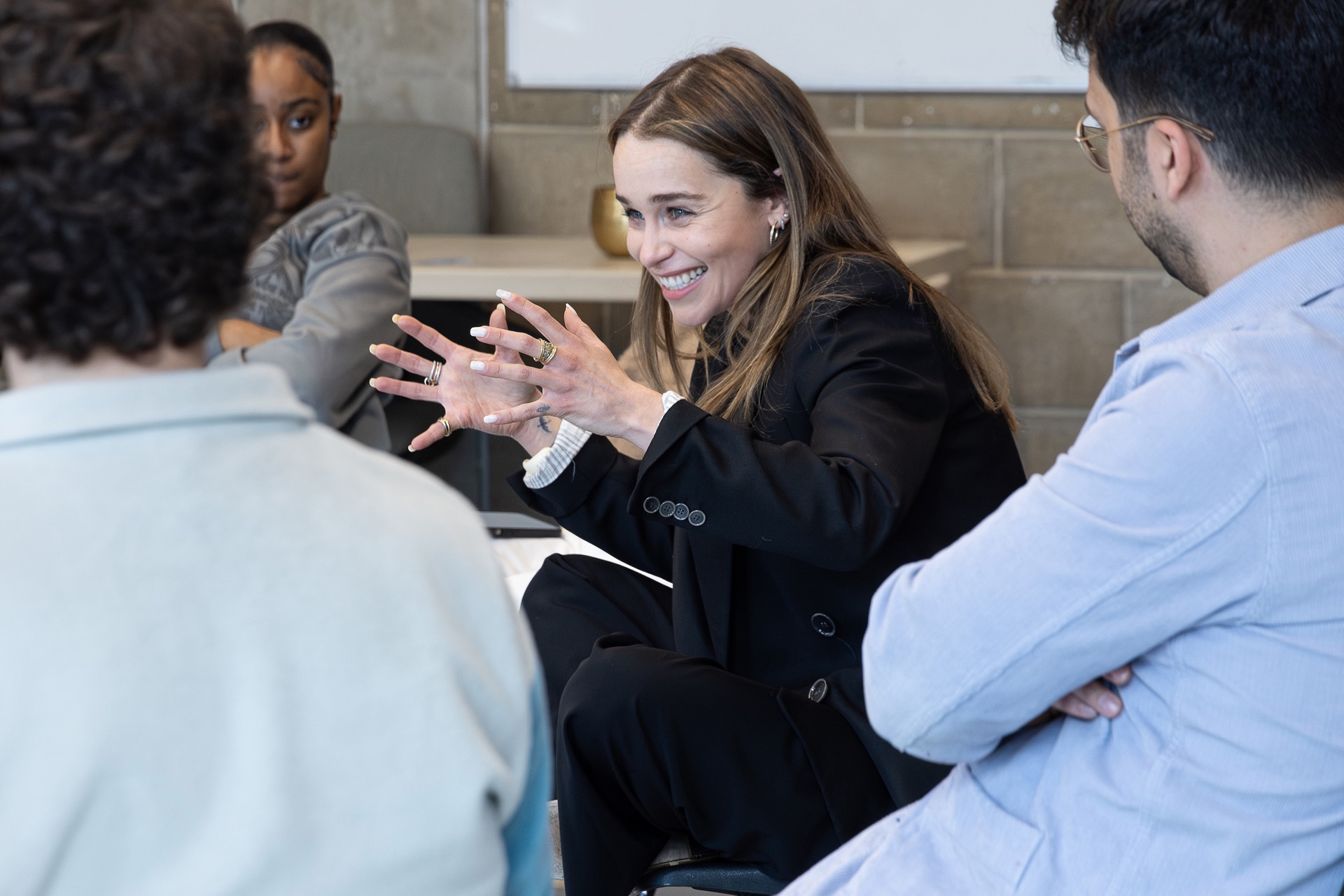
Open Door ambassador Emilia Clarke running an acting workshop. (© Charlie Lyne)
You’ve said that only around 8 percent of the industry comes from working class backgrounds. How does class shape who pursues a career in the arts?
Class shapes who pursues a career in the arts long before talent becomes a factor. When we say only around 8 percent of the industry comes from working-class backgrounds, it’s not a reflection of talent, it’s a reflection of who is able to take the risk, who feels they belong, and who is structurally supported to stay in the race long enough to succeed.
Middle- and upper-class applicants are far more likely to see the arts as a viable option rather than an indulgence because they know they have a financial safety net. For many working class young people, the arts are often framed as unrealistic or financially irresponsible. There’s pressure to choose stability, to earn quickly, or to contribute at home. Even when the talent is there, the idea of pursuing acting can feel like a luxury meant for other people.
Then there’s access: early exposure to theatre, drama classes, private coaching, and networks that quietly demystify the industry. Middle- and upper-class applicants learn the language, the confidence, and the unspoken rules early on. That cultural capital makes the path feel easier to navigate.
Is class still the most difficult part of the access conversation?
I think it is, largely because class is hard to quantify. Many of the people who run institutions, and therefore shape policy, may have a limited understanding of how class affects access and opportunity. There’s often a belief that success is purely the result of hard work and talent. But the reality is that not everyone starts from the same place.
Class is also a broader and more inclusive lens. At its core, it’s about access to opportunity, and it intersects with race, disability, gender, and many other protected characteristics. We may never have a perfect or universally agreed definition of class, but that doesn’t mean we can’t have policy. At Open Door, we’ve chosen to focus on low income, even though class is more complex than that, because financial barriers are significant and measurable. It doesn’t capture every element of class, but making an informed decision is far better than making none.
With rising living costs and ongoing funding pressures, are you concerned the industry is becoming less representative?
Yes, it’s a huge concern and not just for us, but across the whole sector. Everyone is scrambling for funding now, and there’s less of it to go around. When that happens, free programmes and access-based opportunities are often the first things to go, and that inevitably means fewer people can engage with the arts at all. I don’t want to limit our work to just one or two parts of the country. What worries me is that the industry has made real progress over the last few years. It’s positive and feels completely different to when I entered it. It’s vital we don’t slip backwards now.
This is the moment for organisations and individuals to really commit, not just financially, but through partnerships, time, ambassadorship, and long-term support for grassroots organisations like ours. Open Door makes a real, measurable impact. If we want the industry to remain representative, we have to protect and invest in the work that’s making that possible.
What responsibility do institutions and figures in the industry have when it comes to widening access and creating a lasting change?
They have the power to make a real difference. Only 7 percent of the country is privately educated. Around 56 percent of the country identifies as working class, yet it’s the most disproportionately underrepresented group across television, film, and theatre, at 8 percent. That gap alone shows how urgent this issue is. Until class is taken seriously at a policy level, we are going to have major inequality.
Looking ahead, what does lasting success for Open Door look like?
Partnerships and ongoing funding are key so that we can plan, expand, and support even more people who need it. I’d love to have several hubs across the country so no matter where someone lives, they can access training and have the chance of a career in television, film, or theatre.
The Open Door model works. Many of our alumni are now leading productions and winning awards for their performances from Netflix and Apple TV+ to National Theatre and RSC productions. Imagine what we could do with more funding, and how many more talented people we could support to reach their potential.

Tell us about the Big Valentine’s Comedy Shindig.
Open Door’s work is supported by The Big Valentine’s Comedy Shindig, hosted by Joe Lycett at Theatre Royal Haymarket on Sunday 15 February. All proceeds will go towards expanding the charity’s acting hubs and launching a new national backstage programme, helping more young people access careers across theatre, film and television.
Tickets start from £10, with £75 VIP tickets including the best seats in the house and access to the post-show party.