


Inside Frida: How The Tate’s New Exhibition Reveals The Making Of A Global Icon
By
3 months ago
What turns an artist into an icon? This summer, the Tate Modern answers that question through 30 of Frida Kahlo's works and more than 200 objects that trace how her image, legacy and persona have been appropriated, reinterpreted and celebrated across generations
Set to open on Thursday 25 June, Frida: The Making of an Icon is already the highest pre-selling exhibition in the Tate’s history. If this morning’s press preview – filled with a throng of journalists from far and wide (including overseas) anxious to claim a first glimpse at this much-anticipated exhibition – is anything to go by, London is set to be overcome by a Frida frenzy.
Alongside the Tate Modern exhibition, city strollers can see Kahlo’s art on Carnaby Street, where ¡Frida Icónica! floats in the sky, as well as across Tate Collective helmed murals around the Bankside area. At the Tate Modern itself, acclaimed Mexican chef Santiago Lastra (the man behind Marylebone’s Michelin-starred KOL) has dreamed up a special Frida-inspired menu to be enjoyed before or after visiting the exhibition.
Frida: The Making of an Icon made its international debut at the Museum of Fine Arts, Houston in January 2026 before arriving at London’s Tate Modern. It is curated by internationally renowned curators Tobias Ostrander and Estrellita B. Brodsky with the Tate Modern’s Assistant Curator of International Art Beatriz García-Velasco. Below, C&TH meets Beatriz to get the insider take on Frida: The Making of an Icon.
Meet The Curator: Frida: The Making Of An Icon, Tate Modern
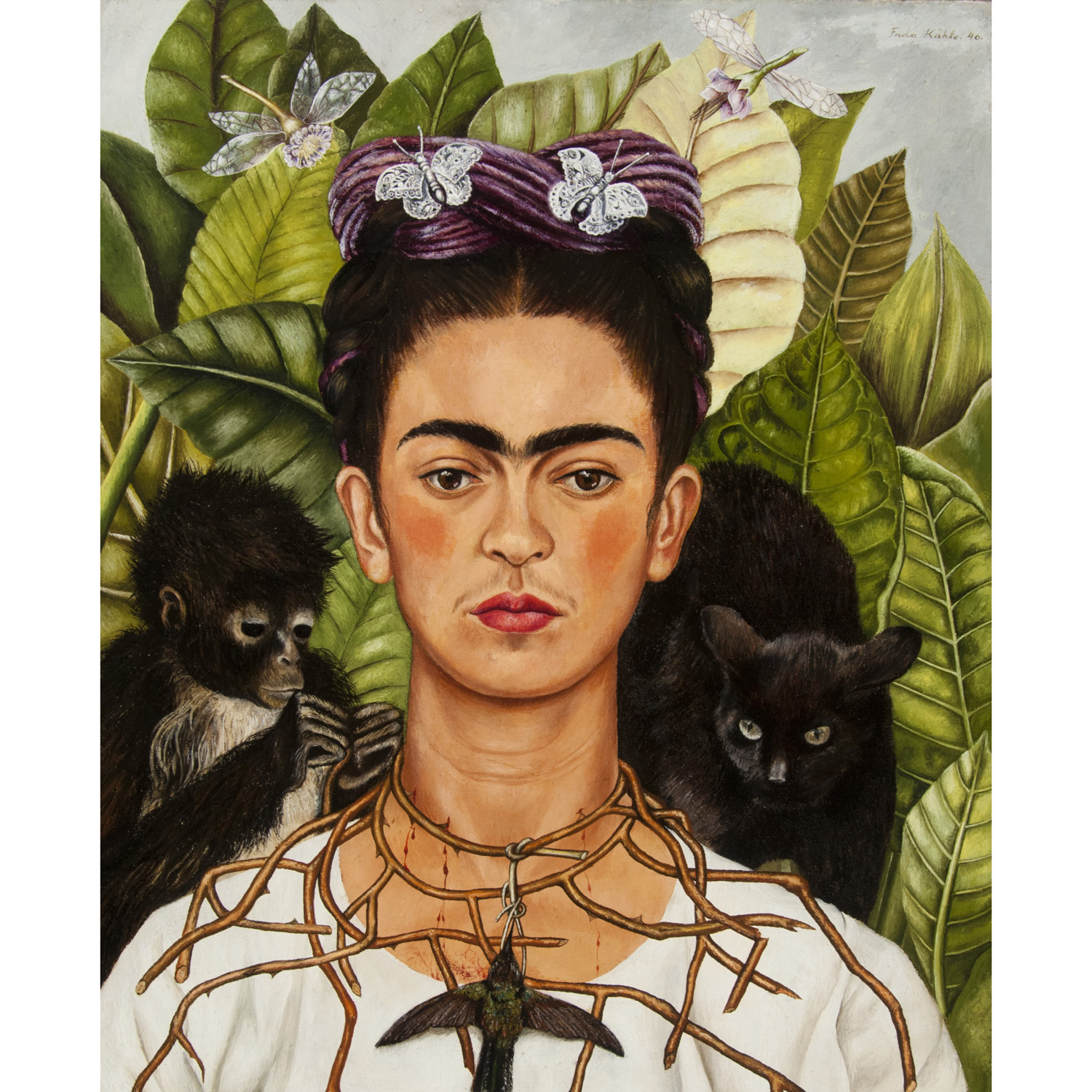
Frida Kahlo, Untitled [Self-portrait with thorn necklace and hummingbird], 1940. (Nickolas Muray Collection of Mexican Art)
The Background
Mexican painter Frida Kahlo lived from 1907 to 1954. Once an aspiring doctor, she was unable to go to university following a bus crash that severely injured her spine and left her bed bound. It is here that Kahlo returned to her childhood passion: painting.
Kahlo is best known for her self-portraits – so much so that even if you don’t know her work well, you will recognise Kahlo’s image. With her elaborate hair styles, signature unibrow and impartial stare, Kahlo is ingrained in the public imagination. This certainly hasn’t always been the case, and has snowballed in recent years. Indeed, during her lifetime, Kahlo was relatively obscure.
Frida: The Making of an Icon is the first major Kahlo exhibition in London in more than two decades. It comes almost three quarters of a century after Frida Kahlo was first exhibited by the Tate: at Mexican Art: from Pre-Columbian Times to the Present Day, which ran through March and April 1953 at the Tate Britain, back when it was home to the full Tate collection. Tate Modern’s first Kahlo retrospective ran in 2005. Where that exhibition brought a whopping 80 of Kahlo’s works to London, many from the US and Mexico, Frida: The Making of an Icon can only boast 23 of the artist’s works in its oeuvre. The subtitle, The Making of an Icon, should be noted: this Frida exhibition is more about the woman, her contemporaneous context and her lasting influence than her art on its own.
As assistant curator Beatriz García-Velasco explains: ‘Frida: The Making of an Icon looks at how Frida Kahlo became one of the most recognisable artists of the 20th century. It is not a traditional retrospective, but a contextual, historical investigation into the phenomenon of Fridamania: how her work, image and persona have been appropriated, reinterpreted and celebrated across generations, and the extraordinary hold she has had on successive artists, activists and communities around the world. The show traces that posthumous journey from a relatively little-known Mexican painter during her lifetime to a global cultural icon.’
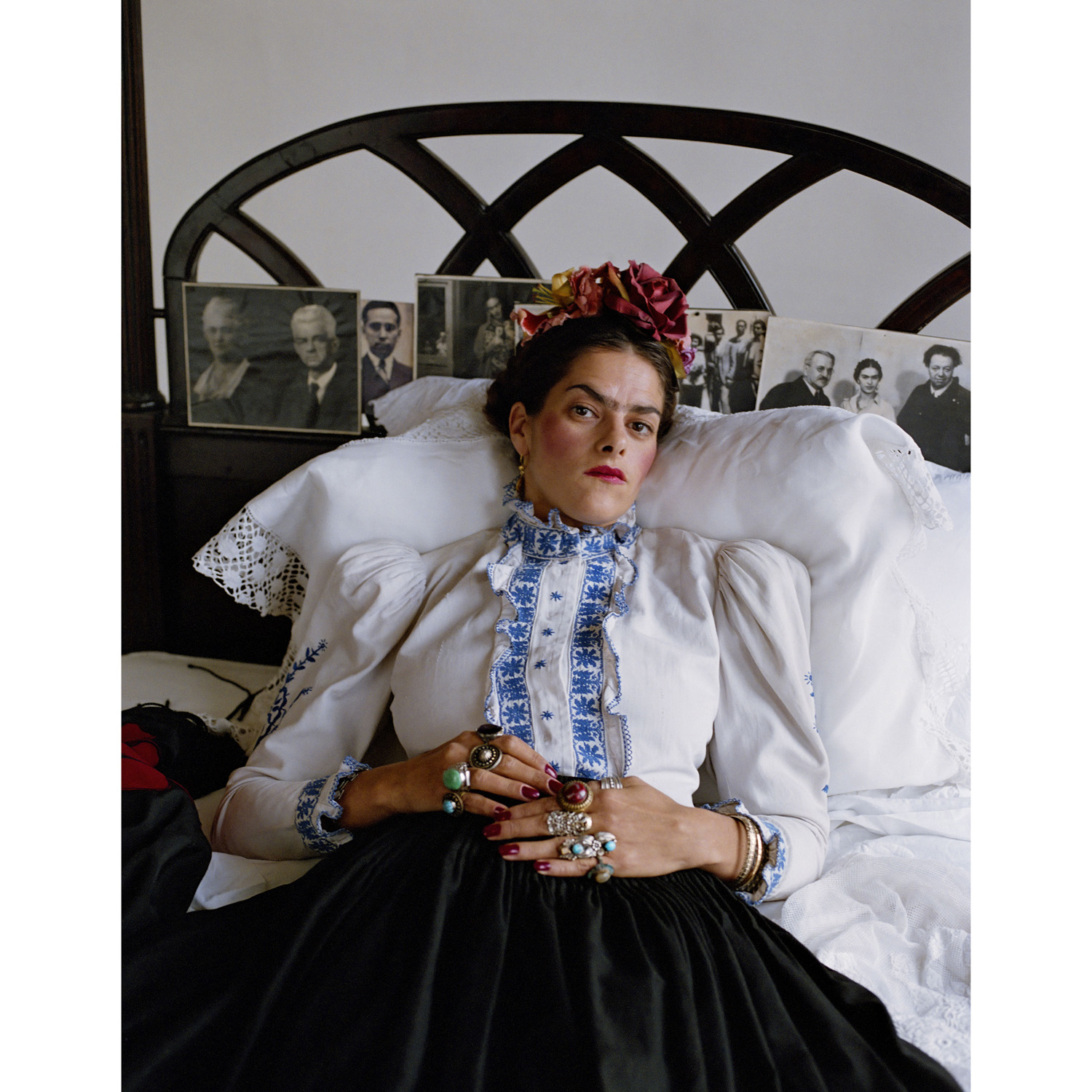
Mary McCartney, Being Frida, London 2000. (© Mary McCartney. Courtesy the artist.)
This is explored across seven thematic sections, beginning with Kahlo’s early work and culminating in the Fridamania iconography we know today. The painter’s likeness has been splashed across all kinds of merchandise in the 72 years since her death, including (but certainly not limited to) books and magazines, dolls, bottlecaps, socks, mugs, tote bags, t-shirts and even period products.
‘The concept was initiated by Mari Carmen Ramírez, Wortham Curator of Latin American Art at the Museum of Fine Arts, Houston,’ Beatriz says. ‘What attracted us to the show was that it does not follow a traditional retrospective format; it is self-referentially questioning the idea of the blockbuster exhibition itself, which felt right given that Tate Modern presented a major Kahlo retrospective back in 2005.
‘Frida has been venerated with quasi-religious devotion by millions of people worldwide, but her work didn’t circulate broadly in the United States until the 1970s,’ Beatriz adds. ‘It was the Chicana/o movement that really catapulted her onto the world stage. The exhibition grew out of a desire to unpick that story critically: to look at how her image and legacy have intersected with art, politics, feminism, Chicana/o culture, queer identity, disability, fashion and popular culture.’
You will visit this exhibition to see Frida, and you will get a good look at some of the painter’s most notable works as you wander through the exhibition’s rooms, including Self-Portrait with Thorn Necklace and Hummingbird (1940). However you will also learn about her lesser known contemporaries and successors, beginning with Galeria de la Raza’s 1978 Homenaje a Frida Kahlo and stretching up to the present day.
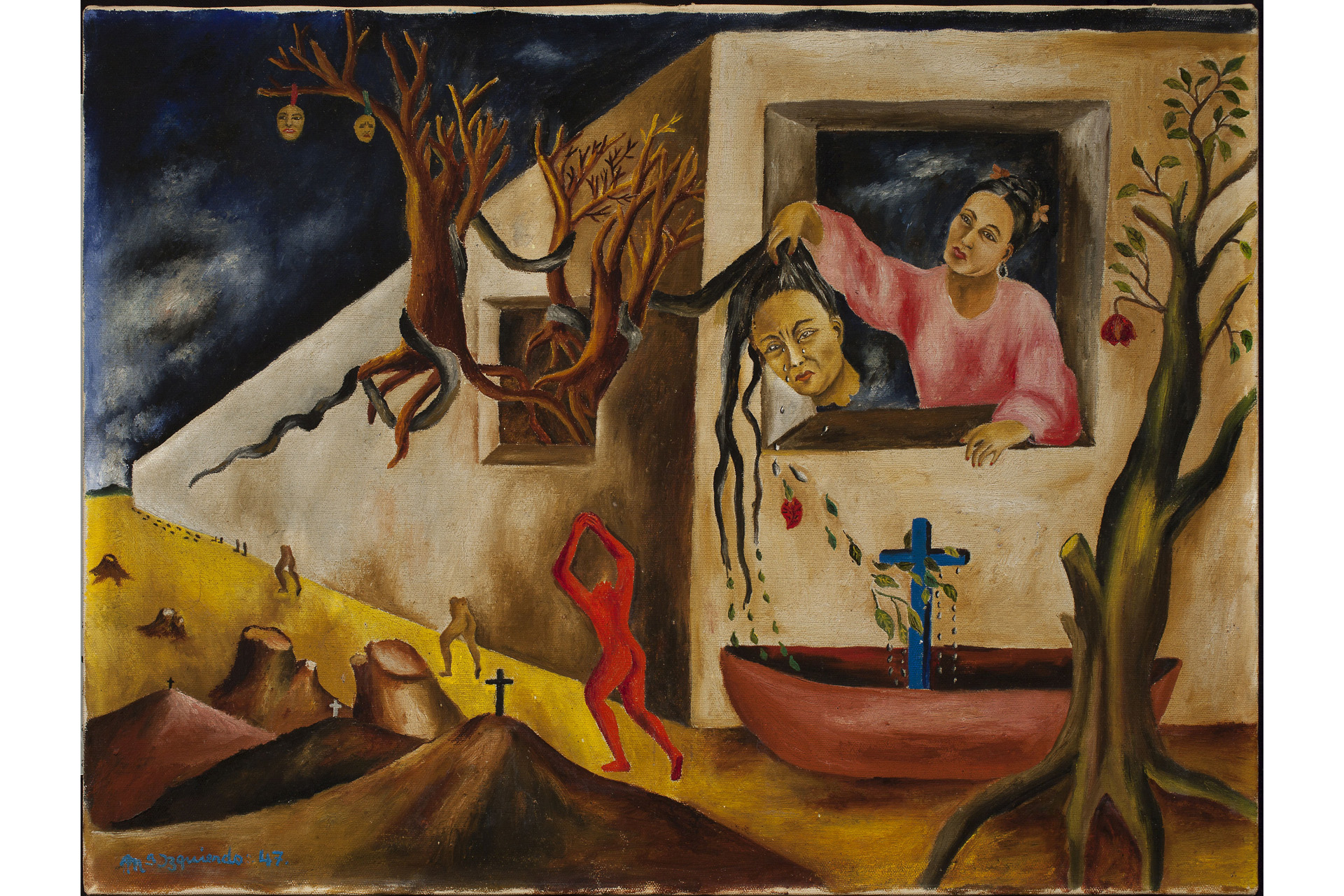
Maria Izquierdo, Dream and Premonition, 1947. Rocio and Boris Hirmas Collection.
What Is On Display?
‘The show is organised into seven thematic sections,’ Beatriz shares. ‘It opens with “Construction/Self-Construction”‘, exploring how Kahlo articulated her many ‘selves’, the avant-garde artist and intellectual, the political activist, the Tehuana, the devoted wife, through a selection of her work, her clothing, and photographs taken of her. It also looks at how her contemporaries in Mexico were investigating self-portraiture to convey both interior life and the revolutionary spirit of the time.
‘”Surrealist Affinities” then traces her pivotal encounters with André Breton and the international exhibitions that first brought her global attention, the affinities her work shares with Surrealism (even as she rejected that label), and the artistic relationships she had with other Surrealist women artists in Mexico,’ Beatriz continues. ‘”On the Other Side of the Border” is possibly the crux of the show, positioning the Chicana/o Movement as the moment when her work and image were first widely appropriated and circulated, and examining how Chicana/o artists in the US reclaimed her as a symbolic ancestor.
‘”Gendered Dialogues” goes on to explore her radical investigations into gender, sexuality and the female body, and their influence on second-wave US feminists like Kiki Smith, Judy Chicago and Miriam Schapiro, as well as transnational feminisms in Mexico and India,’ Beatriz continues. ‘”A Proactive Legacy” brings together artists who have appropriated her image and self-fashioning, and who are influenced by Frida’s bold depictions of disability. “Neo-Mexicanisms” then focuses on a group of 1990s Mexican artists who embraced Frida in the context of economic neoliberalism and LGBTQ+ activism.
‘And finally, “Fridamania” takes a critical look at the extreme commodification of her art and persona through close to two hundred objects: dolls, merchandise, folk objects, fashion magazines and publications,’ Beatriz says.
Throughout the exhibition, Kahlo’s work is spliced by the work of other artists, as well as photographs, sketches, clothing and videos. As Beatriz puts it: ‘The exhibition creates dialogues across time and geography. Kahlo’s works are displayed alongside artists who have responded to her staging of identity, the body, personal experience and politics. For instance, Chicana/o artists in the United States reclaimed Kahlo as a godmother and symbolic ancestor from the 1970s onwards, connecting her to questions of labour, migration, and self-representation. Later artists drew on Kahlo’s bold depictions of the body, pain, gender and sexuality to address subjects that had often been marginalised or silenced.’
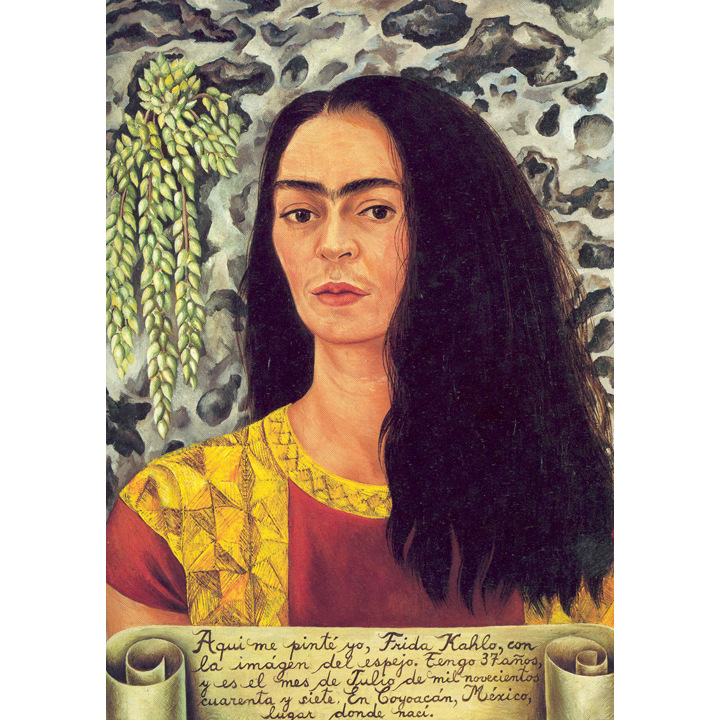
Frida Kahlo, Self Portrait with Loose Hair, 1946. Private collection.
The Highlights
Though only 23 of Kahlo’s works have made their way to London for Frida: The Making of an Icon, there are still some big hitters. ‘The exhibition includes two of Frida’s most important self-portraits: Self-Portrait with Thorn Necklace and Hummingbird and Self-Portrait with Loose Hair,’ Beatriz says. ‘It also brings together important works connected to her Surrealist exhibitions, including The Heart (Memory), Tunas and The Frame, which was acquired by the Jeu de Paume during her Paris exhibition in 1939, along with the original butterfly frame for Self-Portrait (for Jacqueline Lamba), only recently rediscovered by the Estate.
‘Self-Portrait with the Portrait of Doctor Farill is another extraordinary work,’ Beatriz adds. ‘One of her last self-portraits, it depicts her painting her doctor’s portrait from a wheelchair, using blood from her open heart.’
As for special rooms: ‘Another key moment is the Chicana/o section,’ Beatriz says, ‘which includes work connected to the 1978 Homenaje a Frida Kahlo exhibition at Galería de la Raza in San Francisco, one of the first exhibitions in the United States devoted to Kahlo and departs from Frida’s own experience of and ambivalence towards the US, which she expressed in My Dress Hangs Here.’
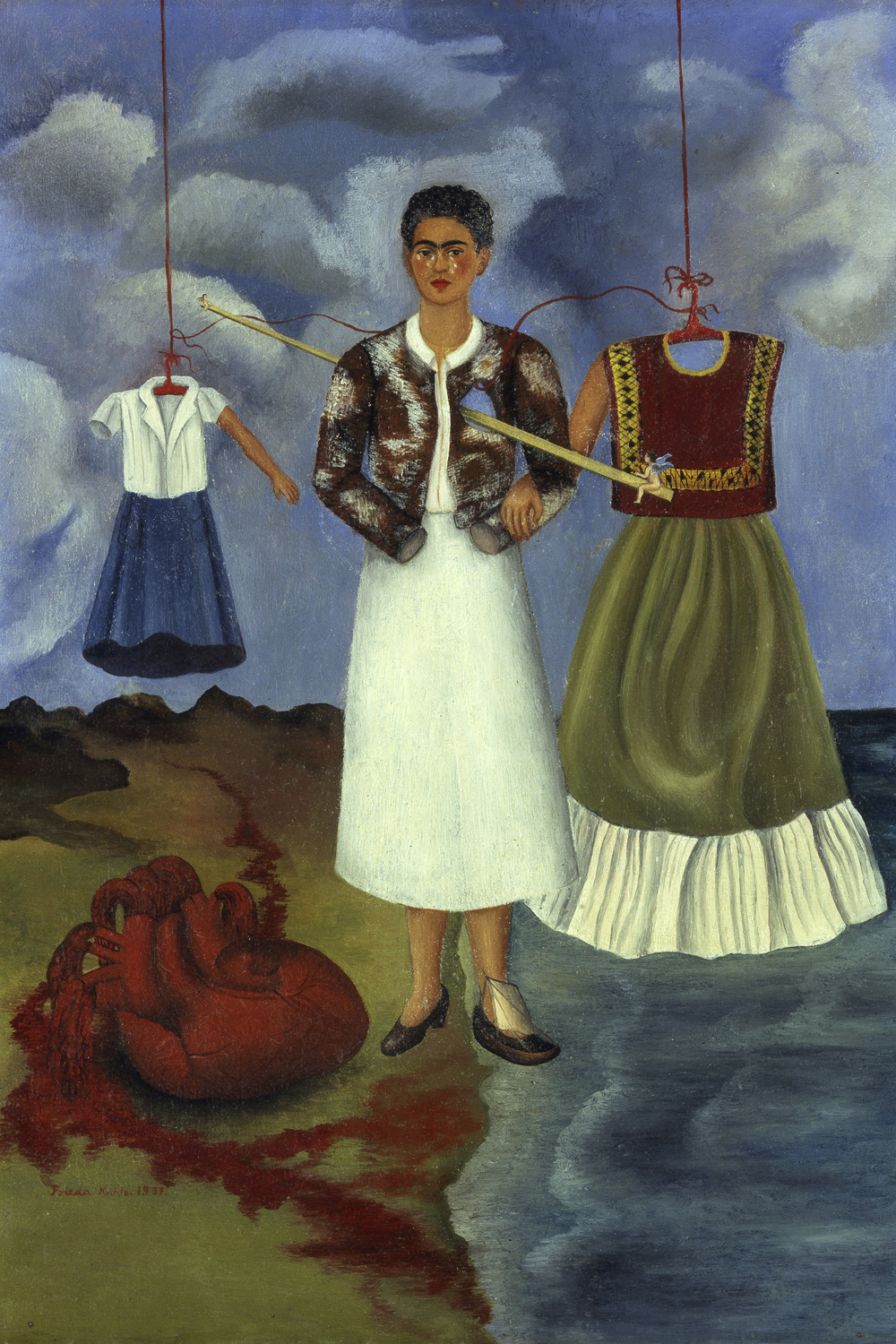
Frida Kahlo, Memory (The Heart), 1937. Private Collection.
The Takeaway
‘There are a number of artists in the show who will be relatively unknown to UK audiences,’ Beatriz says. ‘Visitors may also be surprised by the Fridamania room, which presents close to two hundred objects as a critical investigation into the commercialisation and circulation of Frida’s image – a thematic selection of dolls, magazines, publications, folk objects and merchandise that explores the many different ways people have “owned” Frida.’
While You’re There
‘This summer is a particularly exciting moment for Latin American art at Tate Modern,’ Beatriz shares. ‘Alongside Frida: The Making of an Icon, visitors can also see Julio Le Parc’s Light. Colour. Action., which opened on 11 June, and Ana Mendieta, which opens on 15 July and is placed in direct conversation with the Frida exhibition. It’s also worth making time for the free collection displays.’
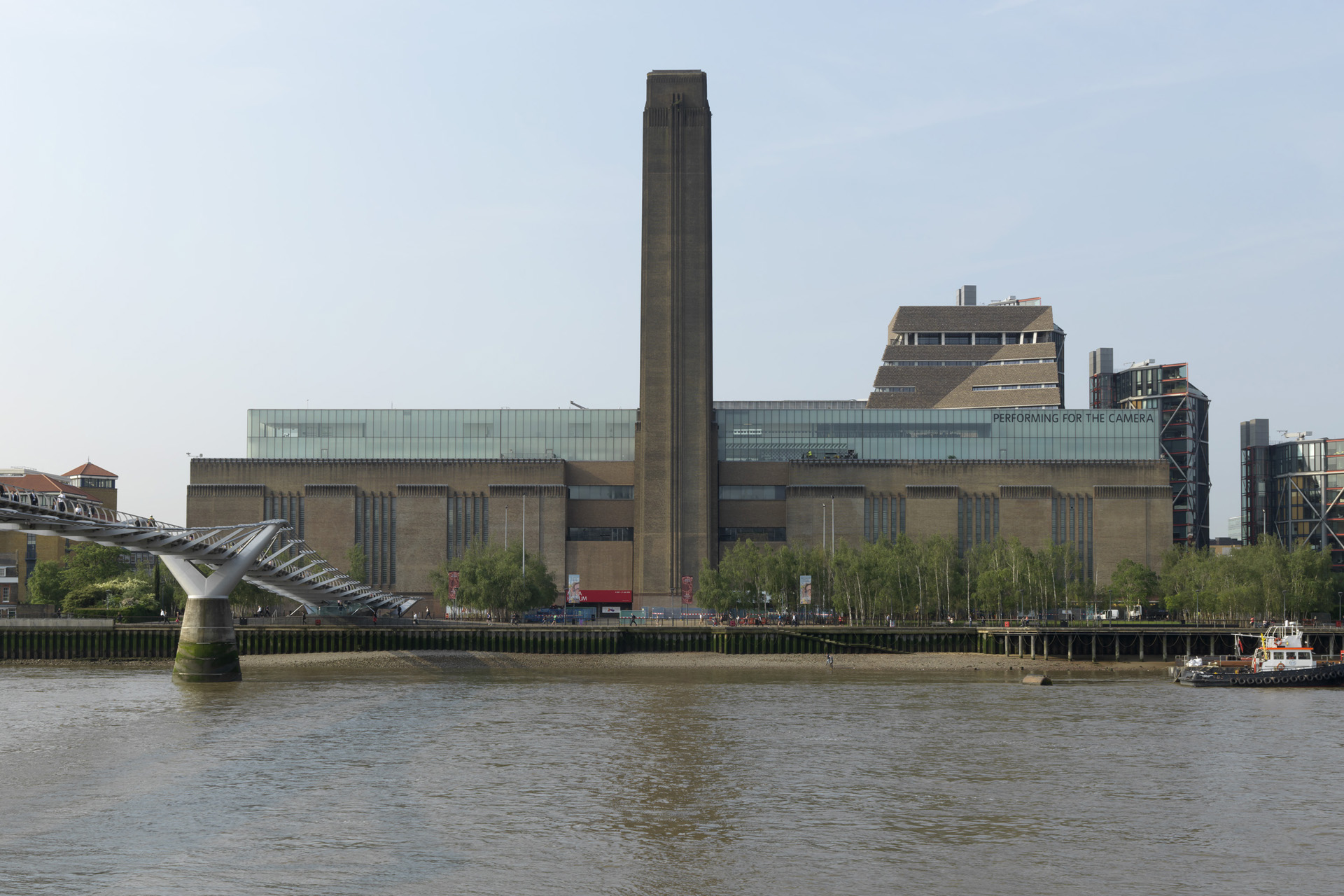
(© Tate Photography)
Where To Go After
‘A wonderful way to continue the visit is with Santiago Lastra’s takeover of the Tate Modern Restaurant, running from 25 June to 31 August,’ Beatriz recommends. ‘We’ve collaborated with Santiago, founder of the Michelin-starred Mexican restaurant KOL, on a menu inspired by the exhibition, so it’s a very fitting way to round off the experience.
‘For something more informal, Corner at Tate Modern is a great option just nearby, and Borough Market has an excellent selection of restaurants with a lovely walk along the Thames to get there,’ Beatriz adds.
Best Time To Visit
‘Friday and Saturday evenings are a great option,’ Beatriz recommends. ‘Tate Modern is open until 9pm, with last entry 30 minutes before closing, so visitors can come after work or make it part of an evening out. Sunday to Thursday, opening hours are 10am to 6pm.’
The Details
- Where? Tate Modern, Bankside, London SE1 9TG
- When? 25 June 2026–3 January 2027
- Opening Hours: 10am–6pm Sunday to Thursday; 10am to 9pm Friday and Saturday
- Tickets: General admission is £25pp with concessions available. Members can visit for free.
- Guide? A smartphone audioguide is available for £5, to be used with your own device and headphones; no headphones or physical audio devices are available at the exhibition.
- How Long? You will want to set aside one to two hours to explore the exhibition in full.