


What Is Queen’s Tennis? (& How To Watch At Home)
By
2 months ago
This beloved British tournament returns next week
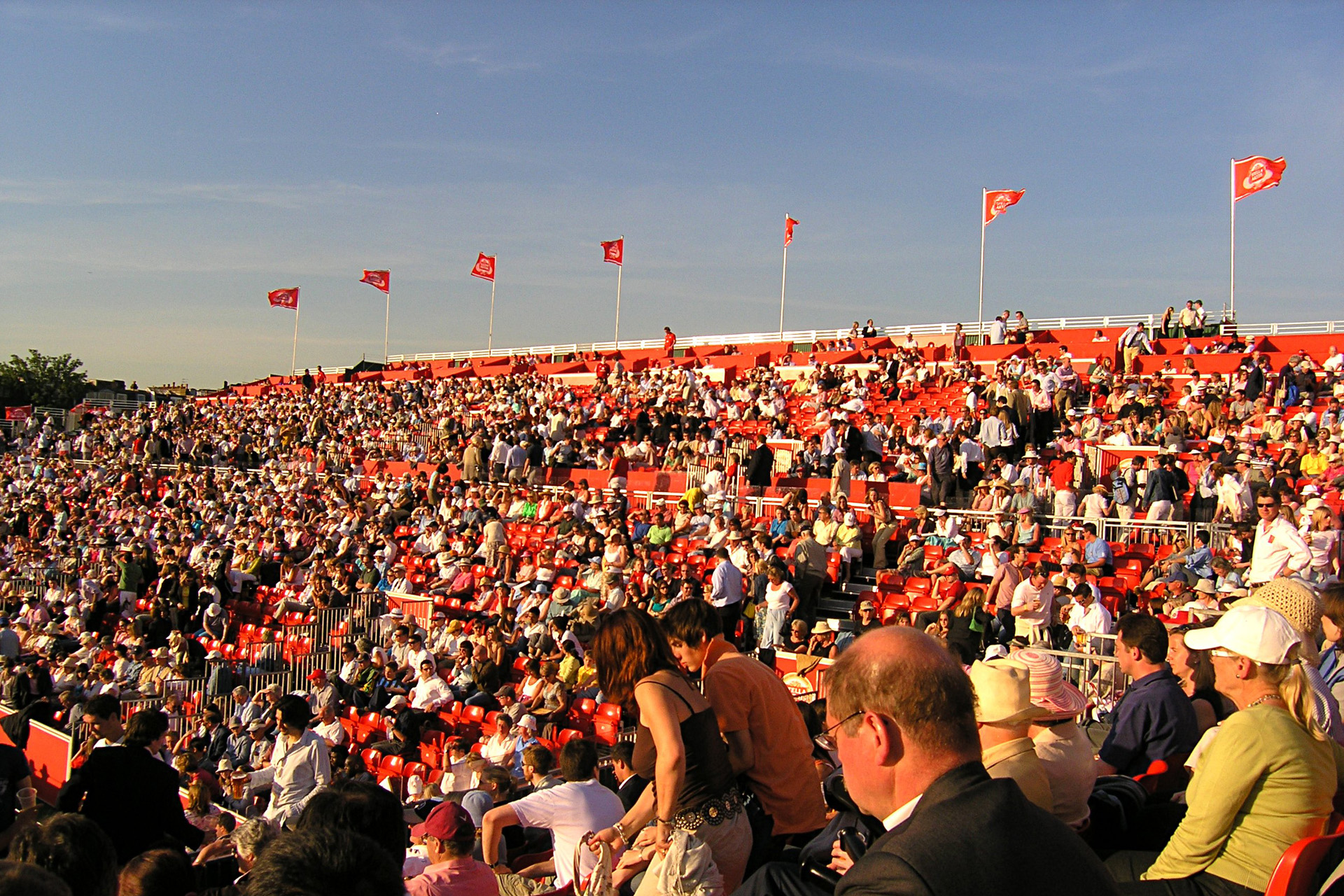
Wimbledon may be the best known British tennis tournament, but Queen’s is our British tennis number one’s favourite to tournament on home shores. ‘I love being at home there,’ Cameron Norrie told C&TH ahead of the tennis season in 2023. ‘The whole grass season is just so special, and it leads up to Wimbledon, which I’m so excited for.’
But what is Queen’s tennis? Here we take a look at the history – plus share how we can watch from home.
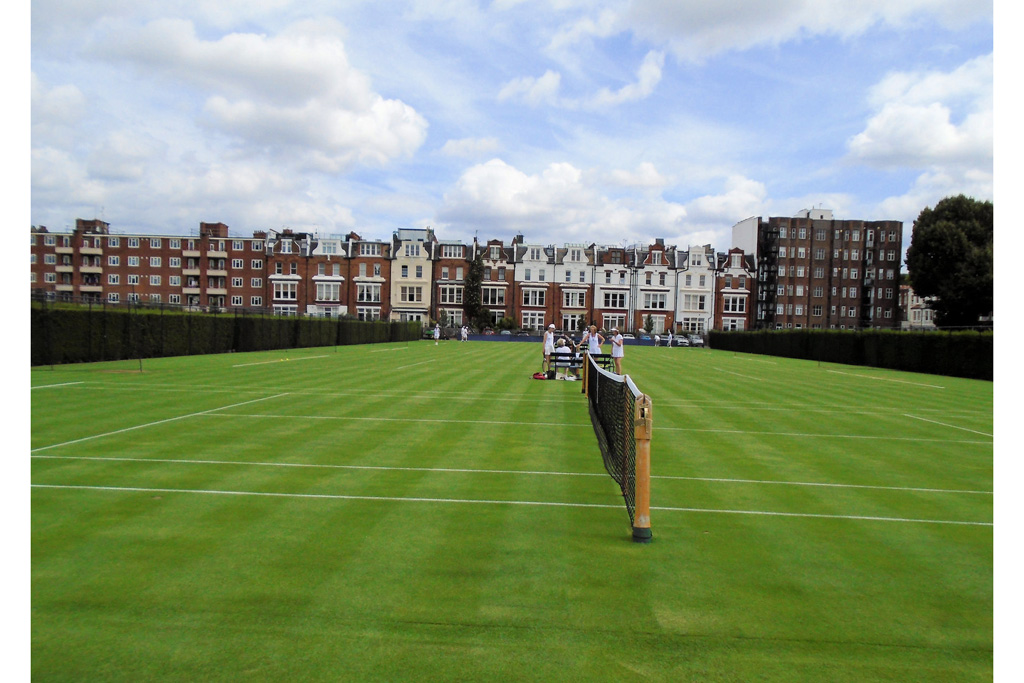
Queen’s Club grass court © Paul Gillett, CC BY-SA 2.0, via geograph.org
Queen’s Tennis: A Guide To The 2026 Grass Tournament
The Queen’s Tennis Tournament – also known as the Queen’s Club Championships, the HSBC Championships (for its title sponsor), or simply Queen’s – is an annual grass court tennis competition held at the Queen’s Club in West Kensington, London. In 2026, Queen’s will run from 8–21 June.
Founded 140 years ago (in 1886), Queen’s welcomed both male and female players every year until the women’s competition was discontinued in 1974. From then, the week-long tournament only welcomed ATP players, and was widely regarded as a Wimbledon warm-up. Flash forward to 2025 and Queen’s was finally added back on the WTA Tour, doubling the tournament in length from one to two weeks.
While the move wasn’t without its controversies – ATP players in particular lamented the poor condition the Queen’s grass might be left in going into week two of a tournament – WTA players embraced the opportunity for more high profile matches on British turf. Top 10 players Zheng Qinwen, Madison Keys and Emma Navarro all competed, alongside reigning Wimbledon champion Barbora Krejcikova and Brits Katie Boulter and Emma Raducanu. In the end, German player Tatjana Maria came out on top (on the men’s side, it was Carlos Alcaraz).
With women’s tennis back on the Queen’s agenda for good, in 2026, 2025 finalist Amanda Anisimova, British star Radacanu, world #2 Elena Rybakina and more are set to compete. On the men’s side, we will see the likes of reigning champion Alcaraz, Brits Norrie and Jack Draper and Aussie #1 Alex de Minaur.
For both the men’s and women’s tennis tours, Queen’s is a category 500 tournament. This is the fourth tier of competition, with up to 500 points awarded to players’ rankings, meaning plenty of top players come here to boost their score. For comparison, a Grand Slam (Wimbledon, Roland-Garros, US Open, Australian Open) is worth 2,000 points.
Dating back to 1890, Queen’s is one of the oldest tennis tournaments in the world. Along with Wimbledon, Queen’s is one of very few remaining grass tournaments in the world. Because of this key similarity and because Queen’s usually concludes one week before Wimbledon begins, it is often considered a warm-up for the Wimbledon Tennis Championships.
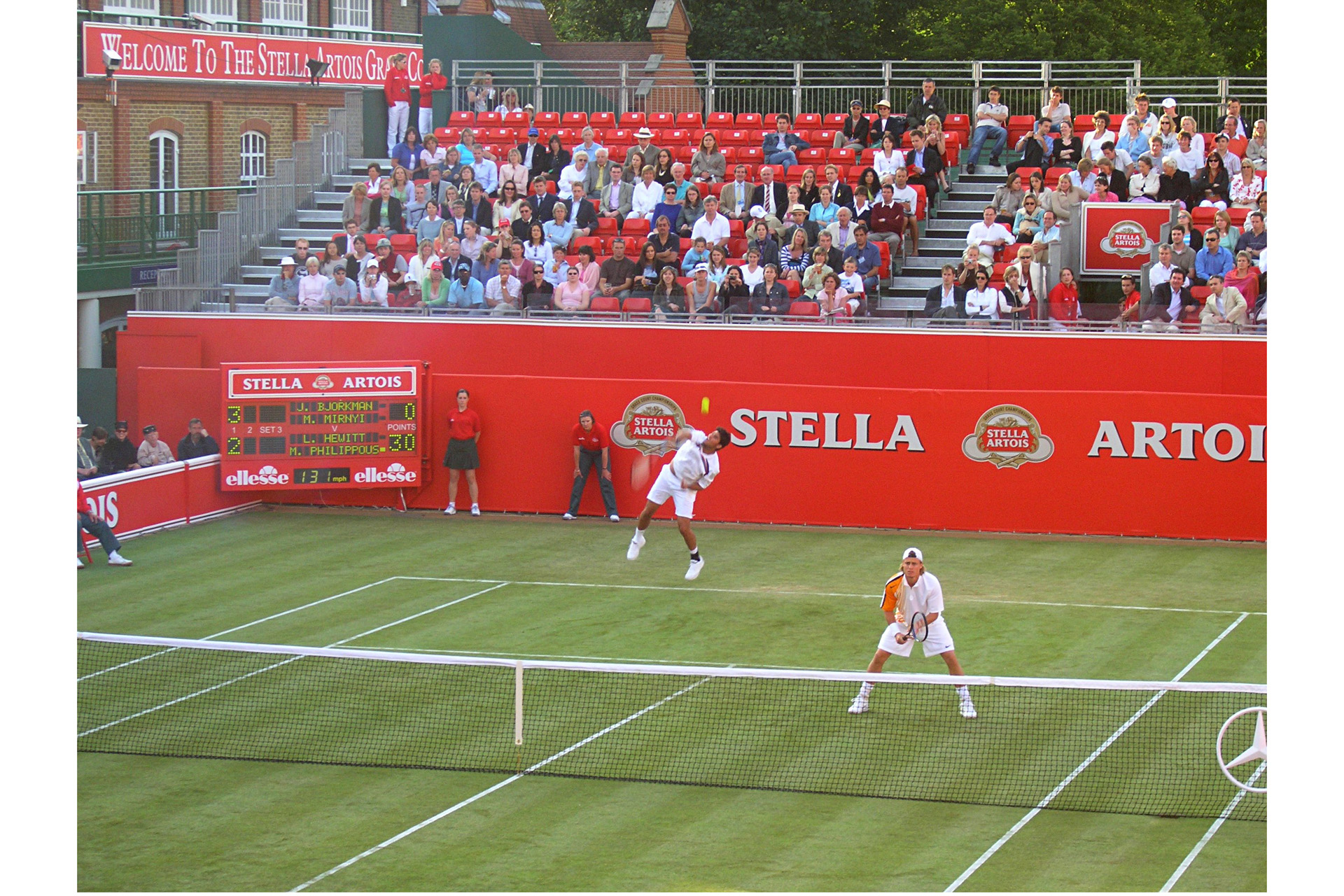
Lleyton Hewitt and Mark Philippoussis at the 2005 Queen’s Club Championships © Shermozle/Wikimedia Commons
A Brief History Of Queen’s Tennis
The Queen’s Tennis Tournament has been held at the Queen’s Club since 1890, but the tournament’s roots can be traced slightly earlier to 1881 when the London Athletic Club hosted a tennis tournament in Stamford Bridge in Fulham (now the home of Chelsea FC). In 1885, this was named the Championship of London, then the London Championships and London Grass Court Championships, before taking the name of its host club from 1977 onwards.
Despite women playing in the tournament from its beginning in 1881, the women’s competition was discontinued after 1973. Before then, the courts hosted tennis legends such as Billie Jean King, Chris Evert and Margaret Court. Since 2025, women have been back in the mix.
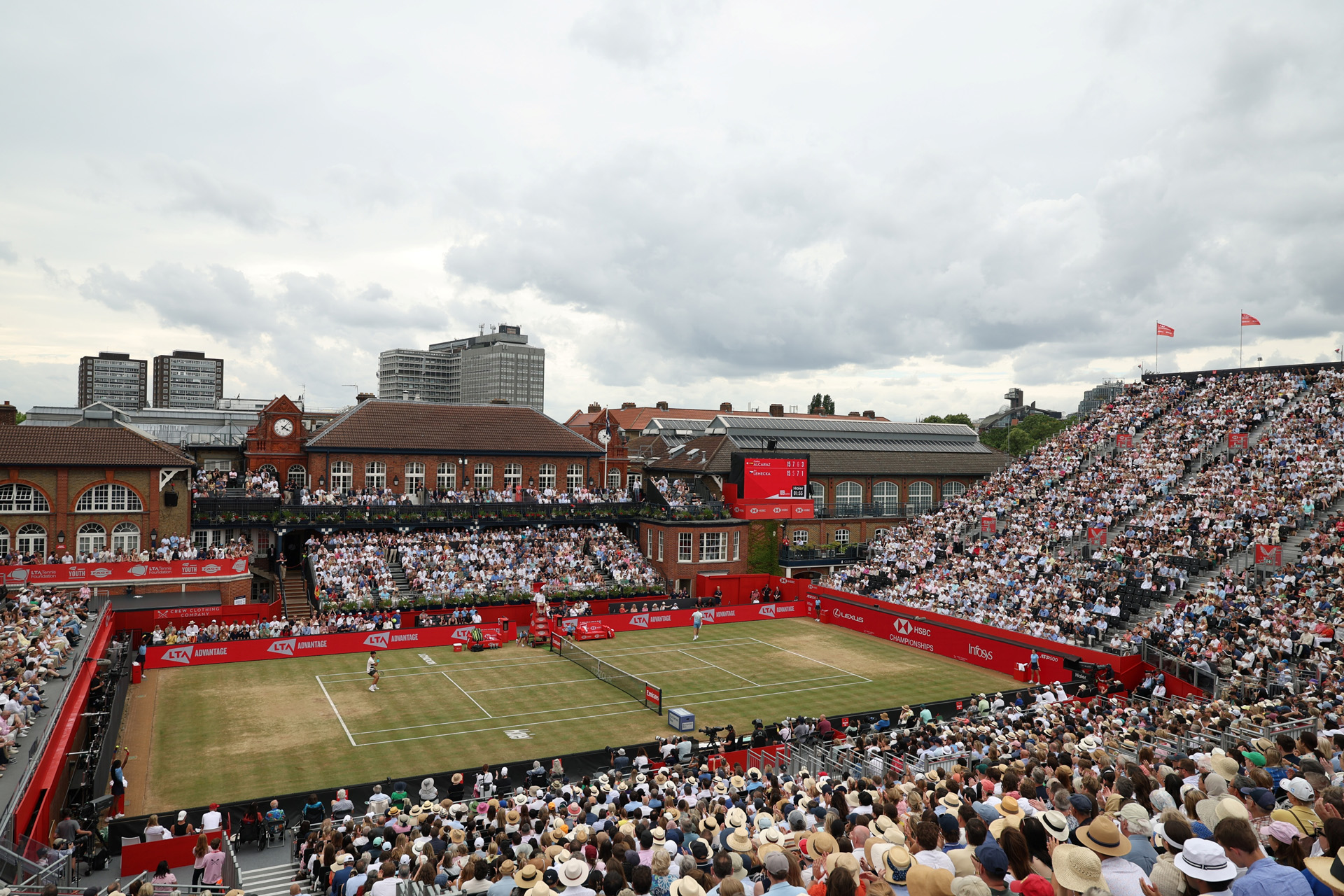
The tournament takes place every year at the Queen’s Club, a renowned private tennis club in west London, which was named for Queen Victoria in 1887 after she granted the club a royal charter. The club is home to 28 outdoor tennis courts and 10 indoor courts; it is also the national headquarters of real tennis (the original sport from which modern tennis derives), rackets and squash. Despite having so many courts, Queen’s is known for being intimate, as the courts offer a relatively small capacity compared to other major tournaments.
The tournament has always been held on outdoor grass courts, and is known for providing a fast and challenging surface, demanding great skill from the players. Singles matches are played as ‘best of three’, and doubles competitions also take place here.
The record holding winner is Andy Murray, who has won Queen’s a total of five times. Because it is thought of as a precursor to Wimbledon, it’s always worth keeping your eye out for the Queen’s results – they might just hint at who is going to prevail later in the summer…
(Getty Images for LTA)
Who Is Playing In 2026?
Find the full singles draw below (Brits first, naturally).
WTA500 (8–14 June):
- Emma Raducanu (GBR) – No. 39
- Elena Rybakina (KAZ) – No. 2
- Jessica Pegula (USA) – No. 5
- Amanda Anisimova (USA) – No. 6
- Victoria Mboko (CAN) – No. 9
- Belinda Bencic (SUI) – No. 11
- Marta Kostyuk (UKR) – No. 15
- Iva Jovic (USA) – No. 17
- Sorana Cirstea (ROU) – No. 18
- Leylah Fernandez (CAN) – No. 22
- Diana Shnaider – No. 23
- Anna Kalinskaya – No. 24
- Hailey Baptiste (USA) – No. 26
- Liudmila Samsonova – No. 27
- Marie Bouzkova (CZE) – No. 28
- Ann Li (USA) – No. 29
- Jaqueline Cristian (ROU) – No. 32
Note that while Russian players Shnaider, Kalinskaya and Samsonova can compete, they cannot do so on behalf of their country amid the Russian invasion of Ukraine.
ATP500 (15–21 June):
- Cam Norrie (GBR) – No. 24 (British no. 1)
- Jack Draper (GBR) – No. 50
- Alex de Minaur (AUS) – No. 7
- Lorenzo Musetti (ITA) – No. 11
- Jiri Lehecka (CZE) – No. 12
- Luciano Darderi (ITA) – No. 17
- Valentin Vacherot (MON) – No. 19
- Tommy Paul (USA) – No. 21
- Alejandro Davidovich (ESP) – No. 23
- Arthur Rinderknech (FRA) – No. 25
- Francisco Cerundolo (ARG) – No. 26
- Jakub Mensik (CZE) – No. 27
- Rafael Jodar (ESP) – No. 29
- Corentin Moutet (FRA) – No. 34
- Alexander Blockx (BEL) – No. 36
- Ugo Humbert (FRA) – No. 58
- Brandon Nakashima (USA) – No. 62
- Alejandro Tabilo (CHI) – No. 68
- Holger Rune (DEN) – No. 74
- Denis Shapovalov (CAN) – No. 81
- Jaume Munar (ESP) – No. 88
- Adrian Mannarino (FRA) – No. 95
- Marin Cilic (CRO) – No. 112
What’s The Prize?
The winner of Queen’s doesn’t just walk home with a trophy and 500 points: there’s a lucrative cash prize to enjoy, too. The winner of the women’s tournament will take home £1.43 million in 2026, a 35 percent increase on 2025. The men’s winner will bag £2.238 million.
There’s a bit of a disparity there – and it’s a tale as old as time. The LTA has a minimum prize value for different levels of tennis tournament, and has pledged to offer equal prize pots at Queen’s and Eastbourne no later than 2029.
How To Get Tickets
Tickets should be purchased directly through LTA at tickets.lta.org.uk, with prices starting at £15pp.
The full tournament takes place at Queen’s Club, Palliser Rd, London W14 9EQ.
Where To Watch Queen’s Tennis On TV 2026
If you can’t be there IRL, luckily BBC has plenty of coverage planned.
Isa Guha is presenting the BBC’s coverage of the women’s Queen’s Tennis Tournament in 2026 across BBC Two, BBC Sport and BBC iPlayer. From Monday 8 June, coverage will begin at 1pm everyday on BBC Two and BBC iPlayer until Friday 12 June. On Saturday 13 June, coverage of the women’s semi-finals will begin at 1.25pm across BBC One, BBC iPlayer and BBC Sport, followed by the final from 1.15pm on Sunday 14 June. Guests include Annabel Croft, Anne Keothavong and Naomi Broady, with commentary from Sam Smith and Kat Downes.
From Monday 15 June, it’s over to the men: Clare Balding will present live coverage everyday from 1pm on BBC Two, BBC iPlayer and BBC Sport until Friday 19 June. The men’s semi-finals will be broadcast on Saturday 20 June from 1pm on BBC One, followed by the final on Sunday 21 June from 1.20pm. Clare will be joined by guests John Lloyd, Annabel Croft, Pat Cash and Leon Smith, with commentary from Andrew Castle and Andrew Cotter.