


Beyond The Dappled Light: Renoir & Love At The National Gallery
By
2 minutes ago
From flirtatious gardens to crowded dancefloors, Renoir & Love reveals an artist preoccupied with pleasure, intimacy and modern life
Pierre-Auguste Renoir does not look very happy. In the self-portrait that greets visitors to Renoir and Love, opening this weekend at the National Gallery, he is dark-eyed, haggard and almost swallowed by the murky brown background. Painted around 1875, it is an unexpectedly sombre introduction to an artist now synonymous with sunshine, sociability and romance.
First staged at Paris’s Musée d’Orsay earlier this year, from that brooding first encounter, Renoir and Love quickly becomes a story of transformation, and a celebration of love in all of its forms. Arranged broadly chronologically, the intimate six-room exhibition gathers some big hitters among its 45 works, all created in the crucial two decades between the mid-1860s and mid-1880s, and gradually revealing an artist working out how to capture modern life. His palette brightens, his brushwork loosens and, by Room 2, light begins to break across his canvases in puddles. Here Dance at the Moulin de la Galette (1876) is given a wall to itself – fitting for a UK debut exactly 150 years after its creation. So familiar as an icon of Impressionism, it is an image that almost precedes itself – but reproductions fail to capture what is an extraordinarily alive painting. Sunlight dapples clothes and faces; dresses swish; bodies turn and trees seem to move overhead, light falling through their leaves. Look closer and individual conversations emerge from the crowd, each figure caught halfway through something.
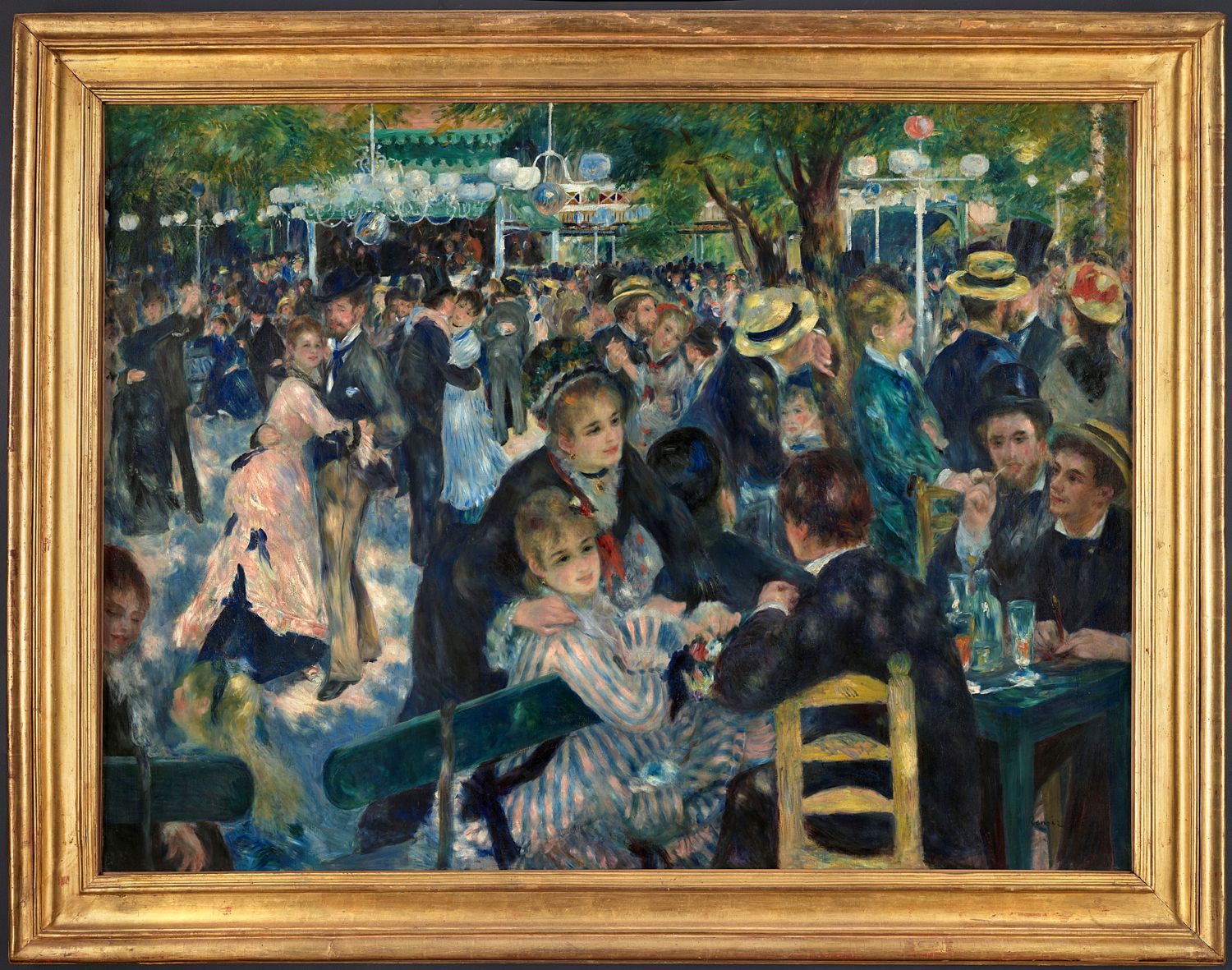
Dance at the Moulin de la Galette, Pierre-Auguste Renoir, 1876. (Gustave Caillebotte Bequest, 1896, Musée d’Orsay)
This is, ostensibly, an exhibition about love, but Renoir’s definition is generous. Across these rooms it can be romantic, maternal, platonic, sensual or simply sociable: a mother glancing towards her daughter in a crowd; friends deep in conversation; dancers pressed together; families lounging outdoors. Sometimes a figure looks directly out of the canvas, meeting our eye as if we have interrupted a conversation. Romance, though, seems to arrive most readily in summer. Renoir’s world is verdant with gardens allowed to grow a little wild, trees trembling with movement and figures escaping Paris for lunches, dances and boating trips. There are floaty dresses and boater hats, al fresco tables and lit cigarettes, matches sprinkling dusty dancefloors.
There was a social shift beneath all this languishing. New railway connections were making the outskirts of Paris increasingly accessible, while Renoir elevated scenes of ordinary modern life to the scale and seriousness once reserved for loftier subjects. By the 1870s, the corsets – figuratively and sometimes almost literally – seem to be loosening. Renoir’s people dance, drink, flirt and sprawl, and modern relaxation itself becomes worthy of painting.
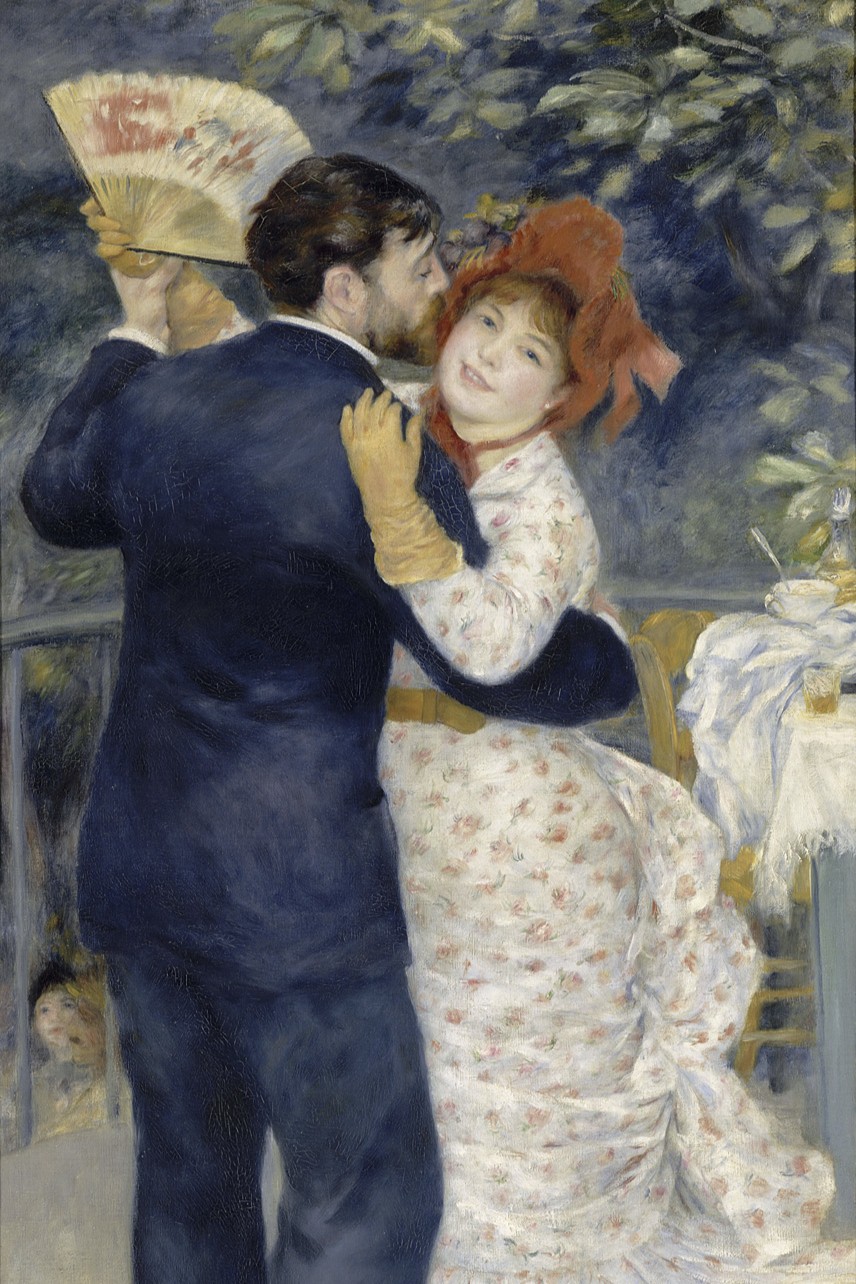
Few subjects communicate that freedom better than dance. The monumental Dance at Bougival and Dance in the Country, both painted in 1883, practically leap from the wall, hung side-by-side, both couples caught mid-turn. But they also arrive at an intriguing moment in Renoir’s career. Having pushed Impressionism towards its shimmering extreme, this is when he began pulling back. Loose brushwork gives way to harder edges and smoother, more sculptural figures as Renoir turns his nose back to the Renaissance art. The Umbrellas, reworked over several years, fascinatingly contains something of both styles, the line between them blurring somewhere in the middle, while The Great Bathers (1884–87) makes the new direction emphatic (if disapproved of critically).
Yet the turn towards the old masters does not abandon Renoir’s earlier instinct to elevate ordinary lives. If anything, it lends them new weight. In the Family room, children beam from canvases, all pudgy legs and sunlit faces, often surrounded by greenery. Motherhood (1885) depicts Renoir’s wife Aline Charigot nursing their first son, Pierre, with the dignity and tenderness of a Madonna.
By the final room, Intimacy, love has become less spectacular again. Familiar faces recur, friends sitting together as their unheard conversations unfold. Occasionally someone catches our eye, as though we have stumbled into a room already occupied. After all the dancing, boating and flirting, there’s an intimacy in sitting with this stillness.
Impressionism is so often encountered as a roomful of famous surnames: Renoir beside Monet, Degas, Pissarro and the rest, each artist understood partly through his proximity to the others. Renoir and Love makes a compelling argument for occasionally breaking up the group. In six compact rooms, Renoir emerges as something more than the painter of dappled parties: an artist who darkens, brightens, loosens and sharpens, eventually questioning the very movement he helped define.
Renoir and Love runs 3 October 2026–31 January 2027 at the National Gallery.