


5 Things Not To Miss At The New Queen Elizabeth II Exhibition
By
1 minute ago
The wardrobe of Britain’s longest-reigning monarch is now on display at The King’s Gallery
Following hot on the heels of the V&A’s major Schiaparelli show, another fashion exhibition has opened its doors in London. In celebration of what would have been Queen Elizabeth II’s 100th birthday, the Royal Collection Trust has curated a landmark exhibition dedicated to the royal’s extensive wardrobe. Opening Friday 10 April, C&TH got an early look at the Queen Elizabeth II: Her Life In Style – as well as a tour of the curator’s must-see displays.
What To Expect From Buckingham Palace’s Queen Elizabeth II Exhibition
One thing is certain about Britain’s longest-reigning monarch: she really did have a truly terrific wardrobe. Whether she chose to wear a sparkling ballgown, an acid-yellow suit or a Burberry silk scarf, Queen Elizabeth II was one of the most well-recognised royals of her time.
View this post on Instagram
But with a wardrobe so full – she did have 96 years to amass it, after all – the Royal Collection Trust certainly had a tough time narrowing down their options for one grand exhibition. With thousands of dresses, shoes, accessories and jewellery to root through, it was a mammoth task – one that Caroline de Guitaut, exhibition curator and Surveyor of The King’s Works of Art, took to with gusto.
‘Queen Elizabeth II’s fashion archive draws together clothing, millinery and accessories, including some jewellery, combined with fashion sketches, correspondence and dress records – revealing for the first time, in the most comprehensive way, a clear fashion trajectory mirroring the prevailing trends of the 20th century,’ she tells C&TH. ‘From the 40s “new look”, 50s glamour, 60s rising hemlines, 70s acid cuts and flowing prints to 80s power dressing, and beyond. (And even instances of experimenting with neon at the age of 90.)
‘The Queen found her own style, creating a look that became instantly recognisable to a global audience, and which, in its elegance and also in its idiosyncrasies, would inspire a generation of future fashion. She made her own decisions about her clothing, and that is what this archive now reveals.’

Evening gown by Norman Harnell, 1957. Worn for a state banquet given for President Eisenhower at the British Embassy in Washington, D.C (c) Royal Collection Enterprises Limited 2025, Royal Collection Trust (Photographer: Paul Bulley)
She adds that, for the very first time, a collection of fashion sketches, fabric swatches, embroidery samples submitted to the Queen for approval – ‘marked “yes”, firmly “no” or with extra notes about sleeve length, silhouettes and hem lines’ – will be on display for the public, illustrating her involvement in the creation process from start to finish.
‘There have been lots of really wonderful surprises while working on this exhibition,’ says Guitaut. ‘But the overarching point is that the Queen’s involvement in the production of her wardrobe was so key, and was to a degree that we had never really realised before. And the wonderful materials, the ephemeral materials, sketches and correspondence within this archive really helps to illustrate that for the first time.’
Curator’s Picks: Highlights From Queen Elizabeth II: Her Life In Style
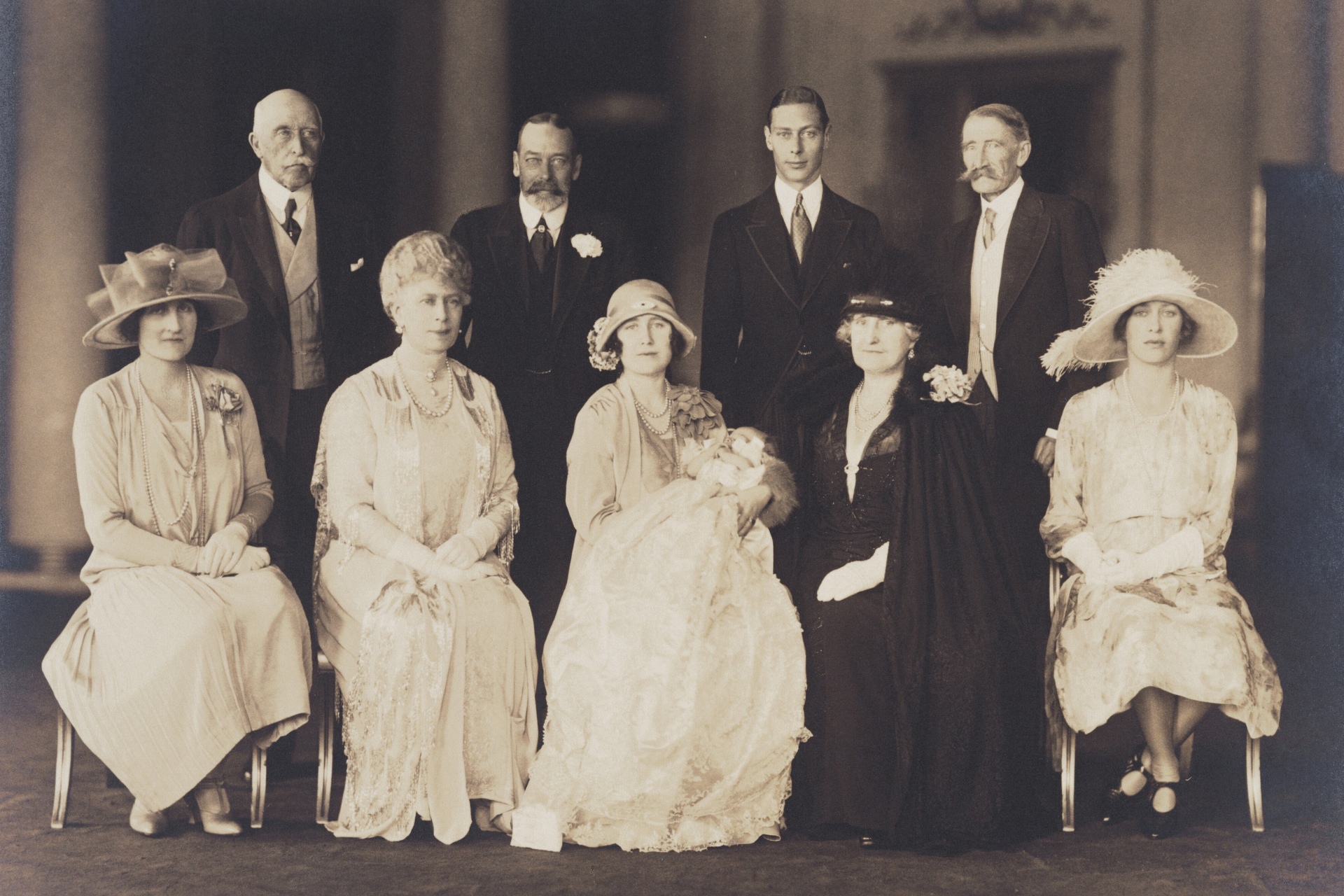
Vandyk, Princess Elizabeth after her christening with her parents, grandparents and godparents, 1926 (c) Royal Collection Enterprises Limited 2026 | Royal Collection Trust
The Christening Robe
You’ll find the first of Guitaut’s highlights in the very chapter of the exhibition. Spanning the late Queen’s childhood, the first few items on display capture her life from newborn to young girl And it’s here that Guitaut highlights one particular item: Queen Elizabeth II’s christening robe. ‘This is the first time we’ve been able to display it like this,’ the curator tells us. ‘We don’t think it’s ever been exhibited before, so it’s quite a special experience.’
She adds that this is a piece of clothing with lots of royal history, having been commissioned by Queen Victoria in the 19th century. ‘It was worn for the first time by [Queen Victoria’s] daughter, Princess Victoria, in 1841 and it is a masterpiece of British manufacture thanks to the combination of Honiton lace and Spitalfield silk,’ says Guitaut. ‘Queen Victoria championed the use of home manufacture, home production – values which we saw were also shared by Queen Elizabeth II. She did the same throughout her life, too. So there’s a really nice synergy between that piece coming so early in the exhibition, and then seeing how the relationship that the Queen had with British fashion unfurled in our time.’
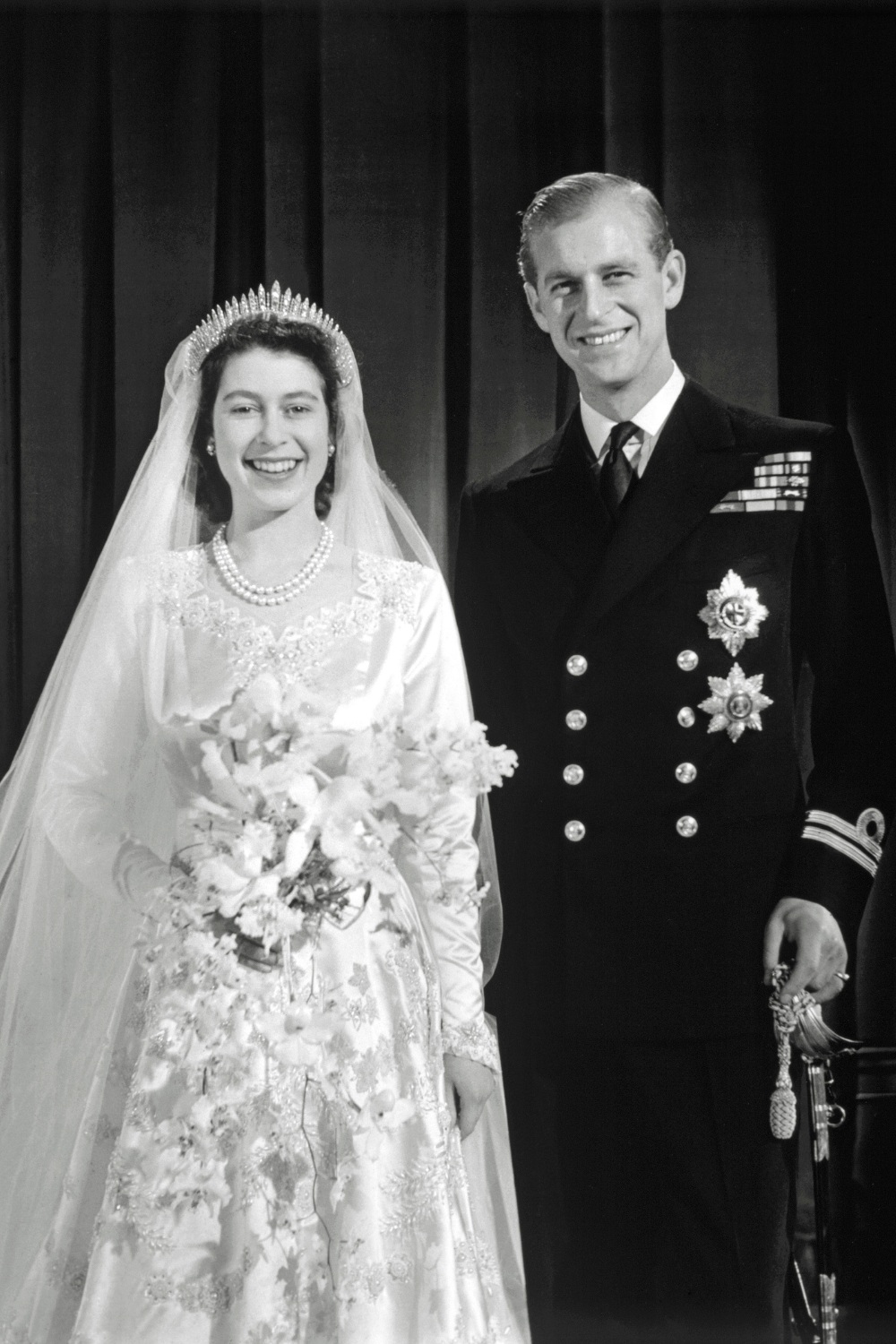
Queen Elizabeth II and Prince Philip on their wedding day, 1947 (c) Royal Collection Enterprises Limited | All Rights Reserved
The Wedding Dress
One of the major must-sees of the exhibition has to be Queen Elizabeth II’s wedding dress. Created by couturier – and close collaborator of the Queen’s – Norman Hartnell for her wedding to Prince Philip in 1947, the satin gown was allegedly inspired by Renaissance artist Alessandro Botticelli’s Primavera; a closer look at the gown reveals a detailed embroidery scheme of wheat ears (for prosperity), garlands of York roses, star flowers, jasmine and orange blossom. The exhibition brings the original dress together with the royal’s tiara, 13-foot train and Edward Rayne sandals (alongside a monogrammed ‘E’ shoebox).
‘The wedding dress is one of two really great masterpieces by Hartnell, and it’s so interesting on so many levels,’ says Guitaut. ‘It’s a historic gown, and it marks a real turning point not just in the Queen’s life, but also post-WW2 society – it marked the beginning of a new chapter.’
This also might be the final time we’ll be able to see the dress in this state. ‘It is likely to be one of the last times we can display it in this manner, on a mannequin,’ says Cecilia Oliver, Textile Conservator for the Royal Collection Trust. She notes that the dress, due to it having been originally treated with tin salts to improve the weight and drape of the fabric, has since become incredibly brittle. ‘Moving forward, we might be able to display it flat, but it will get to a point where we can’t display it anymore. And so this is a very special moment to be able to see it in its full glory, with its train, with its veil.’
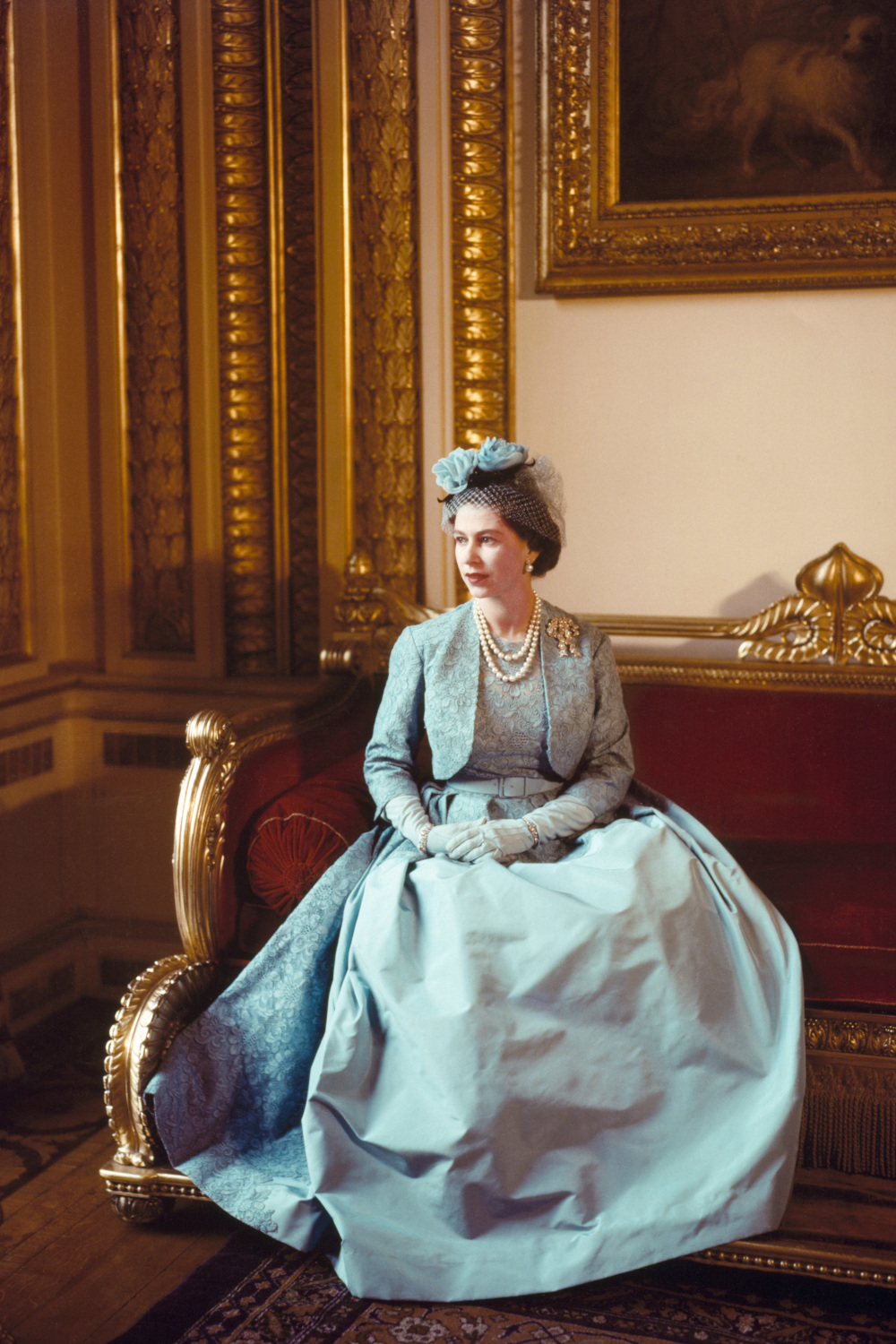
Queen Elizabeth II on Princess Margaret’s Wedding Day, Cecil Beaton, 1960 (c) Cecil Beaton, Victoria and Albert Museum
The Wedding Guest Outfit
From wedding to wedding guest, Guitaut’s next highlight celebrates the Queen’s flair for colour and texture. Visitors will recognise this gown quite quickly, since it sits front and centre on the exhibition poster. ‘This is an outfit worn for Princess Margaret’s wedding in 1960, and it marked a really interesting turning point in royal fashion,’ notes the curator. This was one of the last occasions at which all female royal guests were expected to wear full-length gowns – after this, the calf-length suits and dresses that fill the rest of this display room became more of a norm.
The ensemble in question consisted of a long blue dress and bolero by Norman Hartnell, which the Queen wore with silk and kid leather gloves, jewellery gifted to her on wedding day and bequeathed by mother, and a matching blue hat by Claude St Cyr. (The hat was adorned with roses, in a nod to Princess Margaret’s middle name ‘Rose’.)
Guitaut notes that, for some time, it wasn’t certain that all pieces from the outfit could be found in the Royal Collection Trust archives – but a little digging saw all of them reunited for the exhibition. ‘Reassembling the entire look with the hat by Claude St Cyr, the ensemble itself by Hartnell and the jewellery that goes with it was a really special thing to be able to do.’
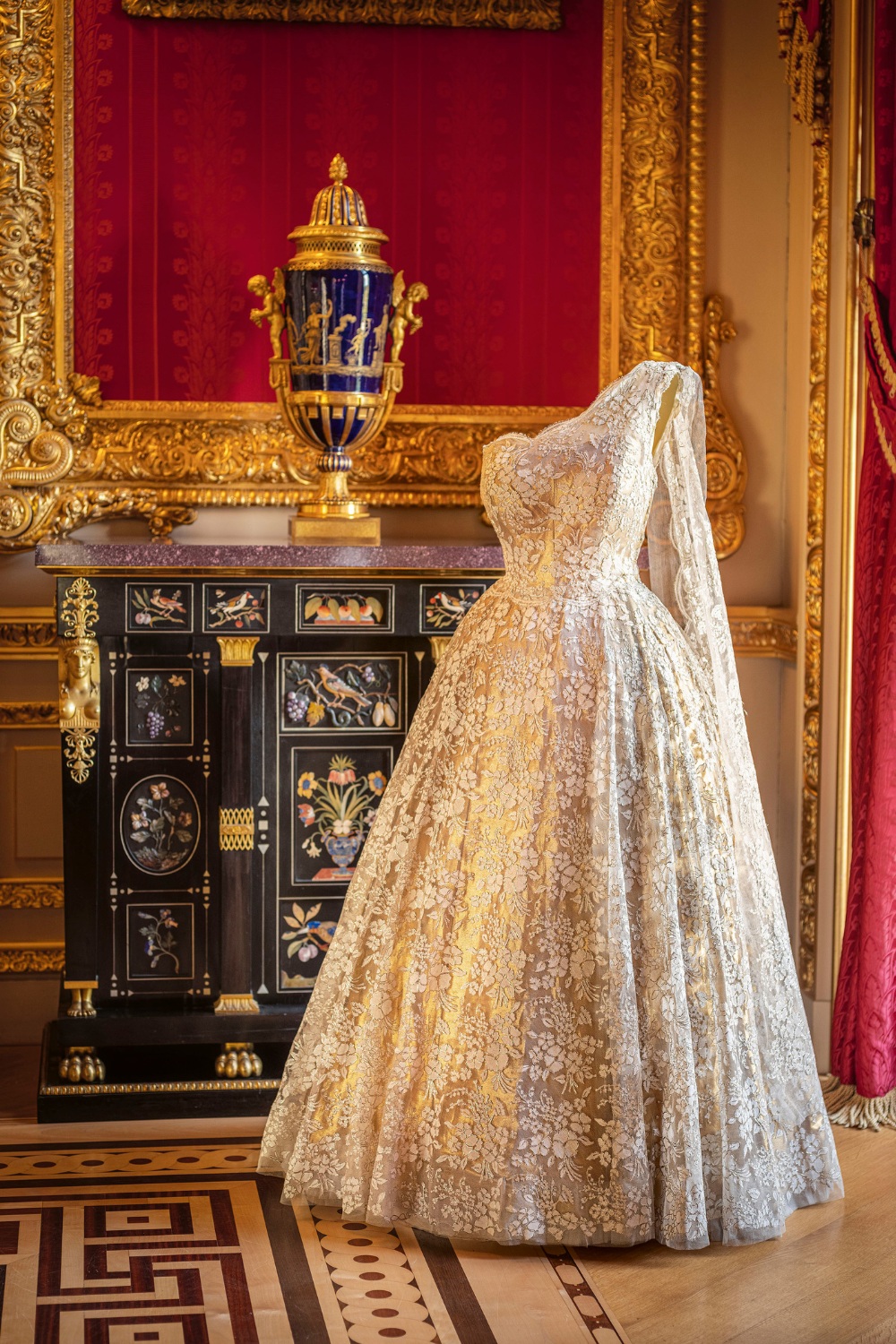
Rare surviving evening gown from Queen Elizabeth’s first Commonwealth tour as monarch, Noman Hartnell, 1953 (Photographer: Paul Bulley)
The Diplomatic Dresses
Moving into the final room of the exhibition, Guitaut describes that space as a love letter to Queen Elizabeth II’s flair for clever dressing at state events. ‘So many of the outfits displayed in this room speak to this idea of diplomatic dressing,’ says the curator.
‘A great example of this is the dress worn for a state banquet with the President of Pakistan in 1961. From the front, it seems quite plain, but the back reveals a complex construction of cultural references. There’s this dramatic waterfall pleat lined with emerald green satin at the back – the colours of the Pakistan flag, and the colours of the order of Pakistan. The gown as a whole is a key example, really, of how the Queen used colour to communicate with her audiences wherever she was.’
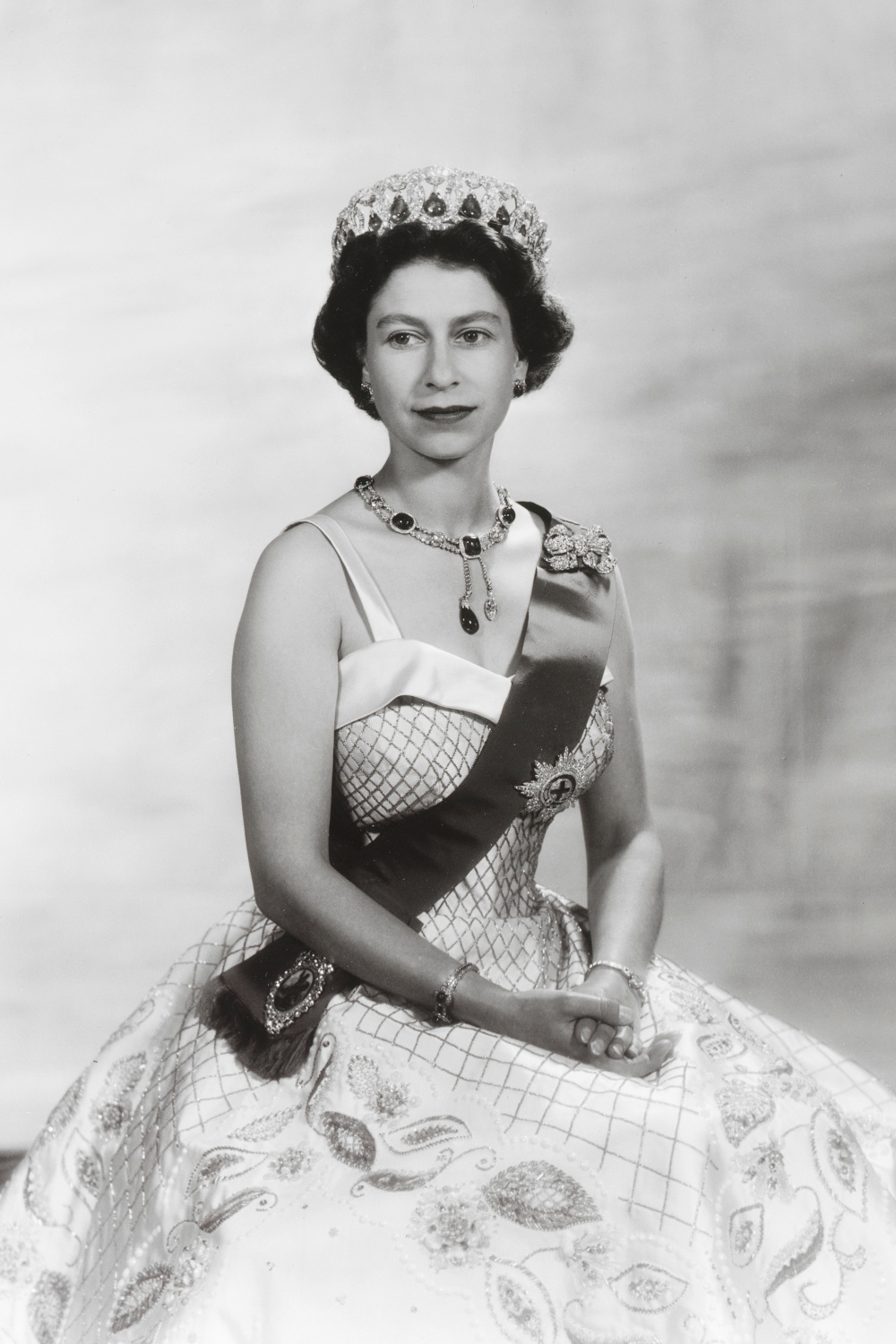
Queen Elizabeth II, Baron, 1956 © Royal Collection Enterprises Limited 2025 | Royal Collection Trust
The Coronation Gown
Guitaut chooses to end her selection with one of the most famous dresses in history: Queen Elizabeth II’s coronation gown. ‘We really can’t avoid this piece, because it is just so important,’ she emphasises. ‘It’s not just as a piece of fashion production, it’s vital history for both the Crown and the Commonwealth. And it is just a masterpiece of craftsmanship in British couture, which is something that the exhibition seeks to draw out – the techniques and the hand skills that went into every piece the Queen chose to wear.’
The Queen once again turned to Norman Hartnell for this commission, asking him in 1952 to produce a gown made of white satin – just like her wedding dress – with extensive embroidery that depicted the countries of the United Kingdom (a rose for England, a thistle for Scotland and a shamrock for Ireland) and the states of the Commonwealth. (Samples of these can be seen in detail just beneath the dress in the exhibition.) And, in a change of tradition, the royal opted for these details to be carried out in coloured embroidery (ascending typically stuck to silver and gold for their coronation) to help each emblem pop more vividly against her dress.
How To Get Tickets For Queen Elizabeth II: Her Life In Style
Tickets for Queen Elizabeth: Her Life In Style are now on sale via the Royal Collection Trust’s website. Prices start at £22 for adults and £11 for children (concessions are also available). rct.uk