






I Tried XERF, The Original ‘Non-Surgical Facelift’ – Here’s What Happened
By
2 months ago
London welcomes XERF, a new 'non-surgical facelift' offering skin tightening and rejuvenation without invasive procedures or recovery time.
A new treatment has just landed in London, promising to tighten and rejuvenate the skin without needles, numbing cream or downtime. When I read about it, it instantly grabbed my attention, as, personally, I lean towards non-invasive treatments. I am also very interested in K-beauty (the treatment originates from South Korea), and the philosophy behind it, where skin health is optimised by favouring prevention, hydration and long-term skin health rather than quick fixes. Dubbed the ‘non-surgical facelift’, XERF uses radiofrequency energy to heat the tissue beneath the skin, with the aim of stimulating collagen and elastin while tightening existing tissue. Intrigued, and a little curious, Laia Farran Graves went along to try it for herself.
What Is XERF, The Radiofrequency Treatment Behind The ‘Non-Surgical Facelift’ Trend?
What Is XERF?
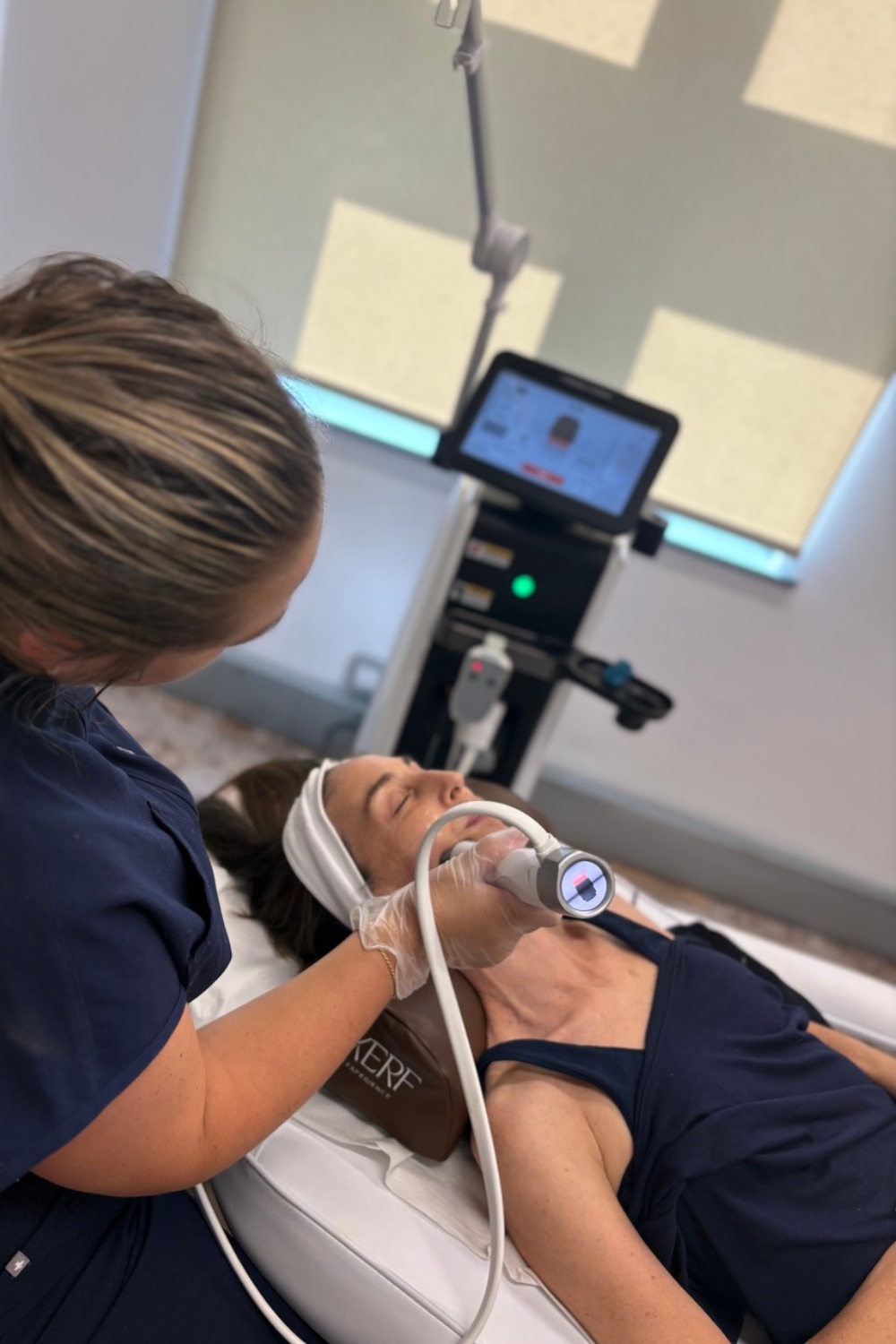
XERF is a machine-based radiofrequency treatment that uses controlled energy to heat the tissue beneath the skin’s surface. What makes it different from conventional radiofrequency treatments is that the energy isn’t simply delivered at one predetermined level across the entire face. Instead, using a handpiece that is repeatedly pressed against your skin, the device measures tissue resistance in each area and adjusts the energy according to where it’s being treated.
XERF has arrived in the UK as part of a wider category of treatments that sit somewhere between traditional facials and more invasive cosmetic procedures, offering structural skin tightening without resorting to surgery.
While XERF isn’t intended to replace a traditional surgical facelift, this new wave of treatments encourages skin health as part of a wider longevity movement, which is increasingly replacing the notion of the quick fix. It is a philosophy that seems to be gathering pace, and one I find particularly interesting.
For those considering surgery, treatments such as this are certainly worth exploring as part of the wider conversation around non-surgical skin tightening. For best results, I was told that two treatments are suggested, at least four weeks apart.
The cutting-edge technology originated in Korea, where it launched in June 2024, and is now being introduced to the UK market.
XERF By Numbers
- More than 50 UK pre-launch clinic orders secured
- More than 1,200 devices sold in the US
- Around 2,500 devices sold worldwide
- More than three years in development
- Nine clinical papers to date
- Approximately 6,000 treatments reportedly carried out per day across the US
XERF has also attracted plenty of celebrity attention, with Kim Kardashian famously posting about the treatment on Instagram and receiving millions of views.
View this post on Instagram
The Treatment: XERF
Before my appointment, I was advised to drink two litres of water a day in the days leading up to the appointment and avoid alcohol and caffeine for at least 24 hours before my treatment, to ensure I was fully hydrated. I was told that one of the most important factors in achieving the best possible results is being well hydrated. The better hydrated you are, I was told, the more comfortable your treatment is likely to be, and the more effectively the technology can perform.
This was followed by a very detailed medical questionnaire (do you have any metal plates, pins, screws, joint replacements, or pelvic floor mesh anywhere in your body?) to ensure I was a suitable candidate.
I arrived at the clinic feeling a little apprehensive. I was travelling straight after the treatment, so I was really hoping that the promise of ‘no downtime’ was a legitimate claim. And, for me, it was.
I lay down on the treatment couch, and a grounding pad (a silver sticker) was placed on my back, with a cable attached to it. The machine was then switched on, emitting a friendly hum which turned into a soft, almost hypnotic bleep, and the treatment began.
The warm feeling on my face was much more comfortable than I had anticipated. For the most part, it felt like a hot stone massage, and I could easily have fallen asleep. Occasionally there was a noticeably hotter pulse, but it was completely manageable and over almost as quickly as it had first arrived.
The whole treatment, I treated my whole face and neck, lasted approximately 90 minutes, and my therapist worked methodically, covering eight areas of the face and neck: the forehead, lower face, jowls and neck on both sides.
The Science Bit
My therapist explained to me that radiofrequency works by delivering heat beneath the skin’s surface, and that XERF incorporates ICD cooling to protect the epidermis, allowing the deeper tissue to reach the temperatures required for the treatment.
She told me that the temperature at the skin’s surface is kept between 38 and 43 degrees, which translates to around 40–60 degrees in the deeper fibrous layers. The result? The heat causes an immediate contraction or tightening response, while also encouraging the longer-term production and remodelling of collagen and elastin.
And the beauty of the treatment is that the aim is for this response to continue after the treatment itself has finished.
On a more technical note, unlike conventional single-frequency monopolar radiofrequency systems, XERF uses two RF frequencies, 6.78 MHz and 2 MHz, which can be used in different combinations to target different tissue depths. In addition, the technology delivers controlled radiofrequency energy not only to the skin but also to deeper soft tissues, reaching the SMAS and repositioning fat cells within that layer, making it part of a broader movement towards regenerative, minimally invasive treatments.
There are also three treatment modes: shallow (designed for thinner areas such as the forehead and periocular region), middle (aimed at the dermis and superficial adipose layer in areas including the cheeks and neck) and deep (designed to target denser tissue and deeper adipose structures in the lower face).
The idea behind this is that the practitioner can select the appropriate mode according to the anatomy being treated, rather than applying exactly the same treatment parameters across the entire face.
View this post on Instagram
Does It Hurt? What’s The Downtime?
There was no pain, no redness and, what I was especially pleased about, no recovery time at all.
So, Did I Notice A Difference?
After the treatment, I looked in the mirror, and there was no redness at all. I did look rested and “well”. I also noticed that my skin felt a little tighter. And, as promised, as I left the clinic, I was able to go about my business as normal.
My only post-treatment instruction was to wear SPF 50, which, if you are reading this article, I suspect you’re probably already wearing, so effectively there is no aftercare.
I doubt that my skin will look as if I have had a surgical facelift in a few weeks’ time, and, in all honesty, that isn’t what I was hoping for. But I am interested to see how much brighter and firmer my skin will look over the next few weeks and months as the collagen-remodelling process takes place.
Watch this space.
C&TH Key Notes
- Tweakment: XERF
- Downtime: None
- Best for: Skin tightening and rejuvenation without surgery (the ‘non-surgical facelift’)
- Cost: From £2,500 for the face, £2,800 for face and neck, and £2,500 for body areas
- Availability: UK clinics from 15 September 2026 (60 clinics already pre-ordered); Ireland from October
BOOK IT