





Meet The Founder Of Sustainable Functional Mushroom Brand Superoom
By
2 months ago
We caught-up with Superoom co-founder Roxanne Pryor
Green Hero: Superoom
How did the idea for Superoom originate?
It came out of my own health falling apart. I developed a cascade of unexplained symptoms from a copper IUD, and whilst navigating that crisis (largely without meaningful support from the medical system), it forced me to take my recovery into my own hands. I ended up turning to functional mushrooms and within three months the weight had dropped off, my skin had cleared, my energy had returned and the panic attacks had stopped.
That turned an existing curiosity into something serious. I first heard about functional mushrooms through research into psilocybin and MDMA for PTSD, and realised there are thousands of species with extraordinary biological effects, most of them still under explored. But when I looked at what I could actually recommend to others, it was low-grade powders and gummies. Research shows that 94 percent of the world’s mushrooms come from China (with little traceability) and one study I came across found that two-thirds of the top sellers did not even contain the right species. Superoom came from a simple belief: people deserve better, more transparent tools for their health.
Where and how do you source the mushrooms, and how do you make the tincture?
Our mushrooms are organically grown in Finland, in arctic conditions of extreme cold, with limited light and intense seasonal pressure. Under that stress they produce far higher concentrations of bioactive compounds as a defence, so we source from those conditions deliberately; that hard-won potency is what we protect in every bottle. We use the compound-rich fruiting bodies only, never mycelium grown on grain.
The tincture is then made through our ultrasonic triple extraction. Mushroom cell walls are made of chitin, which the body cannot break down efficiently. Our process breaks those walls open before the product reaches you, which is why the actives are already liberated in liquid form and absorb far more readily – up to 92 percent bioavailability against 15 to 30 percent for a powder. Every batch is independently tested to confirm purity and potency.

What are some of the benefits of taking your mushroom tinctures?
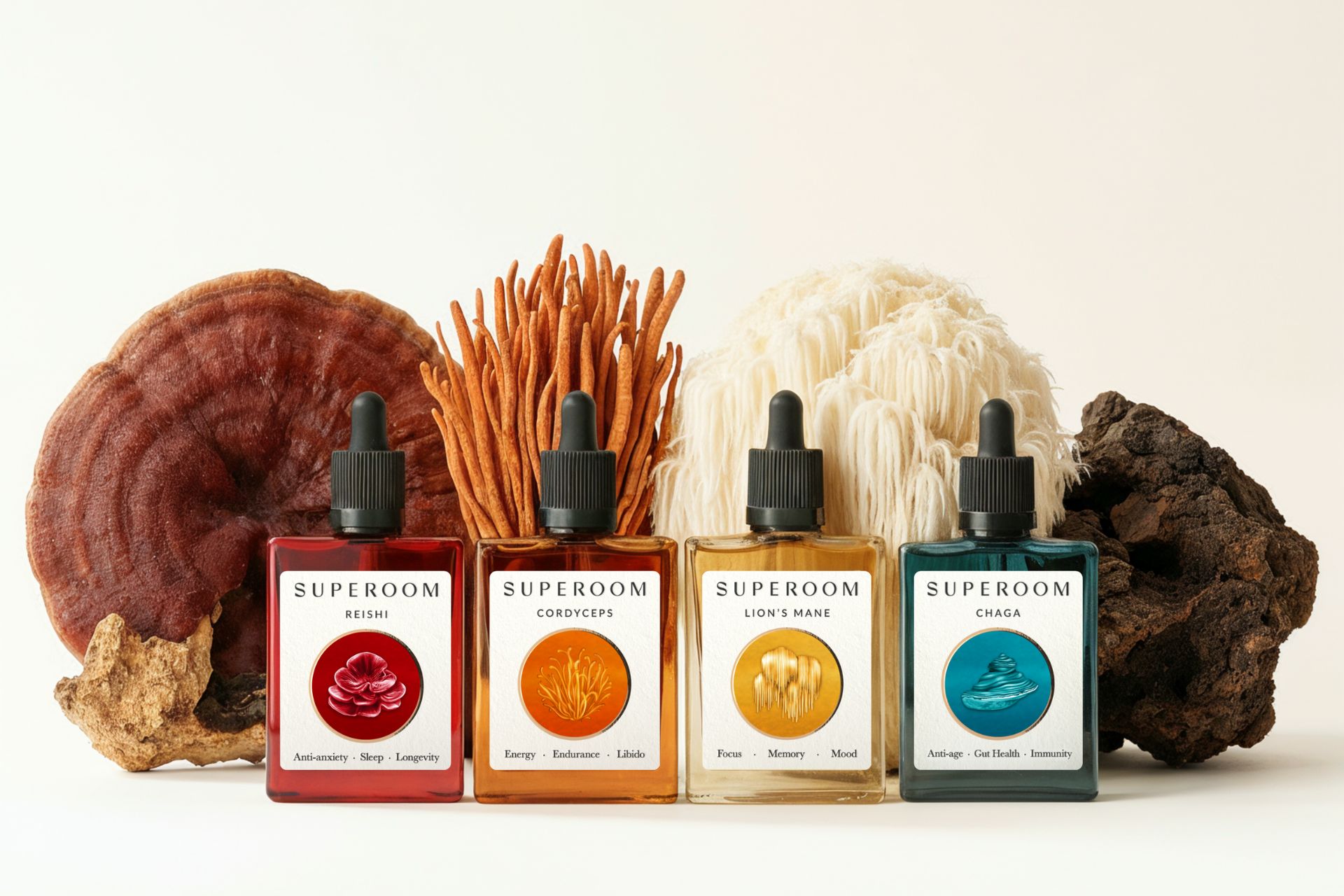
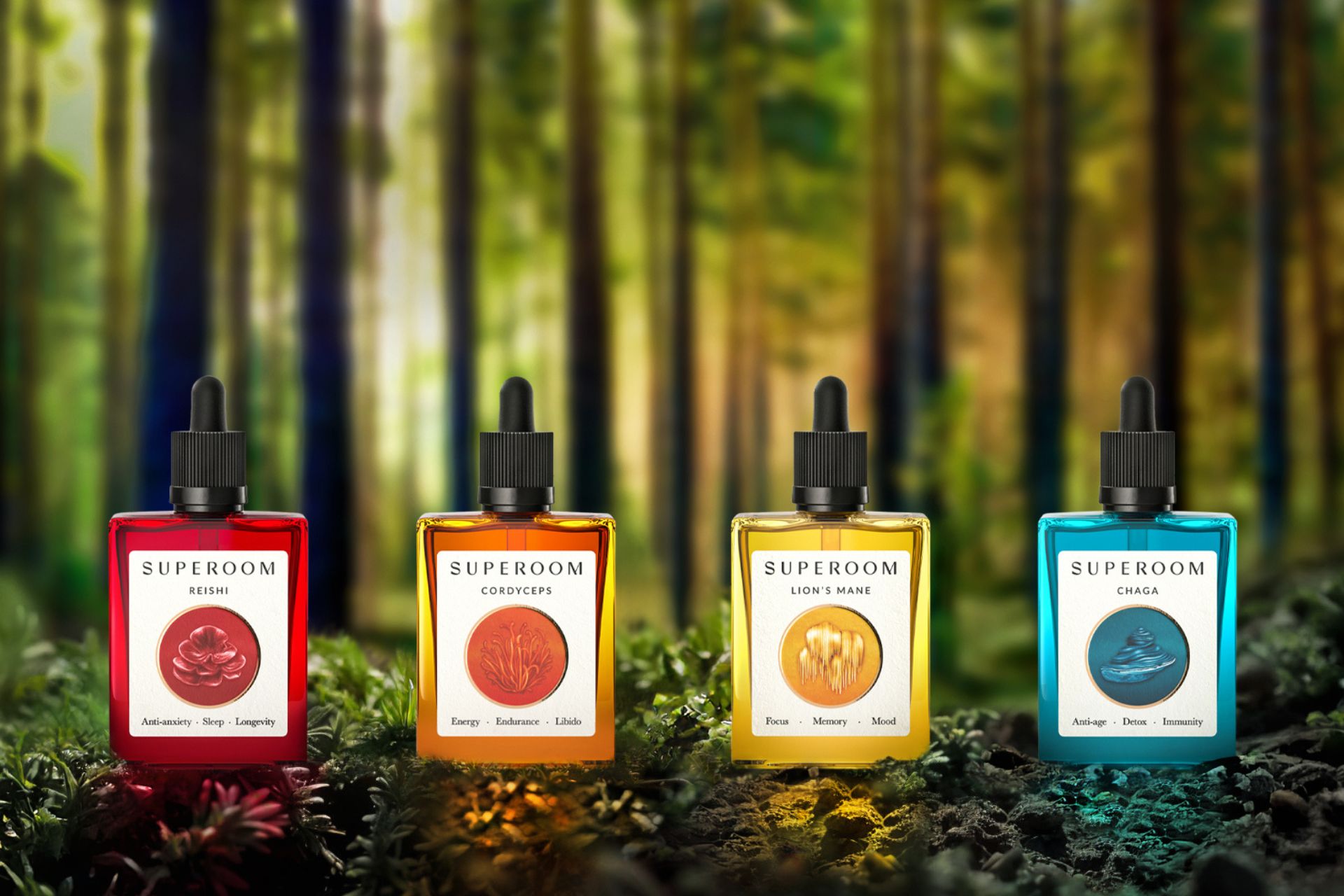
Each mushroom does a distinct job. Reishi is for deep, restorative sleep and a calmer nervous system; it regulates rather than sedates, so you wake clear rather than groggy. Chaga supports immunity, skin and gut health, and is one of the richest natural sources of antioxidants. Lion’s Mane is for focus, memory and mental clarity, working on the pathways behind nerve growth and neuroplasticity. Cordyceps gives clean, sustained energy and endurance without the caffeine spike or the crash. Because they are adaptogens, they work with your body’s own state rather than overriding it, so most people feel a meaningful shift within two to four weeks. These are not quick fixes; they are daily regulators, and they work best inside a life you have actually built to sustain you.
How is Superoom different from other mushroom tinctures?
We built Superoom to clean up a category that has become a wild west, and the difference comes down to three things. First, what is actually inside. The power of a functional mushroom lives in its bioactive compounds, and those are precisely what most powders and gummies barely deliver: cordycepin and adenosine in Cordyceps for cellular energy; hericenones and erinacines in Lion’s Mane for nerve growth and neuroplasticity; triterpenes in Reishi for nervous-system regulation; and betulinic acid and ergothioneine in Chaga for the gut and longevity.
Second, the potency: independent testing shows our formulas are up to seven times more potent than leading competitors. Third, the standard behind it: radical transparency, where we can tell you exactly what is in every bottle and where it came from, in a market where most brands cannot.
What green business practices are you most proud of?
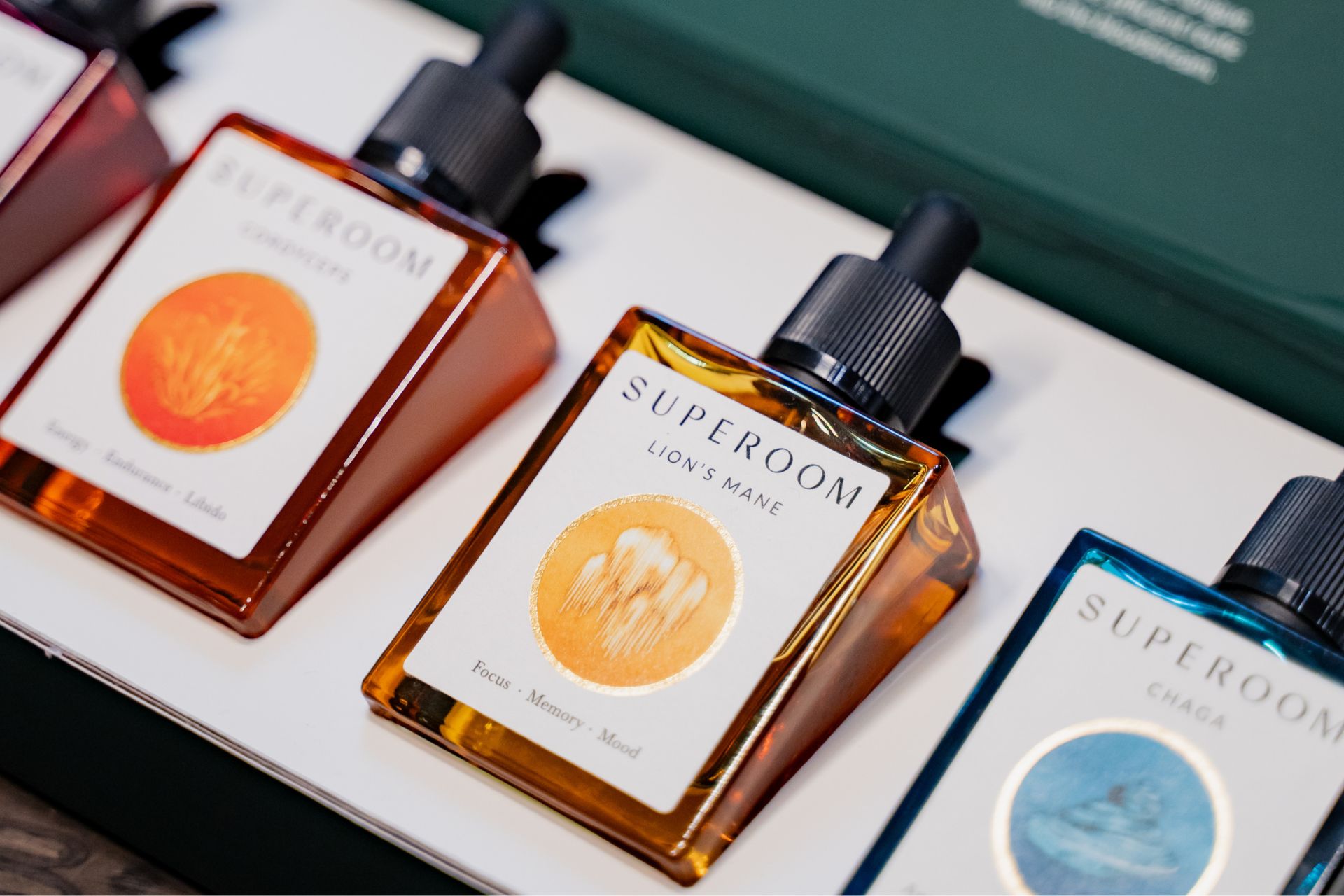
Traceability and sourcing. Our mushrooms are organically and sustainably grown in Finland, with full traceability from substrate to dropper, in a category where the vast majority are sourced from opaque supply chains with no accountability at all. Choosing the harder, cleaner route is the practice I am proudest of. The liquid format then does real environmental work: a small glass bottle of concentrated extract replaces a bulky plastic tub of powder. Our bottles are recycled glass and all of our packaging is recyclable, and because the concentrated extract has a long shelf life, there is very little waste.
Can producing anything really be called sustainable?
Not fully, and I would rather say so than greenwash it. No product is truly without impact, ours included; the honest goal is to keep genuinely reducing it rather than putting the word sustainable on a label and stopping there. I am far more comfortable telling you what we do well and what we are still working on than pretending we have solved something no one has. People can always tell the difference between real effort and marketing.
Who is your own green hero?
David Attenborough. He has spent a lifetime showing people the natural world with real rigour and without hysteria, and made millions of us care about places and species we will never see for ourselves. You cannot protect what you have never encountered, and he brought the whole planet into people’s living rooms. Blue Planet shifted public thinking on plastic more than most policy has managed.
What makes you feel positive about a sustainable future?
If I am honest, I do not feel especially positive, because consumerism and true sustainability sit in tension with one another; by its nature, making and selling more is at odds with taking less from the planet, and I would rather acknowledge that than pretend otherwise. What does give me hope is awareness. Each generation is starting from a more informed place than the last; they read labels, they ask where things come from, and they expect transparency as standard. That rising awareness is what allows future generations to make better choices and take real care of the planet, and it is the same shift Superoom is built on.
And what are the facts that make you feel fearful?
The distance between what we know and what we do. The science has been clear for decades and emissions still rise. Misleading claims muddy the water so badly that people stop trusting anyone, including the brands genuinely trying, which is the same erosion of trust I see across the supplement industry. What unsettles me most is scale and speed; individual effort matters, but the problem is moving faster than the systems built to address it.
Name three other brands you admire for doing the right thing, and why.
Patagonia, because they built environmental responsibility into the structure of the company, not just the marketing, and were willing to lose sales to stay consistent. Faith In Nature, for genuinely rethinking packaging and refills rather than tinkering at the edges. And Who Gives A Crap, for proving an everyday product can be ethical and commercially successful at the same time.
What are the biggest challenges in running a sustainable business?
Cost and honesty. The better material, the cleaner supply chain, the smaller batch: all of it costs more, and a growing brand feels every penny. The harder discipline is refusing to overclaim; saying only what you can prove can feel like competing with one hand tied behind your back when others are not held to the same standard. But it is the whole point of the brand, so it is non-negotiable.
What advice would you give to other businesses aiming to do better?
Start with something real, and do not wait to be perfect. Choose the changes you can genuinely stand behind, do them properly, and talk about them honestly, including what you have not solved yet. People trust progress and transparency far more than a flawless story that falls apart under one question. And never let the word sustainable stand in for something you have not actually done.
How do you feel about the climate crisis?
It concerns me, but I try to stay pragmatic about it. It is real and it is serious, and I do not think panic or guilt actually change anything; what matters is what people and businesses genuinely do. I am also realistic that the forces driving it are enormous, so I focus on the parts I can actually influence, running my own company as responsibly as I can and being honest about the limits of that, rather than pretending any of us has it solved.
What are three things we can all do as individuals to help in the climate crisis?
Buy less and buy better; fewer things of higher quality that you will actually keep. Pay attention to the brands you fund, because where you spend is a vote, and companies respond to it faster than to almost anything else. And reconnect with nature in whatever small way you can. People protect what they love, and it is hard to care about something abstract you never experience.
How do you think the media and governments could help the climate crisis?
The media could move from fear to usefulness; less doom, and more clarity on what actually works and on who is genuinely doing it versus who is greenwashing. Governments could make the honest choice the easy one, rewarding the businesses doing the hard, expensive, right thing and penalising misleading environmental claims, so that integrity stops being a competitive disadvantage. At the moment, doing the right thing tends to cost more and shout less. That is exactly what policy is best placed to change.
Find out more at superoom.life