


Point Of Reflection: How Water Became The Highlight Of Garden Design
By
4 months ago
Our best garden designers are transforming how we capture, store and celebrate every drop of water
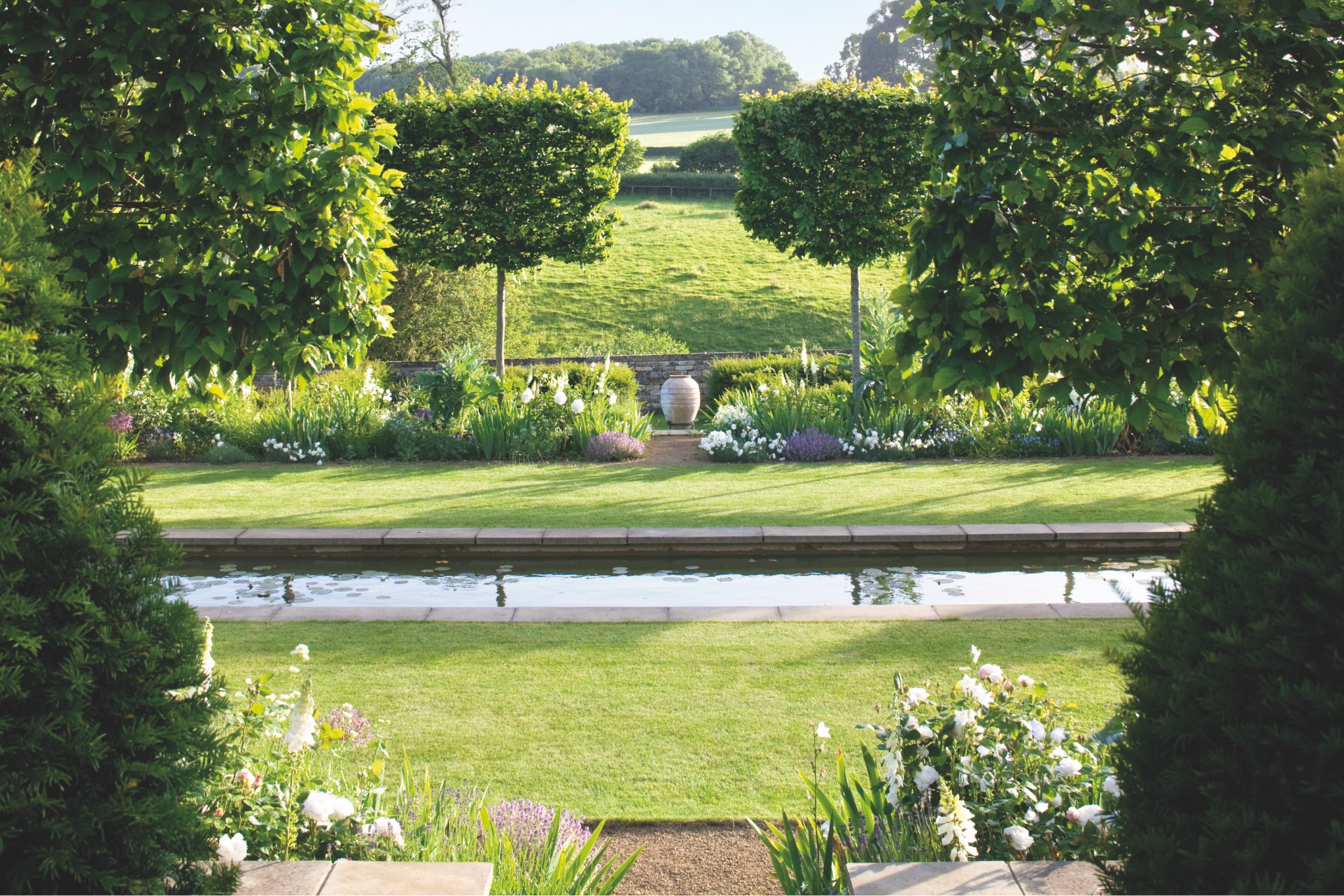
Water garden design is fast becoming the defining feature of Britain’s most beautiful outdoor spaces – and not just for looks. As our weather swings between drought and downpour, the country’s leading garden designers are rethinking how we capture, store and celebrate every drop, from below-ground rainwater tanks to seasonal ponds and swimming ponds that double as wildlife havens. Kendra Wilson speaks to garden design experts about making water work harder, and more beautifully, at home.
Water Is Having A Major Moment In Garden Design
If you think about your favourite gardens in the British Isles, the chances are they will feature water. And not just in the form of a water feature – but in a meandering stream, a river tributary, or an unfussed-over lake. Shaded in parts, the sounds are different as well as the sights, with a wider variety of birds and eye-catching insects than are noticeable in more formal areas. Here, a splashing fountain or a silently flowing rill is also a magnet. We are simply attracted to water – it’s primal. We couldn’t survive without it.
Having long been used to a reliable amount of rain in the UK (on average every three days), we are not in the habit of considering water as a precious resource. Now, our lived experience is different, and over six months we can have prolonged rain followed by drought, followed by a protracted heatwave, followed by flooding.
Water is also quite expensive, so it makes sense to have some autonomy at home in the face of weather events that are beyond our control. Diverting every downpipe towards water storage, which irrigates the garden while taking pressure off drains, is a good start.
Studio Bristow
The best garden designers are happily accepting the challenge of improving the ecological function of their clients’ gardens. For internationally renowned landscape gardener Jinny Blom, water has always been a concern, having spent some of her youth living off-grid in the South of France with no local water source. At her house in Oxfordshire she has installed a ‘substantial’ below-ground tank, which stores water from the farmhouse roof. ‘I can’t bear wasting fresh water. It only comes from the sky; we can’t make it,’ she says. ‘It’s a gift that needs treasuring.’
On large projects, Jinny Blom Studio will focus not only on rainwater storage but also slowing, spreading and diverting storm water. Methods of surface drainage are out in the open, there for all to see. ‘We create seasonal ponds to take surface water runoff. These ponds naturalise, fill with reeds and rushes, and become excellent fluctuating damp or wet habitats,’ Blom says. ‘They also look good.’ A series of ephemeral ponds can move water towards a useful destination, such as a lake.
An unclogged channel, variously known as a culvert, swale or just plain ‘ditch’, is another way of keeping a valuable resource on site. ‘I’ve always made them where we are altering ground significantly,’ says Blom. ‘To aid drainage, modulate the land, protect buildings and to manage water where you want it to go.’
Ponds and lakes are having a renaissance; increasingly, people are attracted to plunging into something that looks natural. Twentieth-century swimming pools were often hidden behind tall hedges, their Mediterranean blue looking reproachful in bad weather and their covers looking even worse in winter. A pond, on the other hand, looks perfectly at home with raindrops hitting the surface, and has a different kind of beauty in frost. In every season it has something to offer.
In a small enclosure, a scaled-down fountain or pond holds attention, distracting from imperfect structures beyond the boundary. Conversely, a natural swimming pond – built from scratch, with an engineered, nature-oriented filtration system – can deepen appreciation of a terrific view. Snowdonia-based Studio Bristow built a swimming pond overlooking a farming landscape in Herefordshire: it reflects the sky in a proscribed space, bringing human scale into the foreground. As a foreground element, water has more depth than a patch of grass.
Adding native plants to a pond means more will naturally come in. The studio’s founder Dan Bristow plants flowering rush and marsh cinquefoil into ponds; water mint and water forget-me-not may follow. A natural swimming pond is a good solution in a bigger garden, he says, ‘when the desire to attract wildlife is as strong as wanting a cool dip’.
‘People are becoming aware that gardens can help with wider environmental issues, rather than simply being decorative spaces,’ says Tom Massey, Chelsea Flower Show star and author of RHS Waterwise Garden. Clearly, it’s chic to be water-wise. ‘Many of the things that help a garden function better ecologically also make it feel better emotionally, and aesthetically.’