


Flower Moon: Here’s When May’s Full Moon Will Rise
By
3 months ago
Plus: what it means
Each night, the moon looks a little fuller as we approach the zenith – and then, as always, the reverse will happen as the glowing orb wanes to a crescent and a new moon once again.
In May, there are not one but two full moons bracketing the month: the Flower Moon on Friday 1 May, followed by the Blue Moon on Sunday 31 May 2026.
Here’s everything you need to know about May’s lunar events.
May’s Full Moons 2026: Flower Moon & Blue Moon
May’s first full moon, the Flower Moon, will reach its fullest at 6.23pm – but we won’t be able to see it. Instead we have to wait for the moon to rise above the horizon, which will begin at 8.45pm. After a sunny day in southern England (with highs of 26°C), a cloudy evening might hamper your view, but you can rest assured the moon will appear full the evenings before and after.

Why Is It Called The Flower Moon?
In Native American tradition, every full moon has a (usually seasonal) nickname. May’s full moon is called the Flower Moon, owing to the abundance of blooms that spring up around the time of the year that this full moon shines, particularly wildflowers.
‘Naming the full Moons has been done by ancient peoples around the world to mark events, as well as to act as a calendar,’ astronomy expert Dr Darren Baskill tells Science Focus. ‘While we might now say to a friend, “Let’s meet at 1pm on Sunday 7 May”, we could equally say: “Let’s meet two days after the full Flower Moon when the sun is highest in the sky”, and both mean the same time to within a few minutes.
‘While the Full Moon names in common use today originate from North America, a huge variety of names were used by indigenous cultures both across North America, Europe and around the world,’ Dr Baskill adds. ‘The name Flower Moon was used by those native to areas where carpets of flowers bloomed at this time of year, but other Native American cultures used different names depending on what was happening in their locality at that time of the year.’
Examples include ‘blossom moon’, ‘corn-planting moon’, and even ‘moon when the horses get fat’, which was used by the Cheyenne people of the American Great Plains. ‘In some parts of the UK, the May Full Moon was called the Mothers’ Moon, as that is when a wide variety of animals are busy looking after their young,’ Dr Baskill says.
The Spiritual Meaning
Drawing on the idea of abundant plants and flowers, the Flower Moon is spiritually connected to new beginnings, fertility and growth; you might want to use the opportunity to embrace change or pursue new opportunities. Occurring in May, the Flower Moon is also associated with the peak of spring’s energy, and therefore vitality, inspiration and the pursuit of one’s goals.
Astrologically, the Flower Moon is often seen as a time to let out deep feelings and be more vulnerable. As with all full moons, the Flower Moon also signifies a culmination of energy, a fresh slate, and a time to release what no longer serves you and make space for new growth.
The Flower Moon rises in Taurus, and this sign might feel its energy most palpably – as will the opposite sign, Scorpio. Taurus will feel a culmination of energy related to their core values and security, while Scorpio might experience shifts in their partnerships and shared resources.

Leonardo DiCaprio and Lily Gladstone in “Killers of the Flower Moon,” streaming on Apple TV+.
Killers Of The Flower Moon (2023)
May’s full moon might also make you think of the 2023 film starring Leonardo Di Caprio and Robert Di Niro, Killers of the Flower Moon. Here, the full moon – so associated with new life and abundance – takes a dark turn.
Indeed, in Martin Scorsese’s film, a time of abundance and prosperity for the Osage people (the discovery of oil on their land) is twisted and ‘killed’ by white exploiters who infiltrated the community before committing the ultimate act of betrayal: systematically murdering the Osage people to steal their oil and land rights.
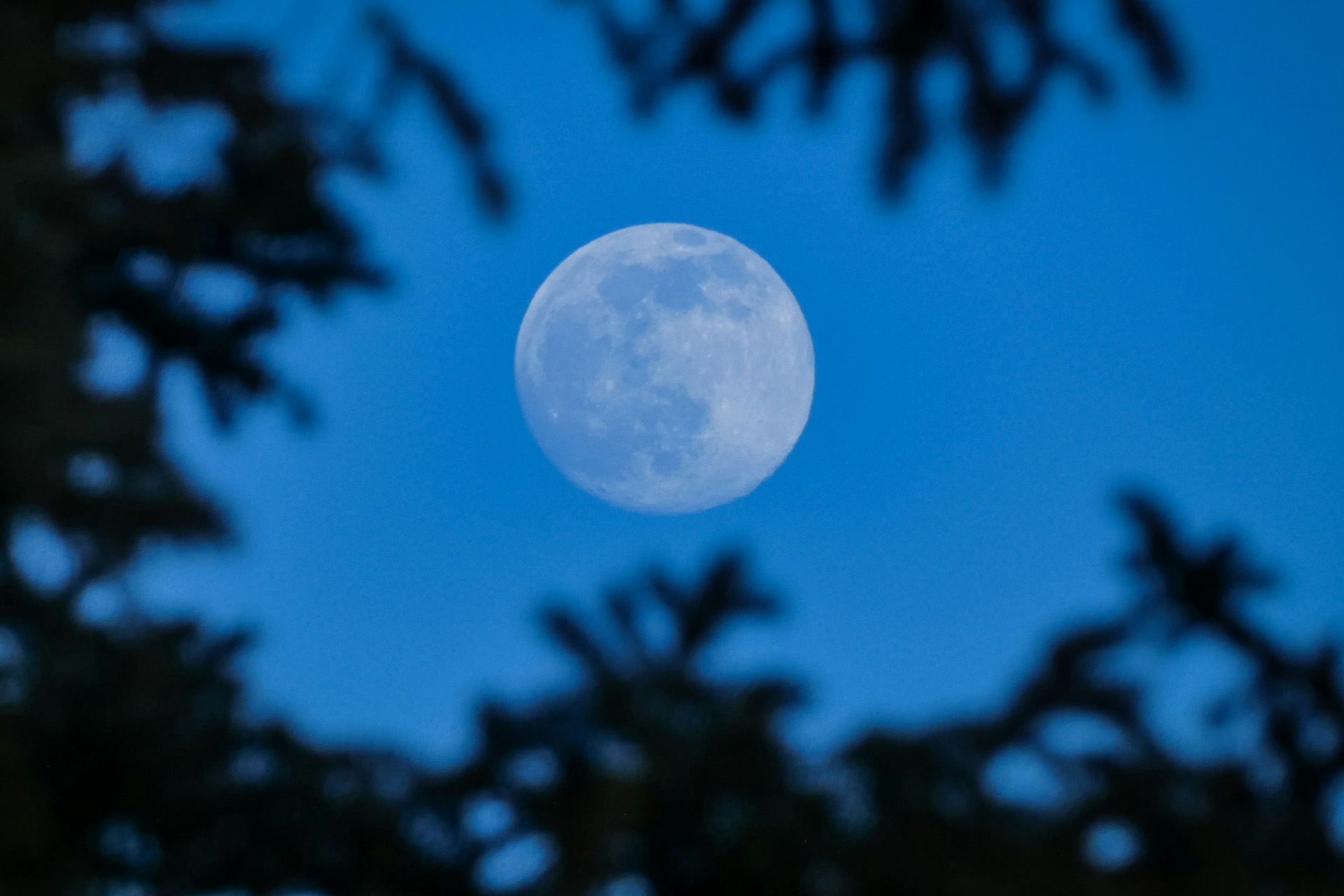
A Blue Moon isn’t actually blue.
May’s Blue Moon
May’s second full moon, the Blue Moon, will be at its fullest at 9.45am on Sunday 31 May 2026, but we won’t be able to see it until it rises in the sky at 10.04pm. Again, keep your eyes on the skies on the dates either side to catch a glimpse of the Blue Moon at its zenith.
We all know the phrase ‘once in a blue moon’: it means occasionally but rarely, like seeing certain family members once a year or less. The phrase comes from the lunar phenomenon, the Blue Moon, which is the second full moon to rise in a single calendar month.
With moons running on a cycle of 29.5 days (that’s 29 days, 12 hours and 44 minutes, to be precise), we typically see one full moon per month, tallying up to 12 per year. But because the lunar cycle is shorter than a full month on Earth, every two to three years, we see 13 moons in one year – the additional moon being the Blue Moon.
Occasionally we get two Blue Moons in one year – but only when there is a Blue Moon on the schedule, and the days line up to skip the short month of February, squishing two moons into January, followed by two moons in March. This is much rarer than a singular Blue Moon, occurring around every 19 years. The most recent instance was 2018, with the next instance not until 2037.
Unsplash
When Is The Next Full Moon?
After the Blue Moon, the next full moon is June’s Strawberry Moon, so-called to mark the short strawberry harvest season. The Strawberry Moon will reach its zenith in the wee hours of 30 June, but it will appear full on the evenings either side: 29 June and 30 June 2026.
2026 Full Moon Calendar
There are 13 full moons in 2026, including the Blue Moon in May. They are:
- 3 January: Wolf Moon
- 1 February: Snow Moon
- 3 March: Worm Moon
- 2 April: Pink Moon
- 1 May: Flower Moon
- 31 May: Blue Moon
- 30 June: Strawberry Moon
- 29 July: Buck Moon
- 28 August: Sturgeon Moon
- 26 September: Harvest Moon
- 26 October: Hunter’s Moon
- 24 November: Beaver Moon
- 24 December: Cold Moon