


14 Beautiful Royal Wedding Dresses From The Last Century
By
2 weeks ago
From the modern gowns worn by Kate Middleton and Meghan Markle to the late Queen Elizabeth II's historic wedding dress
When it comes to wedding inspiration, there’s a royal bride for every generation. (After all, who doesn’t dream of marrying a prince?) But getting a princess ready to glide down the aisle involves secrecy, hand-stitching and a rather lot of silk. Ever wondered how some of the most famous royal wedding dresses in the world came to be? Here, we look back at some of our favourites from the last century.
The Most Beautiful British Royal Wedding Dresses
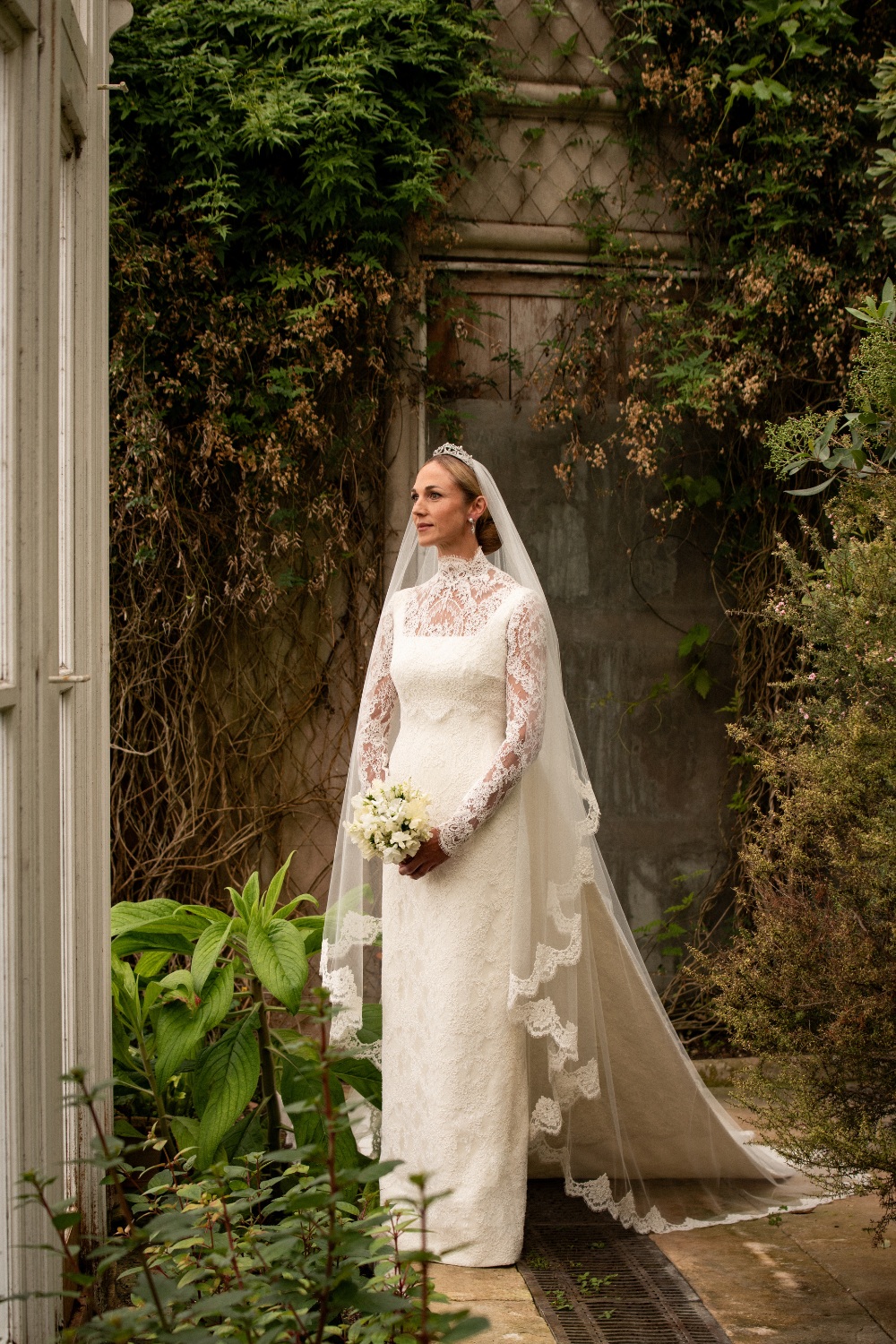
Harriet Sperling’s Wedding Dress (2026)
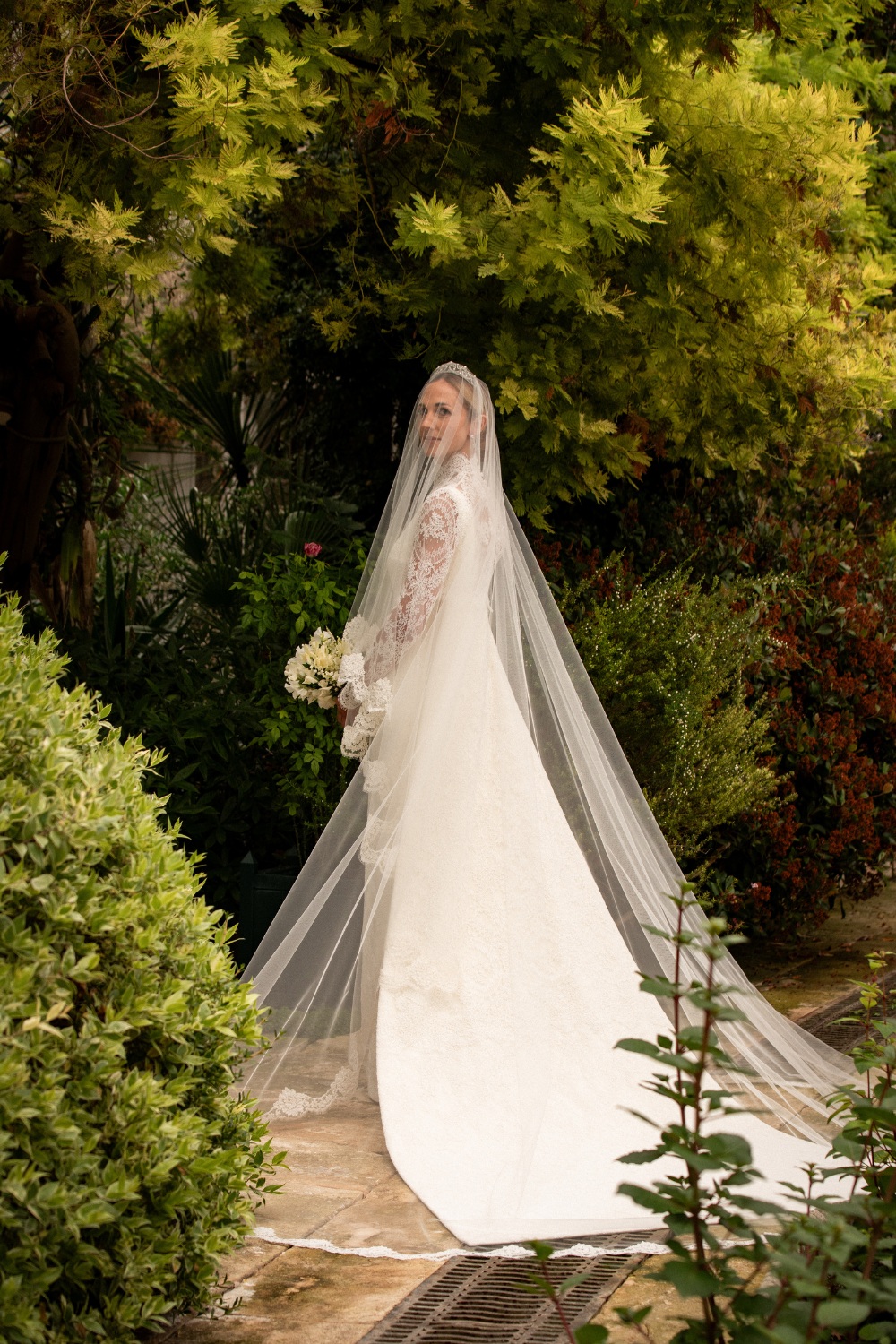
Harriet Sperling on her wedding day, wearing Emilia Wickstead, 2026 (c) Peter & Harriet Phillips (photo by Mark Nicholson)
The most recent royal wedding was just this year, when Harriet Sperling married Peter Phillips, Princess Anne’s son, on 6 June 2026 at All Saints Church in Kemble, Cirencester. It’s said the couple met thanks to their daughters, who play in the same local hockey team; their parents eventually crossed paths, resulting in one of the most talked about weddings of the 2020s.
For the big day, the bride opted for a beautiful bespoke gown from London-based designer Emilia Wickstead. Developed from initial sketch to final creation, the dress was crafted entirely by the brand’s in-house team at its West London atelier, and took 140 hours to make. The bride also reportedly attended fittings at Emilia Wickstead’s private salon on Sloane Street in the lead up to the big day.
The dress itself was made from Italian ivory crêpe, comprising a square-neck column underdress paired with a delicately cropped French Leavers lace over-jacket decorated with all-over prairie flowers. A standout detail, the lace was meticulously hand-applied and has a heritage tracing back to the early 1900s, following the invention and patenting of the revolutionary Leavers loom in Britain. Lace detailing carried through from the dress to the veil, with scalloped lace appliqué used to enhance the gown’s architectural, sculptural lines, extending across the neckline and cuffs. The 19th century-inspired train, meanwhile, measured three metres, stretching out behind her from the waist. The finishing touches were no less special: a pair of custom slingback shoes by Jimmy Choo and a new tiara by famed Mayfair jeweller Pragnell.
Princess Beatrice’s Wedding Dress (2020)
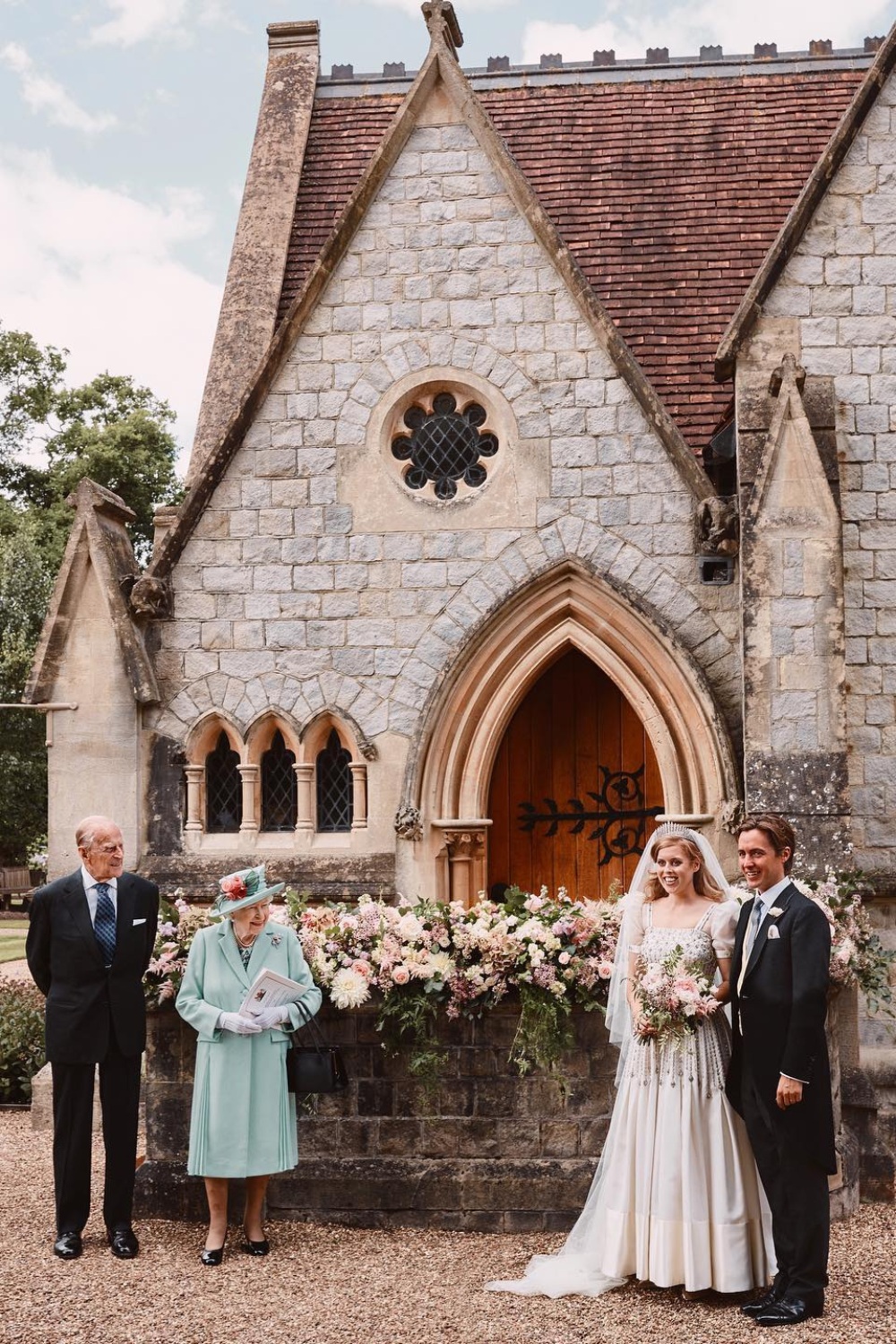
Princess Beatrice on her wedding day, 2020 (c) @theroyalfamily
Despite getting married in the middle of the Coronavirus pandemic, Princess Beatrice had one of the most celebrated wedding celebrations in royal history. The ceremony, which took place on 17 July 2020, saw the Princess marry English property developer and Italian noble Edoardo Mapelli Mozzi. The two, who had known each other since childhood, began dating in 2018 and announced their engagement the following year.
Princess Beatrice’s wedding dress consisted of an ivory peau de soie taffeta gown, with ivory duchess satin sleeves, diamanté adornments and a checkered, geometric bodice. And for fans of the royal family, the dress was very familiar; it’s previous owner was none other than the Princess’ grandmother, Queen Elizabeth II. Acting as her ‘something old’ and ‘something borrowed’, the gown was originally designed by couturier Norman Hartnell for Queen Elizabeth II, who wore it to the premiere of Lawrence of Arabia in 1962. It was remodelled by dressmaker Angela Kelly and designer Stewart Parvin for Princess Beatrice to wear on her wedding day.
Princess Eugenie ‘s Wedding Dress (2018)
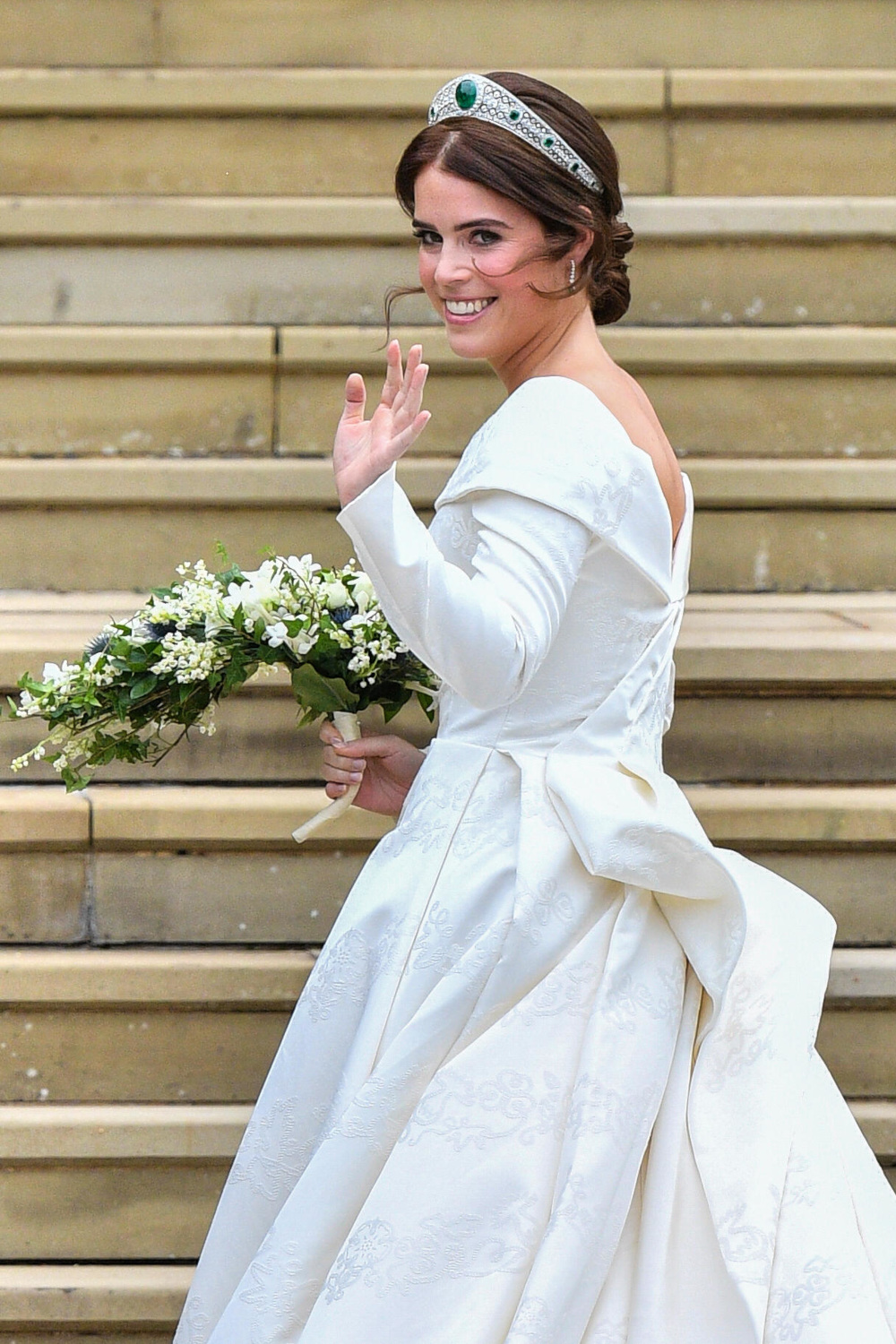
(c) John Rainford/WENN
The second royal wedding to take place in 2018 was that of Princess Eugenie and Jack Brooksbank, who tied the knot 12 October. The couple met during a ski break in Verbier, Switzerland – where it’s said that Jack fell in love at first sight. They began dating in 2010, and were together for seven years before announcing their engagement.
Just like the royal brides before her, Princess Eugenie turned to British designers for her wedding dress: Peter Pilotto and Christopher de Vos, who headed up the fashion label Peter Pilotto. The dress featured a wide-neck V shape, folded shoulders and a low back that draped into a flowing full-length train – but the defining feature was the low back. This is a design that usually wouldn’t be taken up by a royal, but Eugenie is said to have specifically requested it to show the scar on her back which she retained following surgery at age 12 to correct her scoliosis. The design also features a thistle, shamrock, rose and ivy, which were added to the dress in a garland of rope-like motifs woven into into a jacquard of silk, cotton and viscose blend.
Meghan Markle’s Wedding Dress (2018)
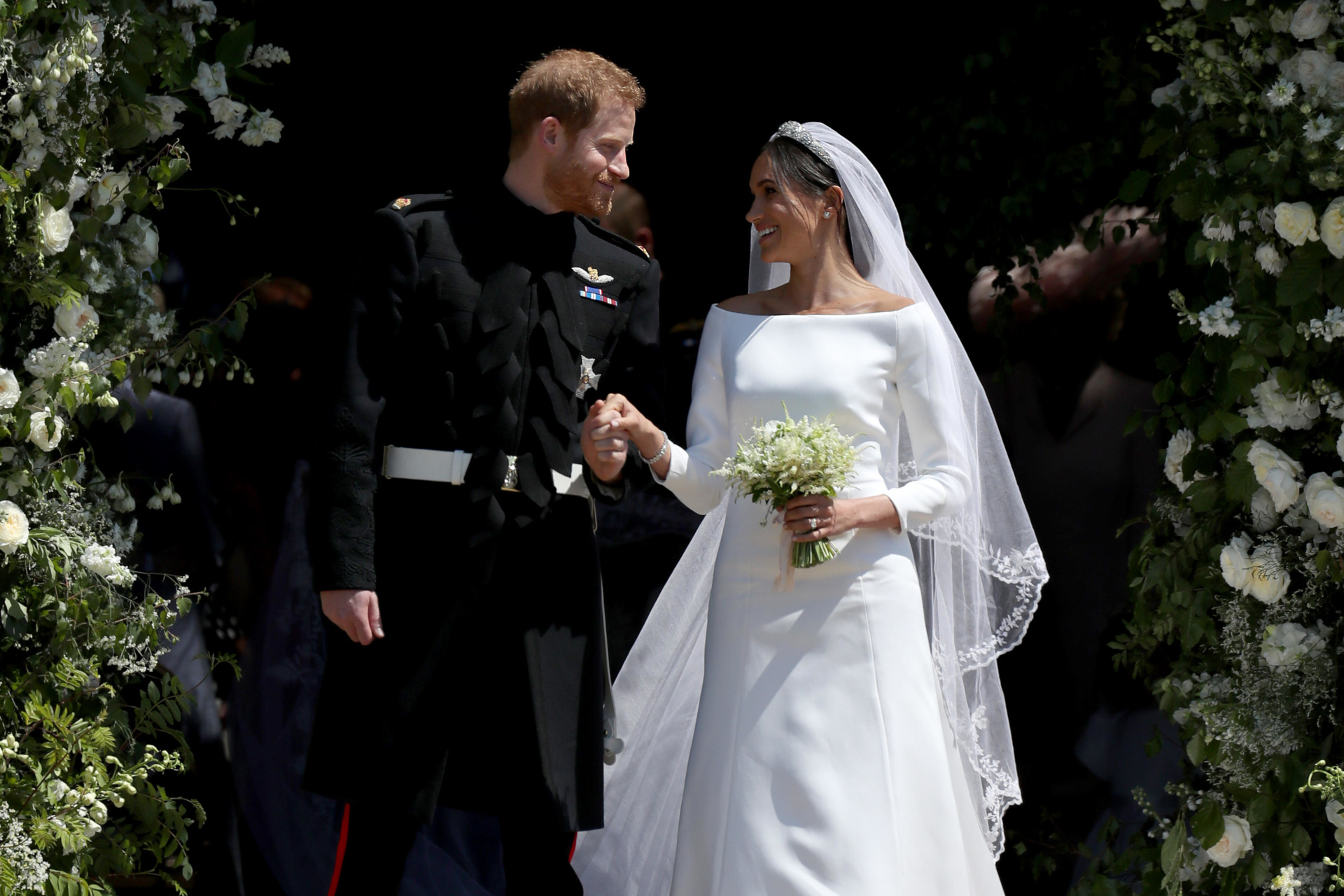
Prince Harry and Meghan Markle on their wedding day (c) Jane Barlow/PA Images Alamy
The most watched royal wedding of all time was that of Prince Harry and American actress Meghan Markle – AKA the Duke and Duchess of Sussex – who got married at St George’s Chapel at Windsor Castle on 19 May 2018. The pair, who began dating in 2016, publicly announced their engagement in late 2017, and upon their wedding Markle became the second American to marry into the British royal family.
Meghan Markle’s wedding dress was designed by British designer Clare Wright Keller, under the Givenchy label. A contemporary gown, Meghan’s gown was minimal and classic in design, avoiding lace and crystal embellishments in favour of plain silk; it featured three-quarter-length sleeves, a simple bateau neckline and a train with built-in triple silk organza underskirt. The finishing touch? A 16-foot-long silk tulle veil, again designed by Waight Keller. It reportedly took longer to finish the veil than the dress itself, with a team of embroiderers taking over 500 hours to complete it.
Kate Middleton’s Wedding Dress (2011)
(c) Alamy
A new generation of royal weddings began with Prince William and Kate Middleton, who were married at Westminster Abbey on 29 April 2011. The two had something of a modern fairy tale romance, having met in 2001 while studying at the University of St Andrews and starting a relationship in 2003. They were together for several years before William proposed to Kate in October 2010, using the same engagement ring that King Charles III had proposed to Princess Diana with.
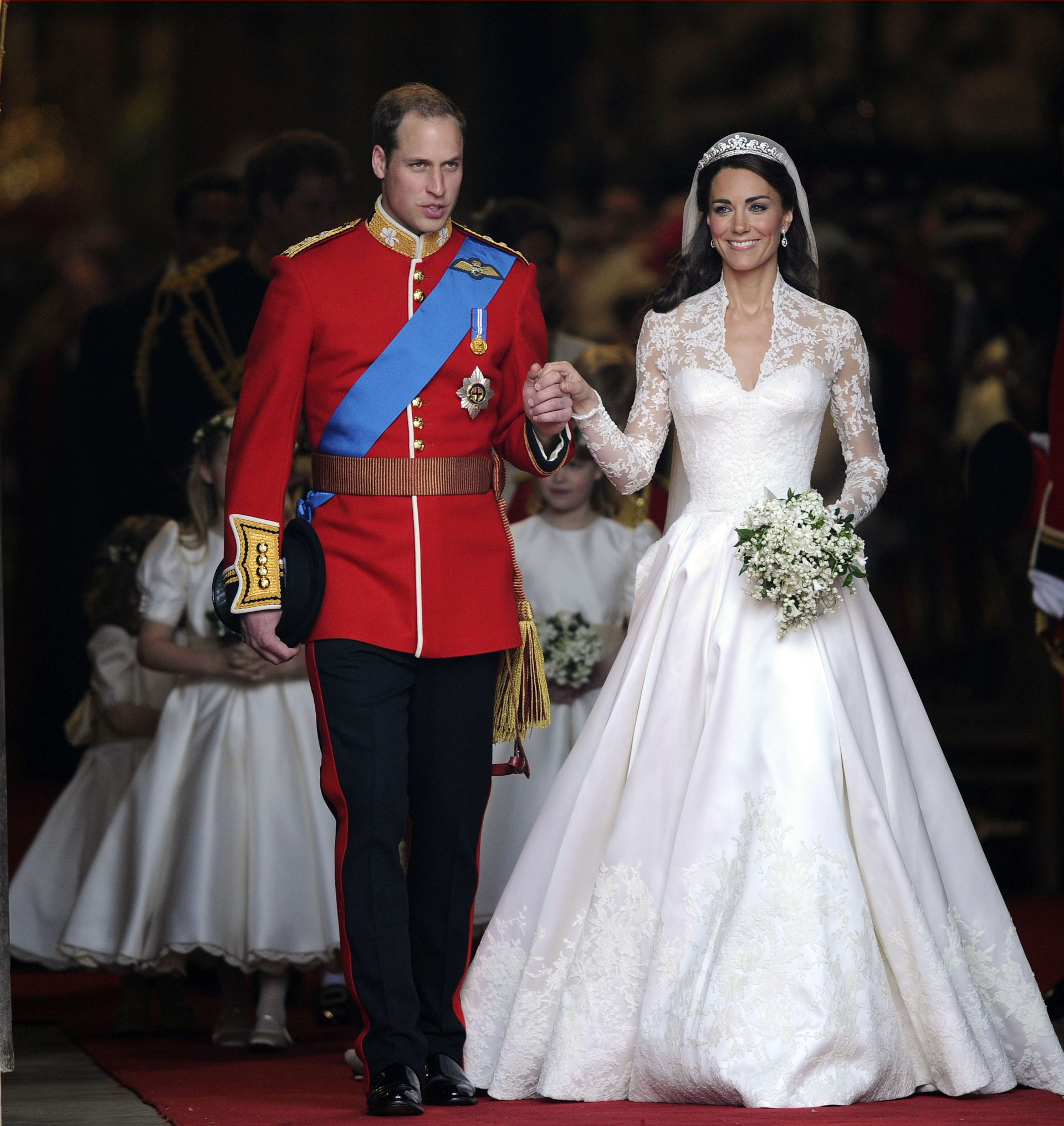
Kate Middleton’s wedding dress was designed by Sarah Burton, who was then the creative director of British luxury fashion label Alexander McQueen. The dress took its cues from Victorian styles, with a narrow waist and padded hips to create a corseted effect, a full skirt (designed to look like an opening flower) leading to white satin gazar arches and pleats that formed a semi-bustle, and 19th century lace sewn into the appliqué lace detailing. It’s also said that a blue ribbon was sewn inside the dress to fulfil Kate’s ‘something blue’. The dress also featured a nine-foot train and a veil decorated with roses, thistles, daffodils and shamrocks.
Queen Camilla’s Wedding Dress (2005)
View this post on Instagram
Despite having a romantic relationship spanning several decades, King Charles III and Queen Camilla didn’t officially tie the knot until 9 April 2005 in a civil ceremony at Windsor Guildhall. The pair announced their engagement just two months before the ceremony, and invited Prince William to be Charles’s best man. While Queen Elizabeth II and Prince Philip did not attend the wedding ceremony, they both went to the Service of Prayer and Dedication and held a reception for the couple in Windsor Castle afterwards.
Queen Camilla wore two outfits on her wedding day – both of which were designed by British fashion house Robinson Valentine, headed up be designers Antonia Robinson and Anna Valentine. Her first wedding ensemble was comprised of a cream silk chiffon dress hemmed with vertical rows of Swiss-made appliqued woven disks and a matching oyster silk basket weave coat, while the second was made up of a floor-length embroidered pale blue and gold coat and a matching chiffon dress, teamed up with gold feathers in her hair. The golden feathers were designed by Irish haute couture milliner Philip Treacy.
Sophie Rhys-Jones’ Wedding Dress (1999)
View this post on Instagram
It’s said that Sophie Rhys-Jones met Prince Edward, the youngest son of Queen Elizabeth II, while working at Capital Radio – and, awkwardly, when he was dating her friend. They met again at various events over the years, and in 1993 (when they were both single) the two reconnected and began dating. After years of back-and-forth from the papers about whether they would marry, Prince Edward finally popped the question in December 1998, leaving them just six months to plan their wedding on 19 June 1999.
The future Duchess of Edinburgh’s dress was the work of bridal gown designer Samantha Shaw. Crafted from hand-dyed silk organza and hand-dyed silk crepe, the full-length gown featured long sleeves and rows of pearls dotted along the neck, sleeves and train – as well as more beads down the back and front of her dress-coat. It’s thought that a total of 325,000 cut-glass and pearl beads were used in the design. The bride also wore a black-and-white pearl necklace, interspersed with white gold rondels, and a matching pair of black-and-white pearl drop earrings; it was personally designed by Prince Edward as a wedding gift, and executed by Asprey and Garrard.
Princess Anne’s Second Wedding Dress (1992)
View this post on Instagram
In August 1989, 16 years after they walked down the aisle, Princess Anne and Mark Phillips announced their separation to the nation, citing that their relationship had been under strain for several years. The royal’s next marriage, however, proved far more compatible. Princess Anne met Timothy Laurence in 1986 while he was serving as an equerry to Queen Elizabeth II. It’s said the two exchanged private letters, which were eventually leaked by The Sun, but their romance remained strong enough for them to marry on 12 December 1992 in a Church of Scotland ceremony (the Church permitted second marriages for divorcees) at Crathie Kirk, near Balmoral.
Steering away from the big royal wedding dress trend, Princess Anne opted for a simple knee-grazing whit dress, over which she wore a matching white jacket. But that was the only part of her outfit that remained white; on her feet, the royal wore a pair of simple black court shoes.
Sarah Ferguson’s Wedding Dress (1986)
View this post on Instagram
A childhood friend of Lady Diana Spencer, Sarah ‘Fergie’ Ferguson similarly married into the royal family, with her wedding to former prince, Andrew. The ceremony was broadcast to over 500 million people worldwide on 23 July 1986. The two were engaged after only a year of dating, having first met in 1985 at one of Queen Elizabeth II’s ‘dine and sleep’ events at Windsor Castle.
British couturier Lindka Cierach designed Sarah Ferguson’s wedding dress. The designer, whose clients included members of both British and European royal families, crafted the dress using ivory duchesse satin and covered it in heavy beading depicting various scenes and motifs. Most notably, it featured hearts, anchors and waves (a nod to her husband, Andrew, who served in the Royal Navy for 22 years), as well as bumblebees and thistles (taken from Sarah’s family heraldry). The gown was also influenced by Sarah’s sister-in-law, Diana; elements like the puff sleeves, full skirt and train – which measured 17 feet and featured the letters ‘A’ and ‘S’ sewn in silver beads – are thought to be a nod to the trends offset by the royal’s earlier gown.
Diana Spencer’s Wedding Dress (1981)
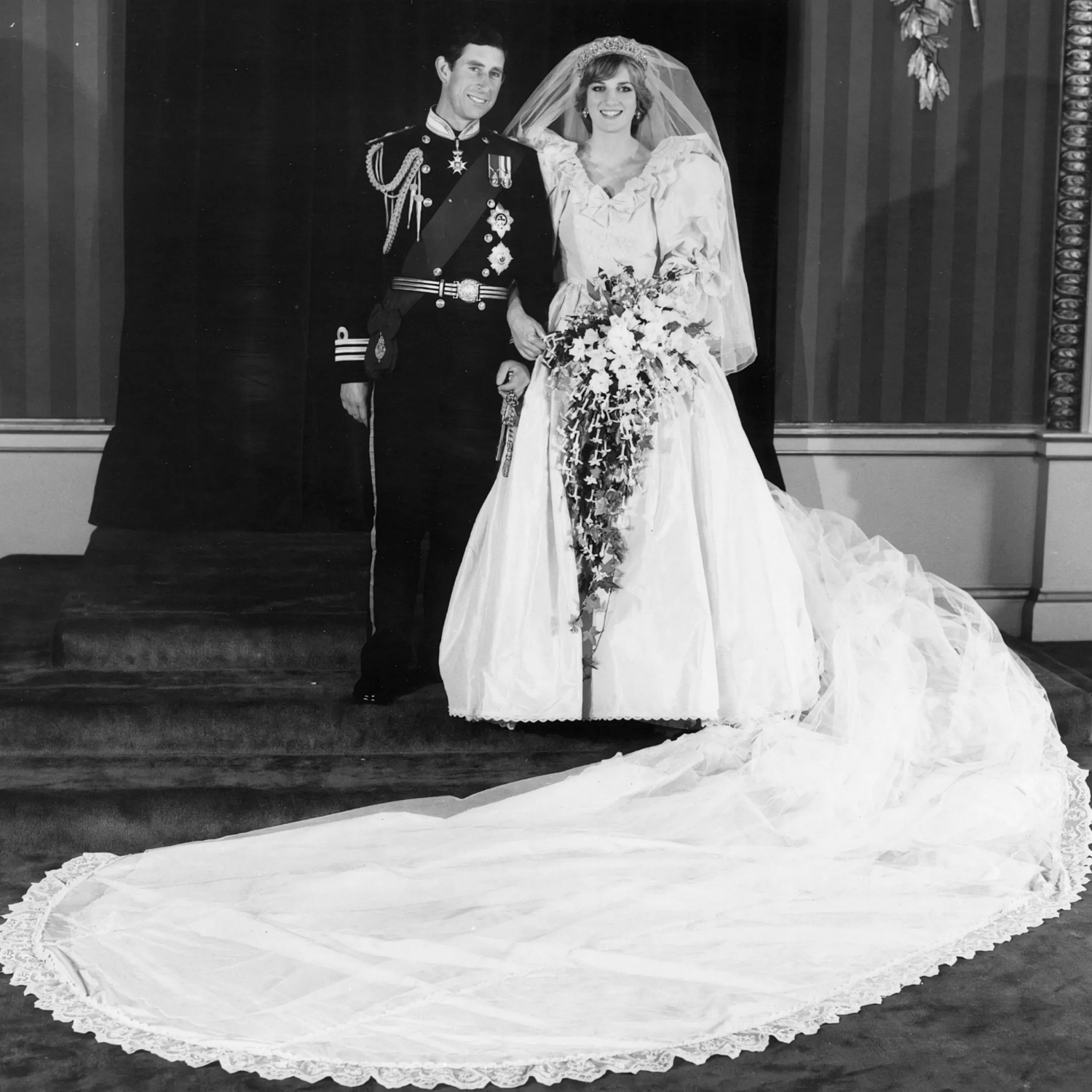
Prince Charles and Lady Diana Spencer on their wedding day, 1981 (United Press International, Public domain, via Wikimedia Commons)
The former Princess of Wales, Lady Diana Spencer, married into the British royal family on 29 July 1981 following a short engagement to Prince Charles. The event proved popular amongst global audiences, as 750 million people tuned in to watch the royal wedding.
Diana, who cultivated a strong fashion following in her lifetime, leaned into popular trends of the decade when it came to her wedding dress – most notably, the design featured a wide skirt, balloon sleeves, a frilly neckline and cuffs, and a stunning 25-foot train. The wedding dress was designed by the Emanuel Salon, which was owned by British designers David and Elizabeth Emanuel. The husband-and-wife duo, who were a favourite of Diana in the years leading up to her marriage, created the dress using ivory silk, pure taffeta and antique lace, as well as 10,000 pearls and sequins. The design process was highly secretive; it’s said that only three members of Emanuel staff were allowed to work on the gown, and that the designers left false breadcrumbs and trails for the press.
Princess Anne’s First Wedding Dress (1973)
View this post on Instagram
The only daughter of Queen Elizabeth II, Princess Anne was always going to be in the spotlight – especially for her fashion. The royal married her first husband, Mark Phillips, on 14 November 1973 at Westminster Abbey. The two had reportedly met five years prior at a party for horse lovers, both being competitive equestrians, and hit it off from there.
Princess Anne’s wedding gown is considered one of the most unique royal dresses, thanks to its blend of Tudor styling and contemporary 70s influences. Featuring a high collar and medieval-influenced bliaut sleeves, the dress was designed by Maureen Baker, the chief designer for British fashion label Susan Small. She teamed up the ensemble with the Queen Mary Fringe Tiara and her signature parted beehive up-do.
Princess Margaret’s Wedding Dress (1960)
View this post on Instagram
One of the biggest royal weddings of the mid-century took place on 6 May 1960, when Princess Margaret – sister to Queen Elizabeth II – married society photographer Antony Armstrong-Jones. The two formally met at a dinner party two years prior, and their romance quickly carried into a proposal that shocked the press since the royal had chosen not to publicise the relationship. Notably, Princess Margaret’s wedding was the first royal wedding to be televised in the UK; it was watched by over 300 million people globally, and was the biggest royal event since Queen Elizabeth II’s coronation.
Like her sister, Princess Margaret wore a wedding dress designed by Sir Norman Hartnell. Margaret apparently asked the designer for an ‘unfussy’ gown, with a tailored bodice and waist, long sleeves and a full-length skirt. Hartnell used silk organza to construct the dress, crafting the voluminous skirt with 30 metres of fabric and avoiding embroidering of flowers and other motifs – although Margaret did team up her wedding gown with the Poltimore Tiara, a headpiece that she herself had bought for the occasion.
Queen Elizabeth II’s Wedding Dress (1947)
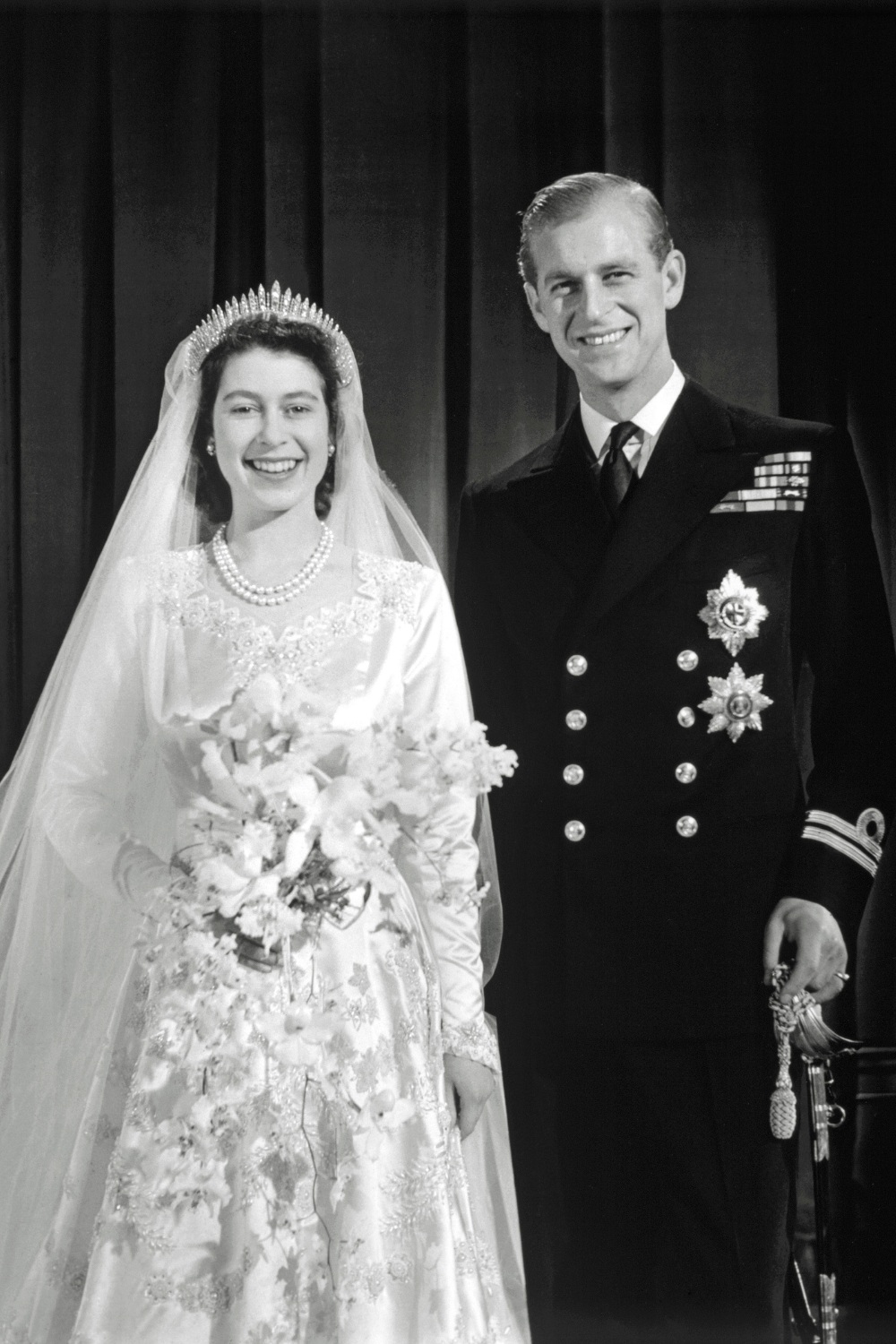
Queen Elizabeth II and Prince Philip on their wedding day, 1947 (c) Royal Collection Enterprises Limited | All Rights Reserved
Despite WWII having ended by the time then-Princess Elizabeth set her wedding date, post-war austerity was still in full swing in Britain. She married her longtime sweetheart, Philip Mountbatten, on 20 November 1947, in a ceremony held at Westminster Abbey – making Elizabeth just the tenth member of the royal family to be married at the Abbey.
Rationing was still in effect for everyone – including the royal family – and it’s said that the future Queen set about saving up clothing coupons so that she could buy her dream wedding dress. She employed the help of her collaborator, the couturier Sir Norman Hartnell, who earned a Royal Warrant as a dressmaker to Queen Elizabeth (the Queen Mother) in 1940 and to Queen Elizabeth II in 1957. The design, which was made from ivory silk and decorated using 10,000 seed pearls, was approved just three months before the wedding date, and took 350 women seven weeks to make. A notable feature of the gown was its train; inspired by Botticelli’s Primavera, it was decorated in a floral design comprised of jasmine, smilax, seringa, and rose-like blossoms.
Wallis Simpson’s Wedding Dress (1937)
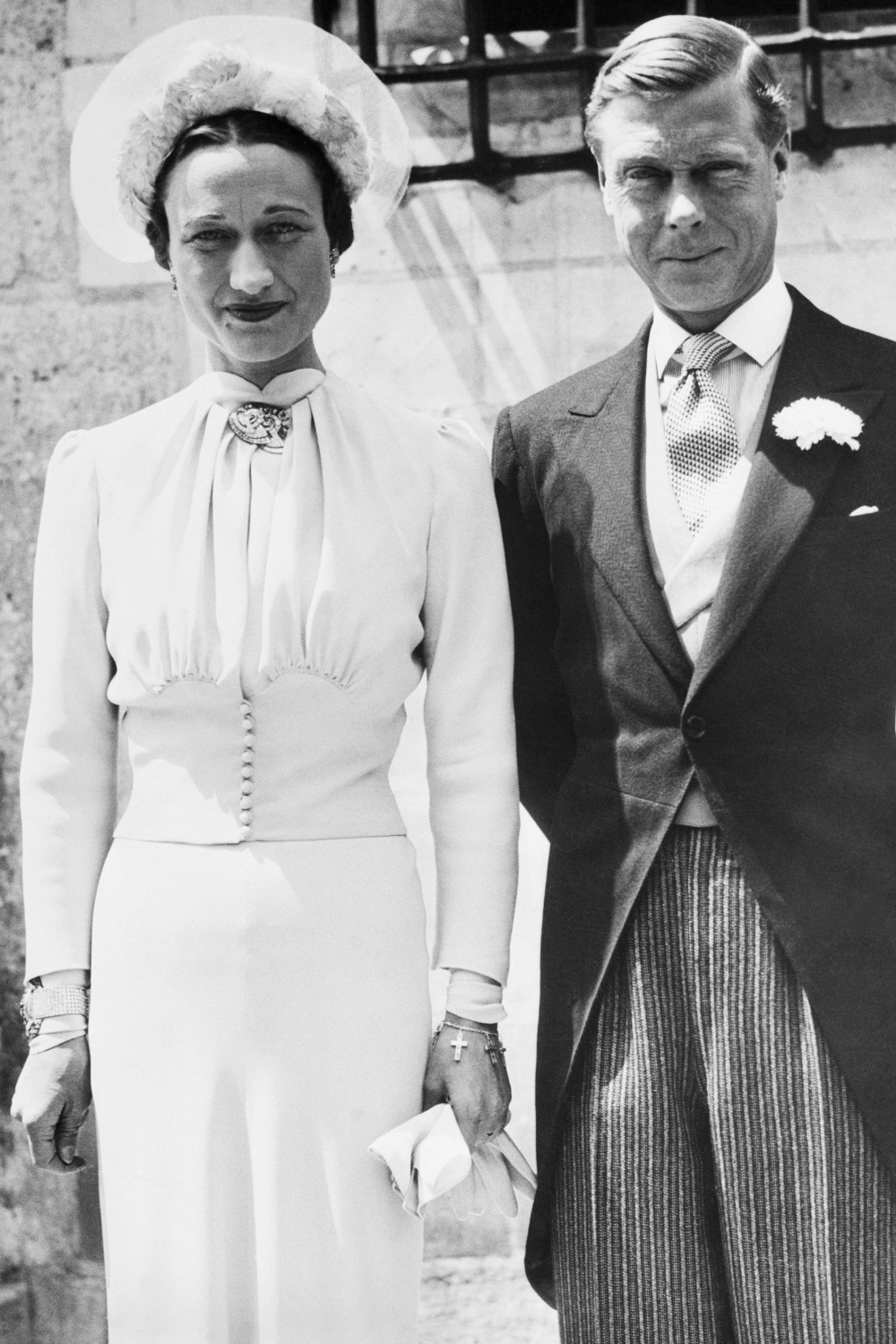
The Duke and Duchess of Windsor on their wedding day, 1937 (The Record (Hackensack, New Jersey), Public domain, via Wikimedia Commons)
Unlike most royal romances, Prince Edward and Wallis Simpson met while they were seeing other people. Once news spread of their relationship – and the royal’s intention to marry the freshly separated Wallis – it sparked harsh disapproval from the Church of England, Parliament and the British public. Undeterred, Edward stuck with Wallis and made the decision to abdicate the throne to his younger brother, King George VI, the father of Queen Elizabeth II. The couple eventually married on 3 June 1937, a month after Wallis’ divorce was made official, in France at Château de Candé.
Known for her coveted sense of style, the future Duchess of Windsor turned to one of the best designers of the era for her wedding dress: fellow American Main Rousseau Bocher. And, unlike most bridal gowns of the time, it was blue. Adhering to the haute couture trends of the late 1930s, Wallis opted for a long, floor-length gown with a nipped-in waist, the tailored silk dress featured a wide-fitting waistband and a gathered bodice decorated with delicate buttons.